Returns and percentages
A return is the gain or loss compared with what you paid, written as a percentage so that a 20 dollar stock and a 2,000 dollar stock can be compared.
- 5 min
- 3 questions
- Lesson 2 of 3
Why you would care
Did it go up a lot or a little, and how do two moves add up? "It's up 30 dollars" sounds big. On a 3,000 dollar stock it is 1%; on a 30 dollar stock it is 100%. Percentages hide three traps that catch smart people every day: losses and gains are not symmetric, percentages do not add up, and "percent" is not "percentage point".
The idea from scratch
The one formula
Return = (end value - start value) / start value.
Always divide by the start. The same 10 dollars is +10% from 100 but only +9.1% from 110.
Trap 1: down and up are not mirror images
If you lose 20%, you need more than 20% to get back. 100 falls 20% to 80. To return to 100 from 80, you need +20 dollars on 80, which is +25%.
| Fall | Gain needed to get back to even |
|---|---|
| -10% | +11% |
| -20% | +25% |
| -50% | +100% |
| -90% | +900% |
Trap 2: percentages multiply, they do not add
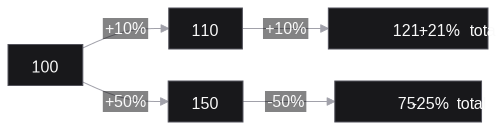
Two years of +10% is not +20%. Year 1: 100 becomes 110. Year 2: 10% of 110 is 11, so 121. Total +21%. Each year's gain earns its own gain. That is compounding.
It works against you too: +50% then -50% is not zero. 100 becomes 150, then half of 150 is 75. Total -25%.
To compare a 10-year result with a 1-year result, convert it to a yearly rate: the annualized return, often called CAGR (compound annual growth rate). It answers "what steady yearly return would give the same end result?"
Trap 3: percent vs percentage point
An interest rate goes from 4% to 5%.
- It rose 1 percentage point (5 minus 4).
- It rose 25 percent (1 is a quarter of 4).
Both are true; say which one you mean. Markets use a smaller unit for rates: a basis point (bp) is one hundredth of a percentage point. 4.00% to 4.25% is +25 bp.
Price return vs total return
A price return counts only the price change. A total return also counts the dividends you received.
See it in Gloom
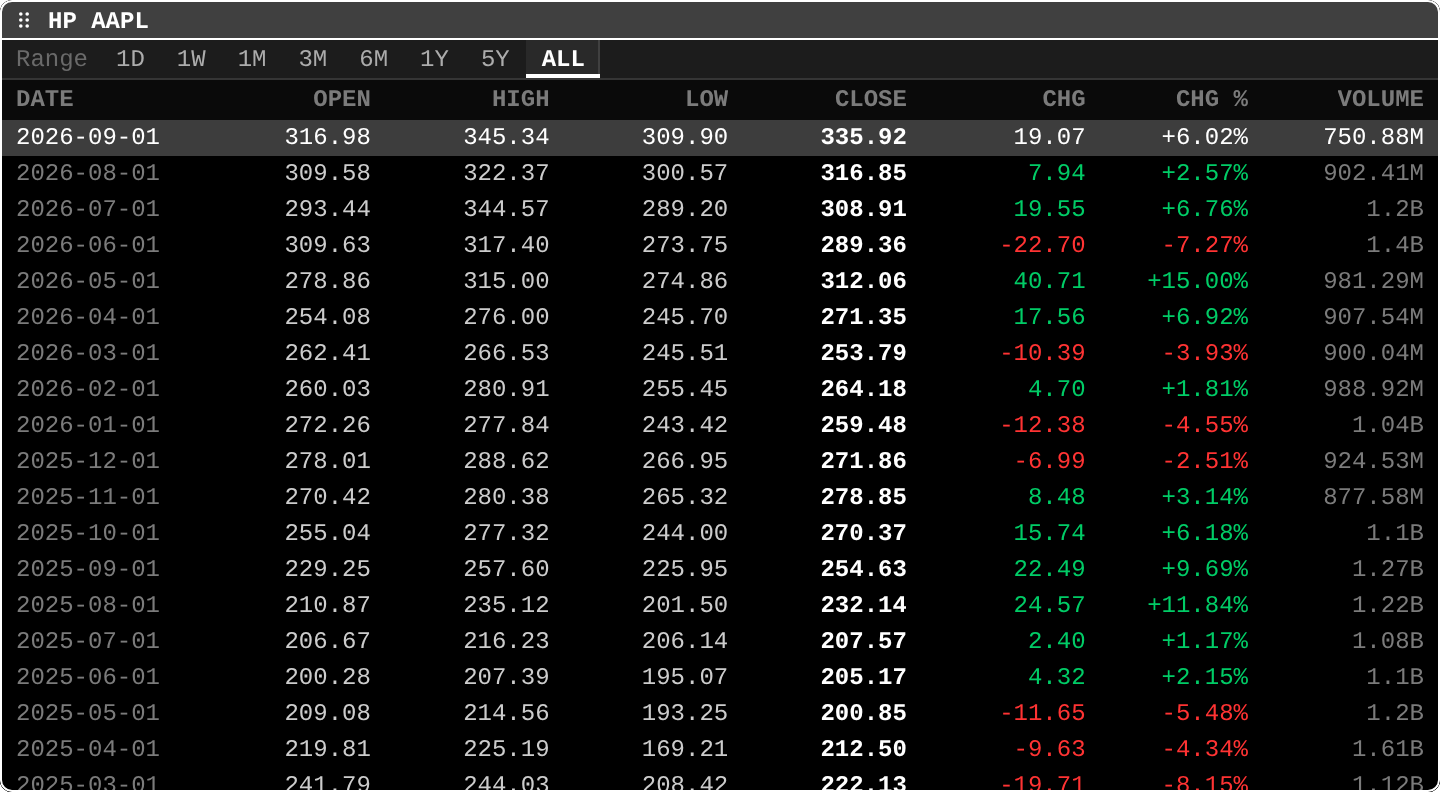
Open ittype HP AAPL in the command bar. (HP is taught in chapter One company and its price.)
- Top row
2026-09-01:CLOSE 335.92,CHG 19.07,CHG % +6.02%. The latest row can be a month still in progress. - Check the formula with the row below: the previous close is 316.85. 19.07 / 316.85 = 0.0602 = +6.02%. Same formula as above.
2026-05-01:+15.00%. Then2026-06-01:-7.27%. Keep these two for Try it.VOLUMEon the right: shares traded during that month (M million, B billion). Not a return, but a reminder of how busy each month was.- Prices are about 15 minutes behind on the free plan and real-time for US listings on Pro; for monthly rows that hardly matters.
Practice and recap
Try it3 tasks
- From the screenshot: April 2026 closed at 271.35 and June 2026 at 289.36. What is the two-month return? ((289.36 - 271.35) / 271.35 = about +6.6%.) Now add the monthly returns, +15.00% and -7.27%: you get +7.7%. Different, because percentages multiply.
- One year: September 2025 closed at 254.63, September 2026 at 335.92. Return? (About +31.9%.)
- A fund fell 50% and then rose 50%. Is it back to even? (No: 100, 50, 75. Still -25%.)
Common mistakes4 mistakes
- Dividing by the end value instead of the start.
- Adding returns across periods. Multiply instead: (1 + r1) x (1 + r2) - 1.
- Saying "rates rose 1%" when you mean one percentage point (100 bp).
- Comparing a price return with someone else's total return.
Check yourself3 questions
- A stock goes from 40 to 50. What is the return?
- A stock falls from 200 to 150. What gain does it need to return to 200?
- A central bank moves its rate from 3.50% to 3.75%. How many basis points is that?
Answers
- (50 - 40) / 40 = +25%.
- It needs +50 dollars on 150, so +33.3%.
- 25 basis points (0.25 percentage point).
Words in this lesson8 words
- return
- (End value - start value) / start value, in percent.
- compounding
- Each period's gain earns its own gain next period, so percentages multiply.
- annualized return (CAGR)
- The steady yearly return that would give the same end result.
- rule of 72
- 72 divided by a yearly rate is roughly the years needed to double.
- percentage point
- The plain difference between two percentages: 4% to 5% is 1 point.
- basis point (bp)
- One hundredth of a percentage point: 0.01%.
- price return
- Return from the price change only.
- total return
- Price change plus dividends (or other payouts) received.
Educational material about reading market data, not investment advice.