Free earnings call transcripts: where to find them and how to read one (2026)
Read them free on investor-relations sites, or on Gloom's transcript pages without an account. Then read one in five minutes, as below.
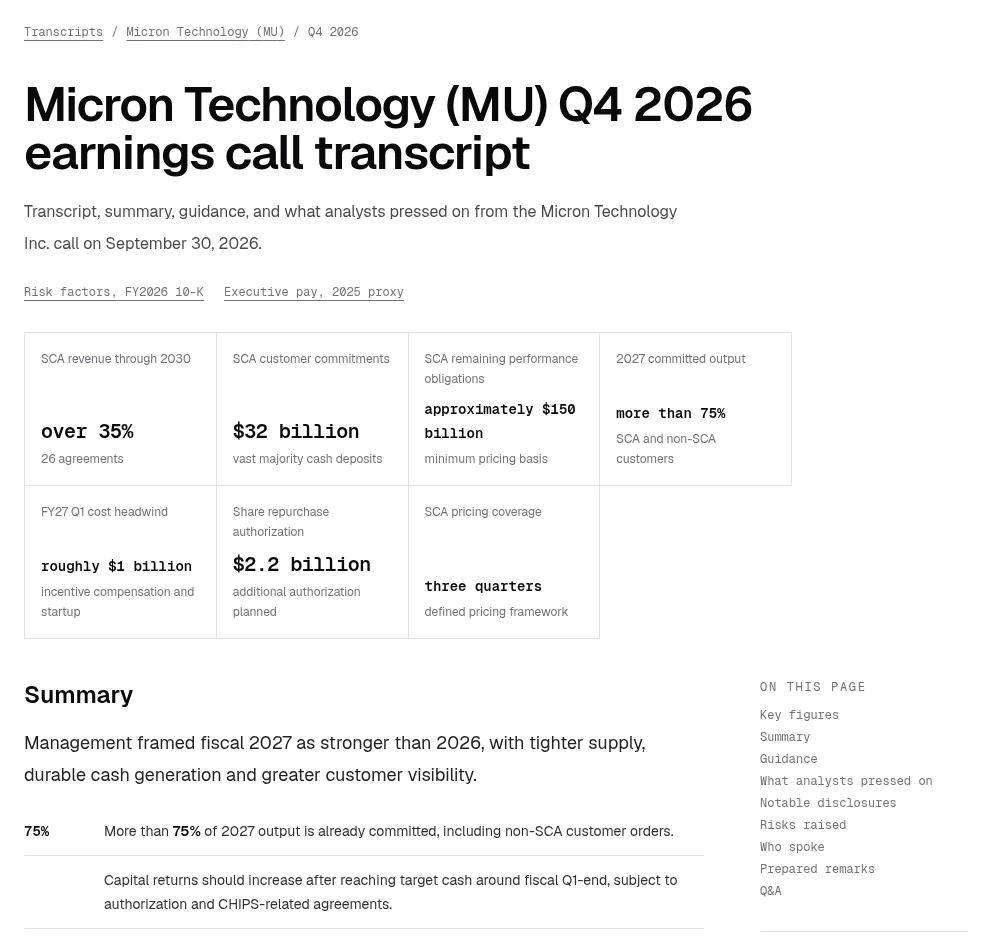
Where to find transcripts
- Investor relations: the quarterly results page usually has the webcast replay and slides, sometimes a transcript.
- SEC filings: the 8-K carries the earnings release, usually not the call.
- Gloom: 1,772 transcripts across 660 companies on October 10, 2026, listed by company and by latest call.
A 5-minute way to read one
Give each step about a minute. If prepared remarks and Q&A are new terms, the Academy's earnings calls lesson explains them first.
- Guidance: note the outlook and the numbers management chose to highlight.
- Tone: compare the wording with last quarter's call, looking for new promises and new hedges.
- First questions: read the first three analyst questions; they show what worried the room.
- Non-answers: write down what management would not answer, or answered without a number.
- Filing: check revenue, margins and earnings per share against the earnings release.
Keep three columns as you go: claim, evidence, open question.
Worked example: Micron, fiscal Q4 2026
Open Micron's September 30, 2026 call and follow along.
1. Guidance
Micron reported $54.23 billion of revenue and guided the next quarter to $61.5 billion, plus or minus $1.5 billion.
The gross margin guide, about 86.25% non-GAAP, sits just below the quarter's 87.0%. More revenue does not have to mean a wider margin.
2. Tone
That is management grading its own outlook. Compare it with what they said on the June 24 call before you agree.
3. First questions
The first three analyst questions were about target cash, capital intensity and gross margin: how much cash comes back, how heavy spending stays, and why the margin guide dips.
The first two came from the same analyst: a question and its follow-up.
4. Non-answers
The first analyst asked how much cash Micron wants to keep before returning the rest.
That answers when, not how much. The amount goes in your open-question column.
5. Filing
Open Micron's earnings release on SEC EDGAR and check the figures above.
On the call, the CFO quoted non-GAAP earnings per share of $33.42. The release also shows the GAAP figure, $32.87, and the reconciliation between them.
The adjustments are mostly stock-based compensation and a $500 million patent license charge.
Your notes after five minutes
| Claim, with its source | Open question |
|---|---|
| Demand strengthened since June (CEO) | Did the June call sound the same? |
| Revenue guide of $61.5 billion (CFO) | Why is the margin guide lower? |
| Target cash by end of fiscal Q1 (CFO) | How much is target cash? |
| EPS of $33.42 (non-GAAP, CFO) | Will the patent charge recur? |
What to look for in the Q&A
The Q&A is the unscripted half of the call. These four patterns are worth a line in your notes.
| Listen for | Write down |
|---|---|
| The same question asked twice | The issue still open |
| A range where a number used to be | What got less certain |
| An answer about a different period | Which period it covers |
| A “when” with no “how much” | The number still missing |
Common traps 5
- Fiscal is not calendar. Micron's fiscal Q4 2026 ended September 3, 2026, and its guidance covers fiscal Q1 2027. Write both labels next to the numbers.
- An analyst's number is not guidance. When an analyst suggests a figure, check whether management confirms it or moves on.
- Speech-to-text can mishear. Names, units and tickers slip. Check any number you plan to use against the release.
- A quote without its question. Read the question before the answer. A short line can lose the condition attached to it.
- One call on its own. Tone only means something against the previous call, so read two in a row.
Read your next call
- Browse the transcripts, pick a company you know, and note one claim to check against its next report.
- Open the earnings function in Gloom: install the free app, then type
ERN MUfor Micron's report dates and past moves.