Earnings calls (CALLS)
CALLS lists a company's earnings calls and opens each transcript with speakers, the analyst Q&A, a tone score, and the guidance and quotes pulled out of it.
- 4 min
- 3 questions
- Lesson 4 of 5
Why you would care
What did management say, and what were analysts worried about? The press release gives the numbers. The call gives the story: why margins fell, what customers are saying, which question the CFO avoided. Professional investors read the Q&A first. The questions show what the smartest people in the room are worried about.
The idea from scratch
An earnings call is a conference call (often a webcast) held the day of the report, usually about an hour:
- Prepared remarks: the CEO and the CFO (chief financial officer) walk through the quarter and the outlook. Scripted and carefully worded.
- Q&A: sell-side analysts ask questions, live. Less scripted, often more revealing.
A transcript is the written text of the call, with who said what (the speakers).
Things worth listening for:
- Guidance and how confident it sounds.
- New words: a product, a risk, a customer mentioned for the first time.
- Dodged questions and repeated questions on the same topic.
- Tone: more cautious or more upbeat than last quarter.
- Press release: numbers
- Call: prepared remarks
- Analyst Q&A
- Transcript with speakers
- Extracted: guidance, quotes, tone
See it in Gloom
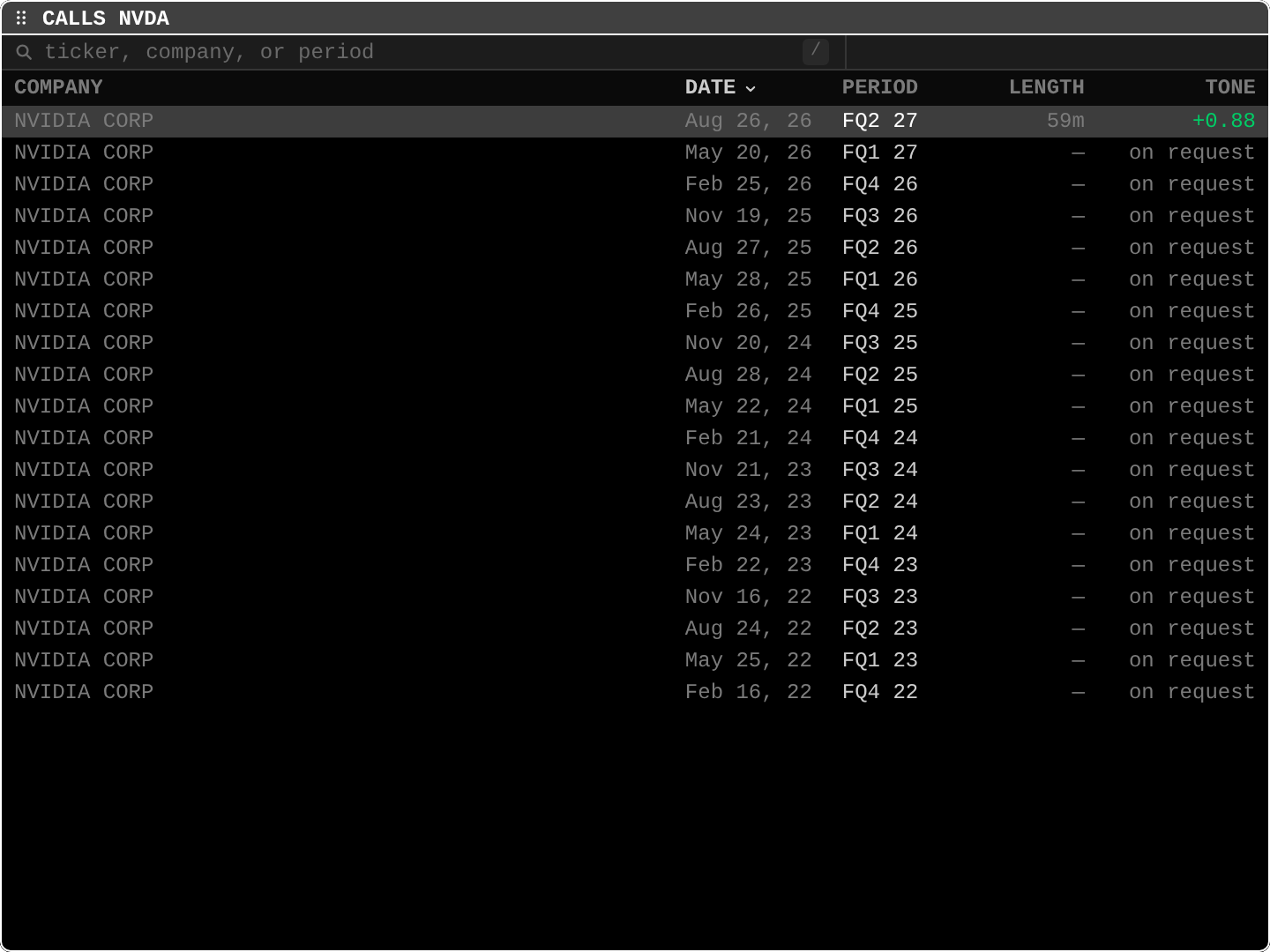
open ittype CALLS NVDA, or CALLS alone for every newly transcribed call as it lands. Enter opens a transcript, / finds a word in it, o opens the source.
Aug 26, 26 FQ2 27 59m +0.88: the latest call, for fiscal Q2 2027, 59 minutes long, with a tone score of +0.88 (positive; the score runs from negative for downbeat to positive for upbeat).on request: older calls whose transcript is produced when someone opens them; the first open takes a moment.- The search box (
/): filter by ticker, company or period. - Inside a transcript: each paragraph with its speaker (executive or analyst and firm), the Q&A section, and the guidance and key quotes the call contained.
Practice and recap
Try it3 tasks
- In the screenshot, how often does NVIDIA hold a call? (Every quarter: Feb, May, Aug, Nov.)
- Which fiscal year does the Aug 26, 2026 call belong to? (Fiscal 2027: NVIDIA's fiscal year ends in late January.)
- Pick a question you would ask NVIDIA's CFO after reading its guidance in the previous lesson.
Common mistakes4 mistakes
- Reading only the prepared remarks. The Q&A is where surprises hide.
- Treating a tone score as a buy or sell signal. It is a rough summary of wording.
- Missing the context of a quote. Open the transcript around it.
- Comparing a call with nothing. Compare it with the previous quarter's call.
Check yourself3 questions
- What are the two parts of an earnings call?
- Who asks the questions?
- What does "on request" mean in
CALLS?
Answers
- Prepared remarks by management, then questions and answers.
- Sell-side analysts covering the company.
- The call exists but its transcript is produced when someone opens it.
Words in this lesson6 words
- earnings call
- The public call management holds after reporting results.
- CEO / CFO
- Chief executive officer / chief financial officer.
- prepared remarks
- The scripted part of the call.
- Q&A
- Questions and answers with analysts.
- transcript
- The written text of the call, with speakers.
- tone (sentiment)
- A score of how upbeat or downbeat the wording is.
Educational material about reading market data, not investment advice.