Updated September 17, 2026
Hiring data
Open roles for every listed company, read daily from the company's own careers system: trends, hiring by function and location, new roles, pay ranges, and theme signals.
What it is
Gloom Cloud reads each listed company's own careers system every day and keeps every posting it has seen, with the day it appeared and the day it went away. That gives a job-postings dataset of the kind institutional desks buy from alternative-data vendors, inside the terminal, for every company under coverage.
It is part of Gloom Cloud Pro. JOBS opens it for a ticker, the Hiring tab shows it inside ticker research, and HIRE ranks every covered company.
Where the data comes from
Not job boards. The collector reads the system the company itself publishes roles on: Workday, Oracle Recruiting, SuccessFactors, iCIMS, Greenhouse, Lever, Ashby, SmartRecruiters, Workable, Eightfold, Phenom, and a few more, plus the job sitemap or structured data of custom careers sites. Discovery runs once per company to find the system and write a recipe; the daily pass runs the recipe, which is one or a few requests per company.
A company that is not covered yet is looked up the first time someone opens it. The pane says so and fills in within a few minutes. A company whose careers site cannot be read stays uncovered and says why.
What is measured
| Measure | Meaning |
|---|---|
| Open roles | Postings live on the careers system at the last read. One requisition listed in several locations counts once. |
| 30 and 90 day change | Open roles now against the daily roll-up 30 or 90 days ago. Appears once the history reaches back that far. |
| Posting pace | Roles the system dates within the last 30 days against the 30 before, from the company's own posting dates. Shown only when most roles carry an exact date. |
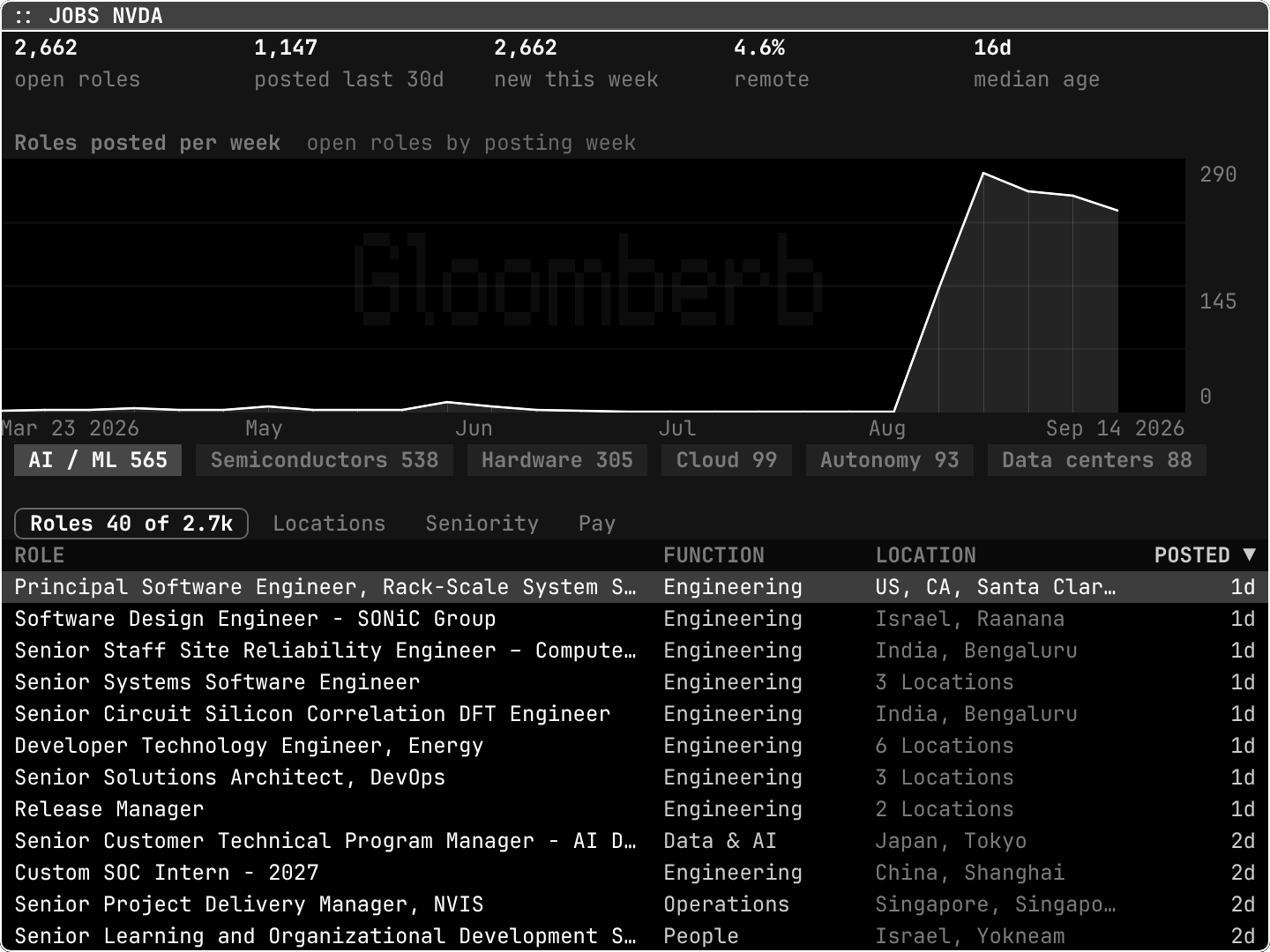
| Roles posted per week | The currently open roles by the week they were posted. Older weeks are thinner because their roles have had longer to fill, so read it as the intake of the current backlog. |
| By function | Each role placed in one of 18 functions from its title and team, rules first, a model for the rest. |
| By country and seniority | From the posting's location and title. |
| Signals | Themes the titles and teams point at: AI, data centers, semiconductors, robotics, security, regulatory, and so on. |
| Pay | Ranges the company publishes, either as structured pay data or written into the posting. Medians across roles that carry one, overall and by function. |
| Median age | Median days since posting across open roles with a date. |
Everything is counted from the posting table, so a figure in the pane can be traced back to the roles behind it.
Reading it
- A rising open count with new roles concentrated in one function is expansion; falling roles in the same function ahead of an announcement is the other thing.
- Compare open roles per thousand employees across peers rather than raw counts.
- Signals surface what the titles say the company is building, often before it is in a filing.
- Posting pace is the earliest read of a change of direction, since roles are pulled before headcount moves.
Commands and tools
| Surface | How |
|---|---|
| Pane | JOBS NVDA for a company, HIRE for the ranking across coverage |
| Ticker research | The Hiring tab |
| CLI | gloomberb fn JOBS NVDA, gloomberb fn HIRE, --json for the structured report |
| ASKG and MCP | company.hiring and market.hiring_movers |
In the pane, o opens the selected role on the company's site and c opens the careers site. The Roles, Locations, Seniority and Pay tabs switch the lower half.
Coverage
Coverage grows from the S&P 500 outward across every US-listed company, then to whatever people open. The share of companies with a readable careers system is high among operating companies and low among shells and acquisition vehicles, which have no roles to read. The HIRE footer shows how many companies are covered right now.