Relative valuation (RV)
RV puts a peer group in one table at today's prices (size, P/E, forward P/E, EV/sales, free cash flow yield and growth) so you can judge a company's price against its peers.
- 4 min
- 3 questions
- Lesson 2 of 5
Why you would care
Is this company expensive compared with its peers, and does its growth justify it? "AMD trades at 158 times earnings." Expensive? Compared with what? A multiple only means something next to the multiples of similar companies, and next to their growth. Relative valuation is how most analysts first judge price: against peers, not in a vacuum.
The idea from scratch
A peer group is a set of companies in the same business, facing similar customers and risks. Comparing their multiples (valuation ratios from chapter 04) shows which ones the market prices high or low.
The core idea: a higher multiple must be paid for by something, usually faster growth, higher margins or lower risk.
Which multiple to use:
| Situation | Better multiple |
|---|---|
| Profitable, stable | P/E, forward P/E |
| Different debt levels | EV/EBITDA or EV/sales |
| No profit yet | EV/sales (price per dollar of sales) |
| Cash-rich, capital-light | FCF yield |
Forward P/E uses next year's estimated earnings (chapter 04, Estimates, surprises and revisions); it falls when big growth is expected.

See it in Gloom
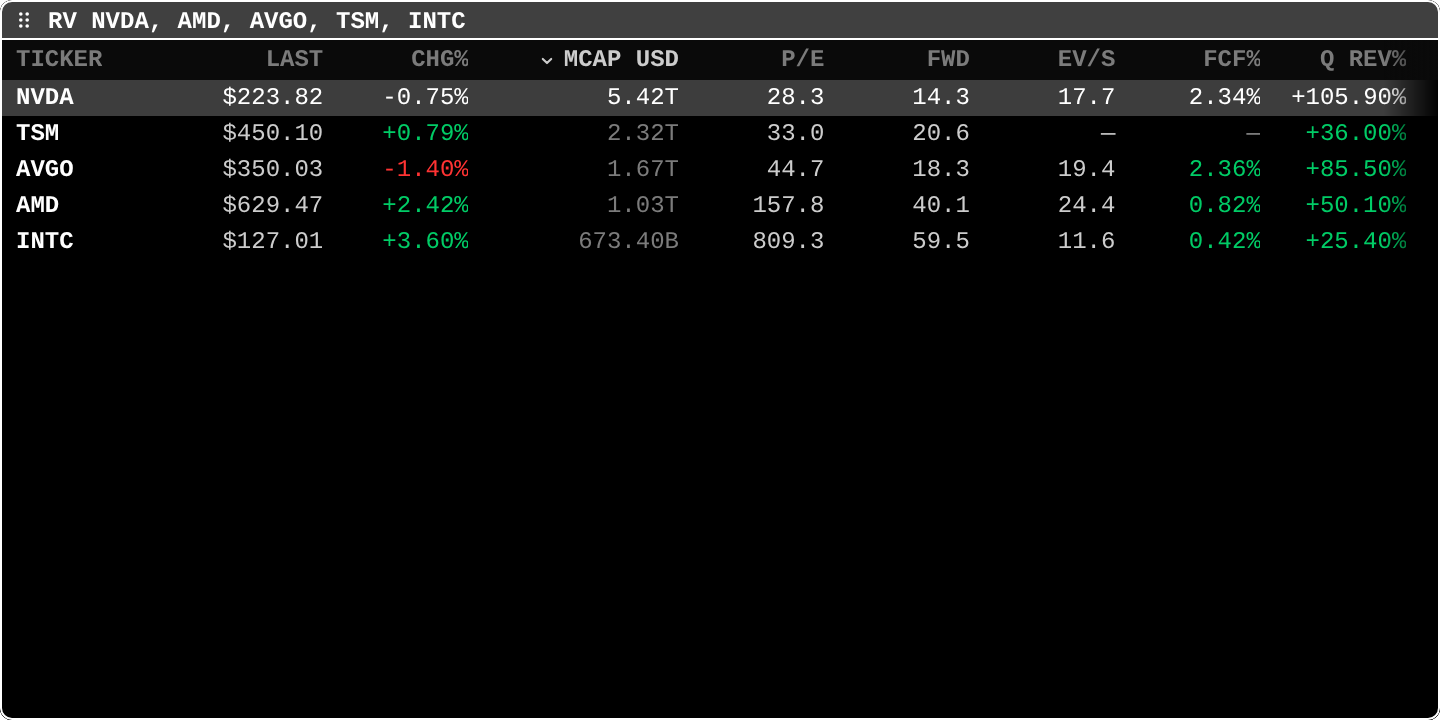
open ittype RV NVDA, AMD, AVGO, TSM, INTC. Click a column header to sort; Enter opens a company.
MCAP USD: market cap, sorted largest first. NVDA 5.42 trillion dollars.P/EandFWD: NVDA 28.3 and 14.3; AMD 157.8 and 40.1. AMD's earnings are expected to grow a lot, so its forward P/E is far lower than its trailing one.INTC 809.3: a P/E this high means earnings are tiny. The multiple is not meaningful as a "price".EV/SandFCF%: price per dollar of sales and free cash flow yield. A dash means not available for that listing (TSM).Q REV%: revenue growth in the latest quarter versus a year earlier. NVDA +105.90%.
Practice and recap
Try it3 tasks
- Which company has the lowest forward P/E? (NVDA, 14.3.)
- NVDA: P/E 28.3, revenue growth +106%. AVGO: P/E 44.7, +85.5%. Which looks cheaper for its growth? (NVDA: lower multiple, faster growth.)
- Why is INTC's P/E almost useless here? (Its earnings are close to zero, so the ratio explodes.)
Common mistakes4 mistakes
- Picking peers that are not really comparable (a chip designer and a chip factory have different economics).
- Judging a multiple without growth next to it.
- Trusting P/E when earnings are near zero or negative.
- Comparing companies with very different accounting or currencies without checking.
Check yourself3 questions
- What is a peer group?
- P/E 40, growth 20%. PEG?
- Which multiple works for a company with no profit?
Answers
- A set of companies in the same business, used for comparison.
- 40 / 20 = 2.0.
- EV/sales (or P/S): price per dollar of sales.
Words in this lesson7 words
- relative valuation
- Judging a price by comparing multiples with peers.
- peer group
- Comparable companies.
- multiple
- A valuation ratio: P/E, EV/EBITDA, EV/sales...
- forward P/E
- Price divided by next year's estimated EPS.
- PEG
- P/E divided by the earnings growth rate.
- EV/sales
- Enterprise value divided by revenue.
- premium / discount
- Trading at a higher / lower multiple than peers.
Educational material about reading market data, not investment advice.