Inflation by component (CPI)
CPI breaks US consumer prices into their components with each one's weight, its monthly, annualized and yearly change, and its contribution to the headline.
- 3 min
- 3 questions
- Lesson 3 of 4
Why you would care
Which prices are driving inflation? "Inflation 3.4%" hides very different stories: gasoline up 27% while used cars fall, or rents rising steadily. Central banks care about which parts move, because some fade quickly and others stick. Reading the components lets you understand the headline before the commentators do.
The idea from scratch
The CPI prices a basket of what households buy, every month (chapter 01, The macro machine). Each item has a weight: its share of typical spending. Shelter (rent and the rental value of owned homes) is about a third.
Key measures:
Headline (all items)
everything.
Core
without food and energy, which swing a lot. Core shows the underlying trend.
m/m
change over one month. y/y: over twelve months.
Annualized 3-month or 6-month rate
the recent pace, scaled to a year. It reacts faster than y/y.
Contribution = weight x change. It answers "how many percentage points of the total came from this component?"
Goods vs services: goods prices (cars, clothes) often swing with supply chains; services (rent, insurance, medical care) move slowly and depend on wages. Sticky services inflation worries central banks most.

See it in Gloom
open ittype CPI.
- Header:
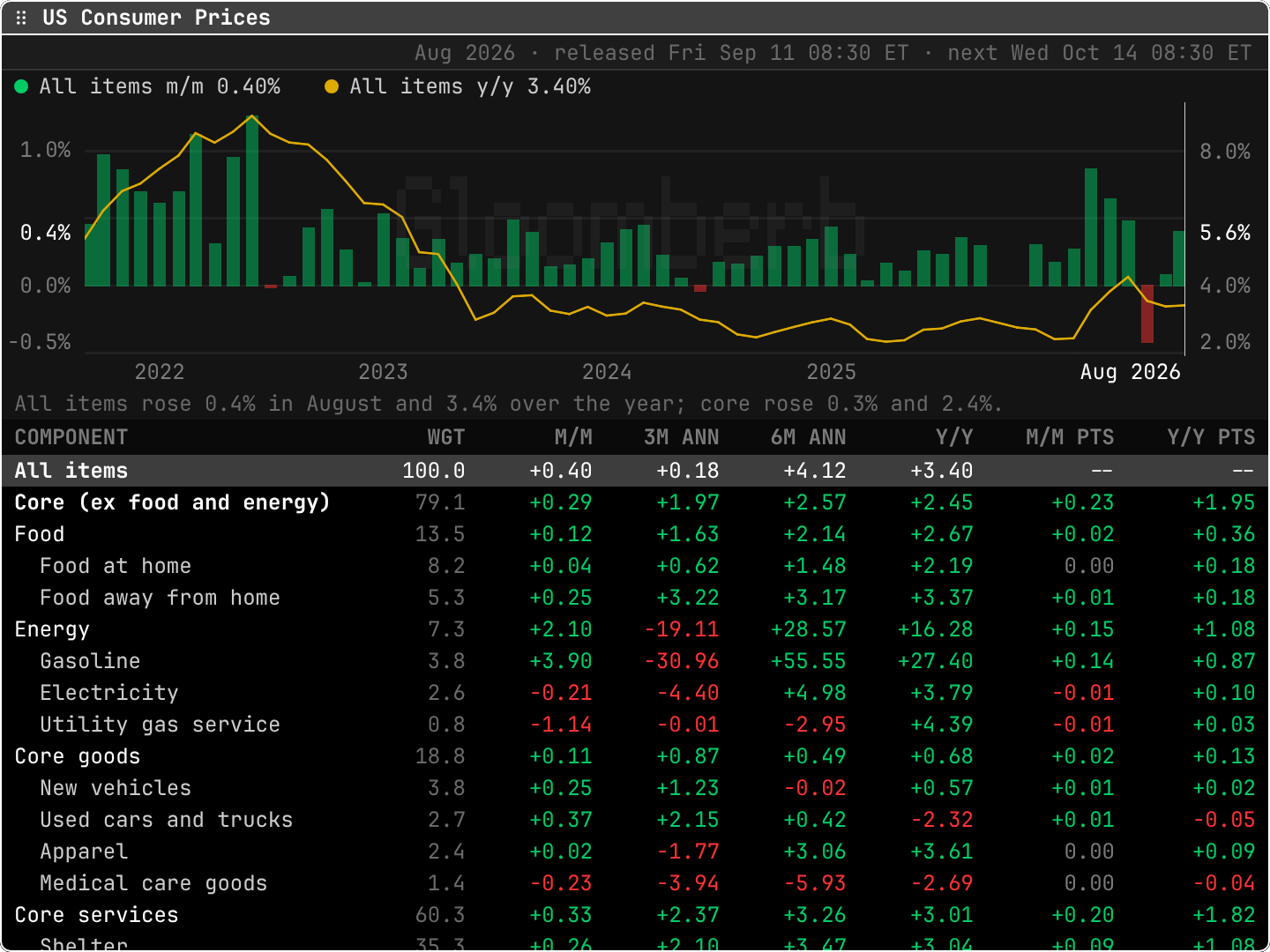
Aug 2026 · released Fri Sep 11 08:30 ET · next Wed Oct 14 08:30 ET. All items m/m 0.40%,y/y 3.40%: headline inflation.Core (ex food and energy): 2.45% y/y, about a point lower: energy is lifting the headline.Gasoline +27.40%y/y: the biggest mover in the table.WGT: Shelter about 35%, food about 13.5%.- The contribution column: how many points each component adds to the headline.
Practice and recap
Try it3 tasks
- Headline 3.4%, core 2.45%. Roughly how much do food and energy add? (About one point, mostly energy.)
- A component with 10% weight rises 5%. Contribution? (0.5 points.)
- Why do central banks watch services inflation closely? (It is sticky and tied to wages, so it fades slowly.)
Common mistakes4 mistakes
- Adding component changes without weights.
- Reading one hot month as a trend; compare 3- and 6-month annualized rates.
- Ignoring that shelter inflation lags real-world rents by many months.
- Comparing CPI with PCE as if they were the same index.
Check yourself3 questions
- What is core inflation?
- How is a contribution computed?
- What does a 3-month annualized rate show?
Answers
- Inflation without food and energy.
- Component weight times its price change.
- The recent pace of inflation, scaled to a yearly rate.
Words in this lesson6 words
- headline / core CPI
- All items / without food and energy.
- weight
- A component's share of the basket.
- contribution
- Weight x change: points of the total from one component.
- annualized rate
- A short-period change scaled to a year.
- shelter
- Rent and the rental value of owned homes.
- sticky inflation
- Price rises that fade slowly, often in services.
Educational material about reading market data, not investment advice.