The Fed path (WIRP)
WIRP turns the prices of overnight-rate futures into the rate the market expects after each scheduled Fed meeting, with hike or cut probabilities and the Fed's own projections.
- 4 min
- 3 questions
- Lesson 2 of 6
Why you would care
What does the market expect the Fed to do, and when? "The market prices two hikes by March." That sentence moves bonds, the dollar and stocks. It comes straight from this screen's numbers. Knowing what is priced also tells you what would be a surprise.
The idea from scratch
The rates involved
- The target range: the range the Fed sets for the overnight rate, like 3.75% to 4.00%.
- The effective fed funds rate (EFFR): the actual average overnight rate between banks, usually inside the range.
- The FOMC meets eight times a year to decide the range.
How futures reveal expectations
Fed funds futures pay based on the average EFFR over a calendar month. Their price is quoted as 100 minus the rate: a price of 95.97 implies a 4.03% average rate for that month.
Doing this for every month, and splitting each month at its meeting date, gives an implied path: the expected rate after each meeting.
Probabilities
If a meeting can only hike or hold by 25 bp, an implied move of +15 bp is read as about a 60% chance of a hike (15 / 25). Gloom's probabilities follow this two-outcome idea, assuming the gap between EFFR and the middle of the range stays constant and no surprise meetings happen. It is a simplification.
The Fed's own view
Four times a year the Fed publishes the Summary of Economic Projections (SEP), including each official's expected rate path (the "dot plot"); the SEP median is shown next to the market's path.

See it in Gloom
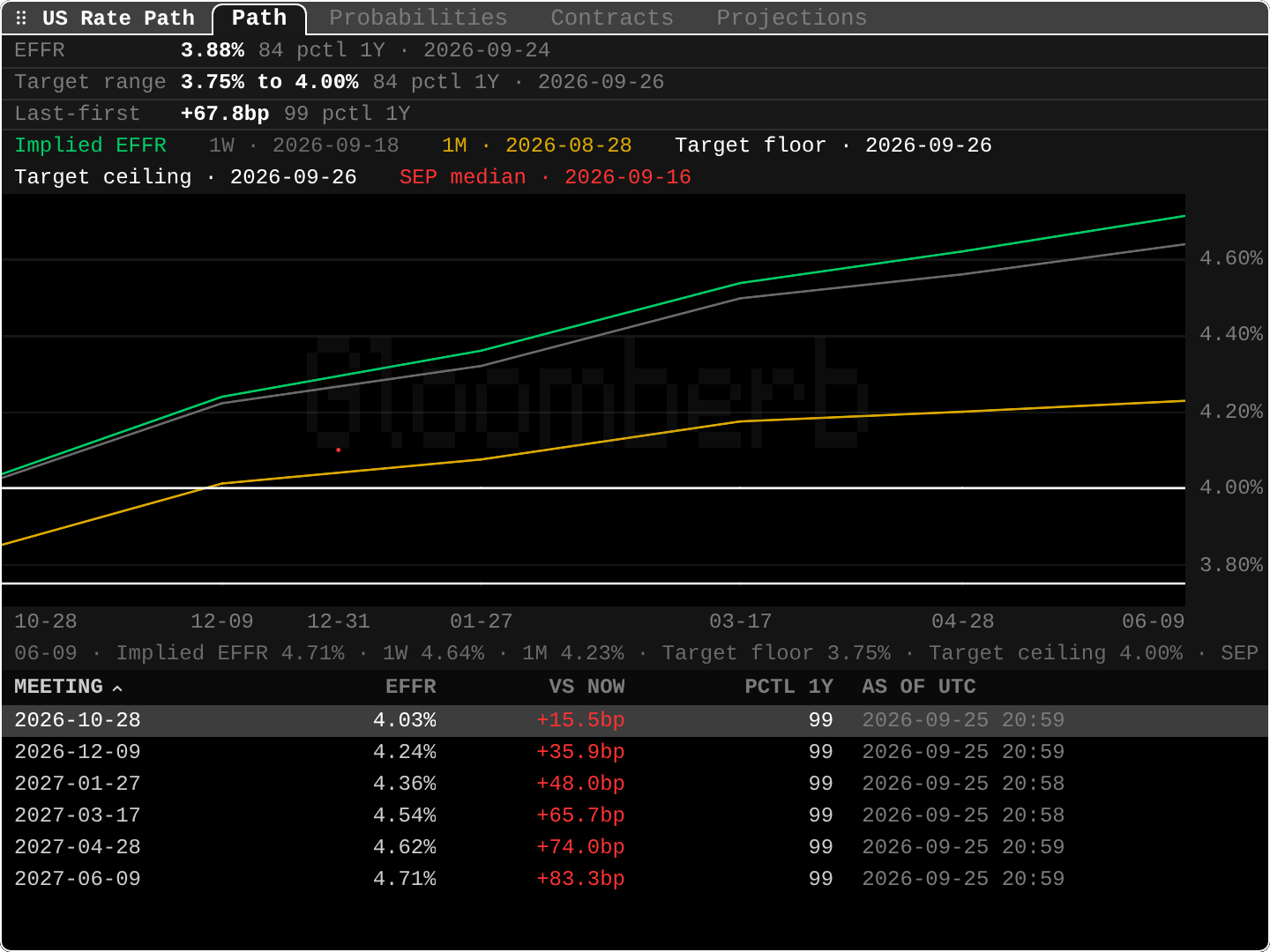
open ittype WIRP. Tabs: Path, Probabilities, Contracts, Projections.
EFFR 3.88%,Target range 3.75% to 4.00%: where policy is today.- Row
2026-10-28 4.03% +15.5bp: after the October meeting the market expects the EFFR about 15 bp higher: a hike is partly priced. - Row
2027-06-09 4.71% +83.3bp: by June 2027 about three 25 bp hikes are priced. - The lines: green (today) above grey (1 week ago) above yellow (1 month ago): hike expectations rose over the month.
SEP median(red dot): the Fed's own projection, below the market's path here.PCTL 1Y 99: these implied rates are at the top of their past year.
Practice and recap
Try it3 tasks
- A futures price of 95.50 implies what rate? (4.50%.)
- EFFR 3.88%, implied after next meeting 3.70%. Hike or cut priced? (A cut of about 18 bp: roughly 70% odds of a 25 bp cut.)
- In the screenshot, did hike expectations rise or fall over the past month? (Rose: today's line is above the 1M line.)
Common mistakes4 mistakes
- Reading the implied rate as a forecast. It is a price, with risk premia inside.
- Forgetting that the EFFR sits inside the range, not at its top.
- Treating probabilities as exact: they rest on a two-outcome model.
- Comparing the market path with an old SEP.
Check yourself3 questions
- What is the EFFR?
- How is a fed funds future's implied rate read from its price?
- What is the SEP?
Answers
- The effective federal funds rate: the average rate banks pay for overnight loans of reserves.
- 100 minus the price.
- The Fed's quarterly Summary of Economic Projections, including officials' expected rate path.
Words in this lesson7 words
- target range
- The range the Fed sets for the overnight rate.
- EFFR
- The effective federal funds rate.
- FOMC
- The Fed committee that sets the range, 8 meetings a year.
- fed funds futures
- Futures on the monthly average EFFR, priced 100 minus the rate.
- implied path
- The expected rate after each meeting, from futures.
- SEP / dot plot
- The Fed's own projections of the rate path.
- hike / cut / hold
- Raise / lower / keep the target range.
Educational material about reading market data, not investment advice.