Value and payoff at expiry
An option's price is what it is worth if used right now (intrinsic value) plus a bet on the future (time value), and at expiry only the first part is left.
- 5 min
- 3 questions
- Lesson 2 of 5
Why you would care
Two calls on the same stock, one costs $6.21 and one costs $1.17. Why? And why does a cheap option lose value even when the stock does not move? The answer is these two parts.
The idea from scratch
In, at and out of the money
Compare the strike to today's stock price. Stock at $100:
| Option | Strike | Name | Why |
|---|---|---|---|
| Call | 95 | in the money | You could buy at 95 something worth 100 |
| Call | 100 | at the money | Strike equals price |
| Call | 105 | out of the money | Buying at 105 what is worth 100 makes no sense |
| Put | 105 | in the money | You could sell at 105 something worth 100 |
Intrinsic value and time value
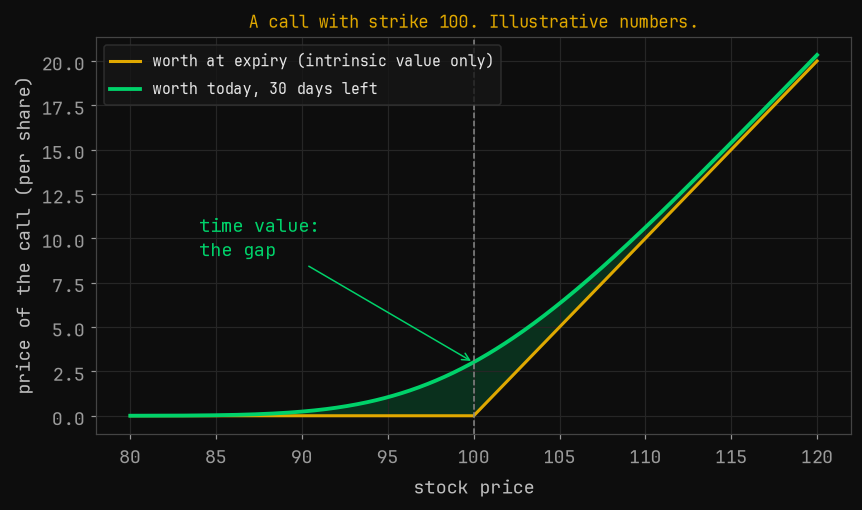
Intrinsic value is what the option would be worth if you used it this second. For a call it is stock minus strike (never below zero). For a put it is strike minus stock.
Time value is whatever the premium pays on top. It pays for the chance that the stock moves your way before expiry.
Illustrative numbers: stock $100, 30 days left, volatility 25%, rate 4%.
| Call strike | Premium | Intrinsic | Time value |
|---|---|---|---|
| 95 | 6.21 | 5.00 | 1.21 |
| 100 | 3.02 | 0.00 | 3.02 |
| 105 | 1.17 | 0.00 | 1.17 |
The at-the-money call has the most time value: it is the one where the future matters most. The 95 call is mostly "real" value.
Time value shrinks every day and is zero at expiry. That melting is what the Greek called theta measures (next lesson).
Profit at expiry
At expiry, only intrinsic value is left. Your profit is that value minus what you paid.
You buy a call, strike 100, premium 3 (illustrative, per share):
| Stock at expiry | Call is worth | Your profit per share | Per contract (x100) |
|---|---|---|---|
| 90 | 0 | -3 | -$300 |
| 100 | 0 | -3 | -$300 |
| 103 | 3 | 0 | $0 |
| 110 | 10 | +7 | +$700 |
Your breakeven is strike plus premium: 103. Below the strike you lose exactly the premium, never more. Above breakeven you gain without a ceiling.
The seller sees the same table flipped: they keep the 3 if the stock stays below 100, and lose more the higher it goes.
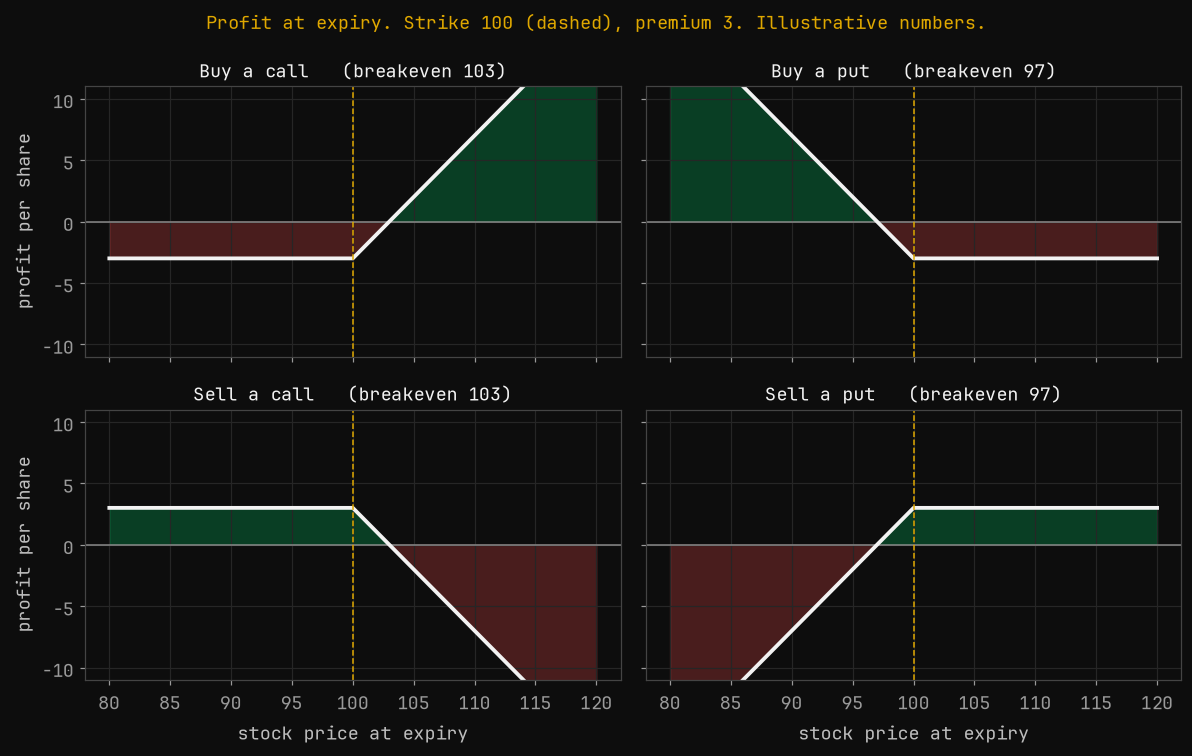
Four shapes cover most of options. Green is profit, red is loss. Buyers have a floor; sellers have a cap on gains.
See it in Gloom
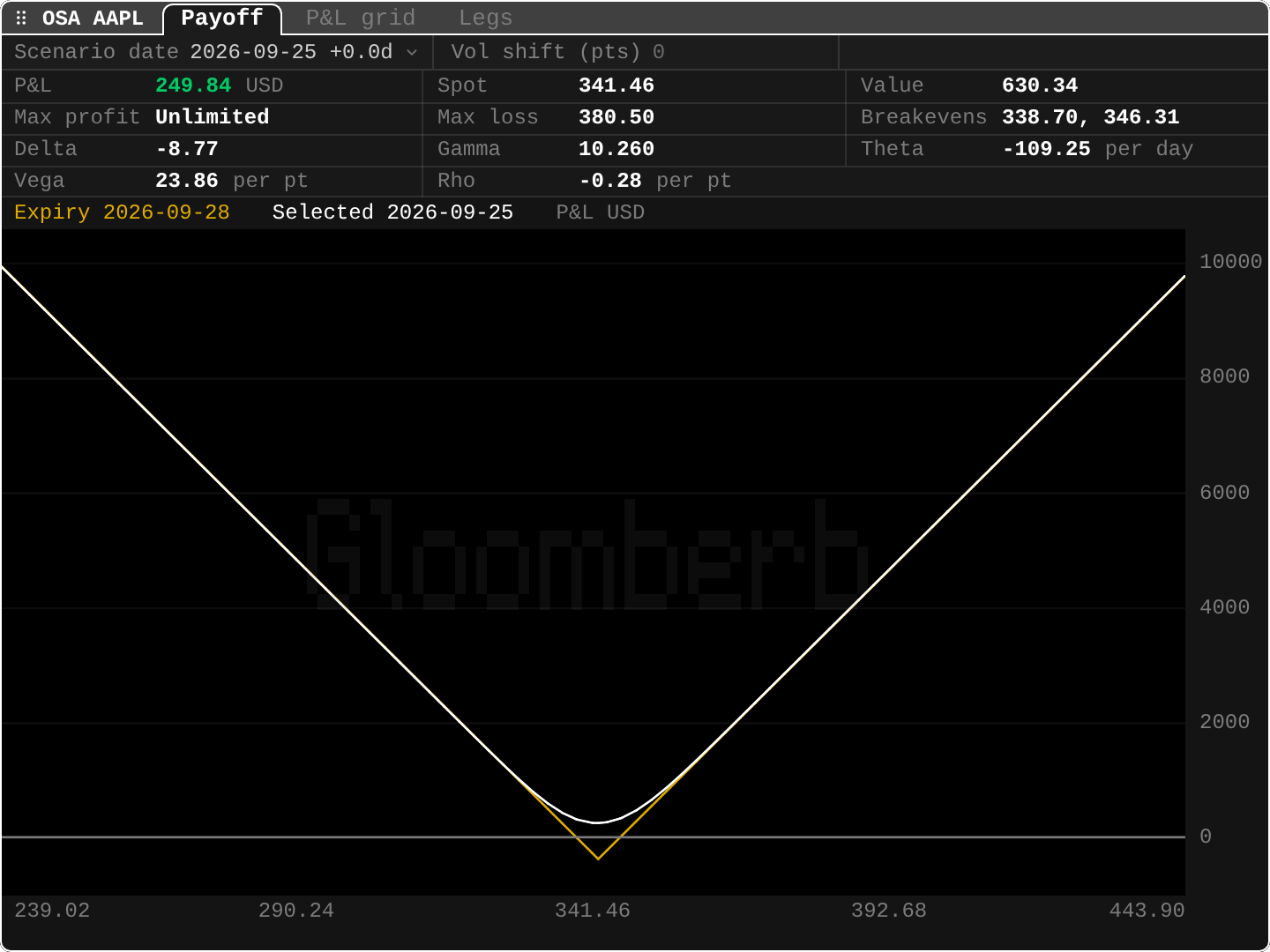
Look at the two lines. The amber V is the profit at expiry: sharp corner, only intrinsic value. The white curve is the profit on a scenario date before expiry. The gap between them is time value.
open ittype OSA AAPL. OSA is the strategy analyzer (full lesson). This example position holds two options, which is why the shape is a V on both sides.
- Amber line. Profit if you hold to the expiry date shown above the chart.
- White line. Profit on the "Selected" date. At the bottom of the V it sits above the amber line: time value still left.
- Breakevens. The header lists where profit crosses zero.
- Max loss and max profit. The header says how bad and how good it can get.
Practice and recap
Try it3 tasks
- In the table above, what is the call's profit at 100? Why not zero? (It is -3: the premium is gone.)
- Using the 105 call (premium 1.17), where is breakeven at expiry? (106.17.)
- Draw a put's version: strike 100, premium 3. Where does it break even? (97.)
Common mistakes3 mistakes
- Thinking "in the money" means "profitable". A call with strike 95 bought at 6.21 needs the stock above 101.21 to profit.
- Ignoring the 100x multiplier when reading profit.
- Forgetting that selling an option also has a payoff: small fixed gain, large possible loss.
Check yourself3 questions
- Stock is 50. What is the intrinsic value of a put with strike 55?
- You buy a call for 2 with strike 40. Where is breakeven at expiry?
- What happens to time value on the last day?
Answers
- 55 - 50 = 5.
- 42.
- It goes to zero. Only intrinsic value remains.
Words in this lesson7 words
- in the money
- An option that would have value if used now
- at the money
- Strike about equal to the stock price
- out of the money
- An option with no value if used now
- intrinsic value
- What using the option now would be worth
- time value
- Premium minus intrinsic value: the price of the chance
- breakeven
- The stock price where profit is zero
- payoff
- Profit or loss at expiry for each stock price
Educational material about reading market data, not investment advice.