Treasury auctions (AUCT)
AUCT lists upcoming and recent US Treasury auctions with the rate each cleared at, how well it was covered and who bought.
- 4 min
- 3 questions
- Lesson 5 of 6
Why you would care
Is there strong demand for US government debt? The US sells hundreds of billions of dollars of debt every week. If buyers show up weakly, yields jump and the whole curve can move within minutes of the result. A "tailing" 10-year auction is a headline on rates desks.
The idea from scratch
The Treasury sells new debt through auctions. Bidders submit the yield they want; the Treasury accepts the lowest yields first until the amount is filled. The highest accepted yield is the high yield (or rate) and everyone gets that rate.
Types of securities:
| Type | Maturity | Note |
|---|---|---|
| Bill | 4 weeks to 52 weeks | Sold at a discount, no coupon |
| Note | 2 to 10 years | Pays a coupon twice a year |
| Bond | 20 and 30 years | Pays a coupon twice a year |
| TIPS | 5 to 30 years | Principal grows with inflation; yield is a real yield |
| FRN | 2 years | Floating rate: pays the bill rate plus a fixed spread |
How to judge an auction:
Bid-to-cover (B/C)
total bids / amount sold. 2.5 means bids for 2.5 times the size. Higher means stronger demand.
Indirect bidders
bids placed through dealers for others, mostly foreign central banks and institutions. A high share signals broad demand.
Tail
when the auction rate comes in above the yield traders expected just before the deadline (the "when-issued" yield). A tail means the government had to pay more than expected: weak demand. The opposite is a stop-through.

See it in Gloom
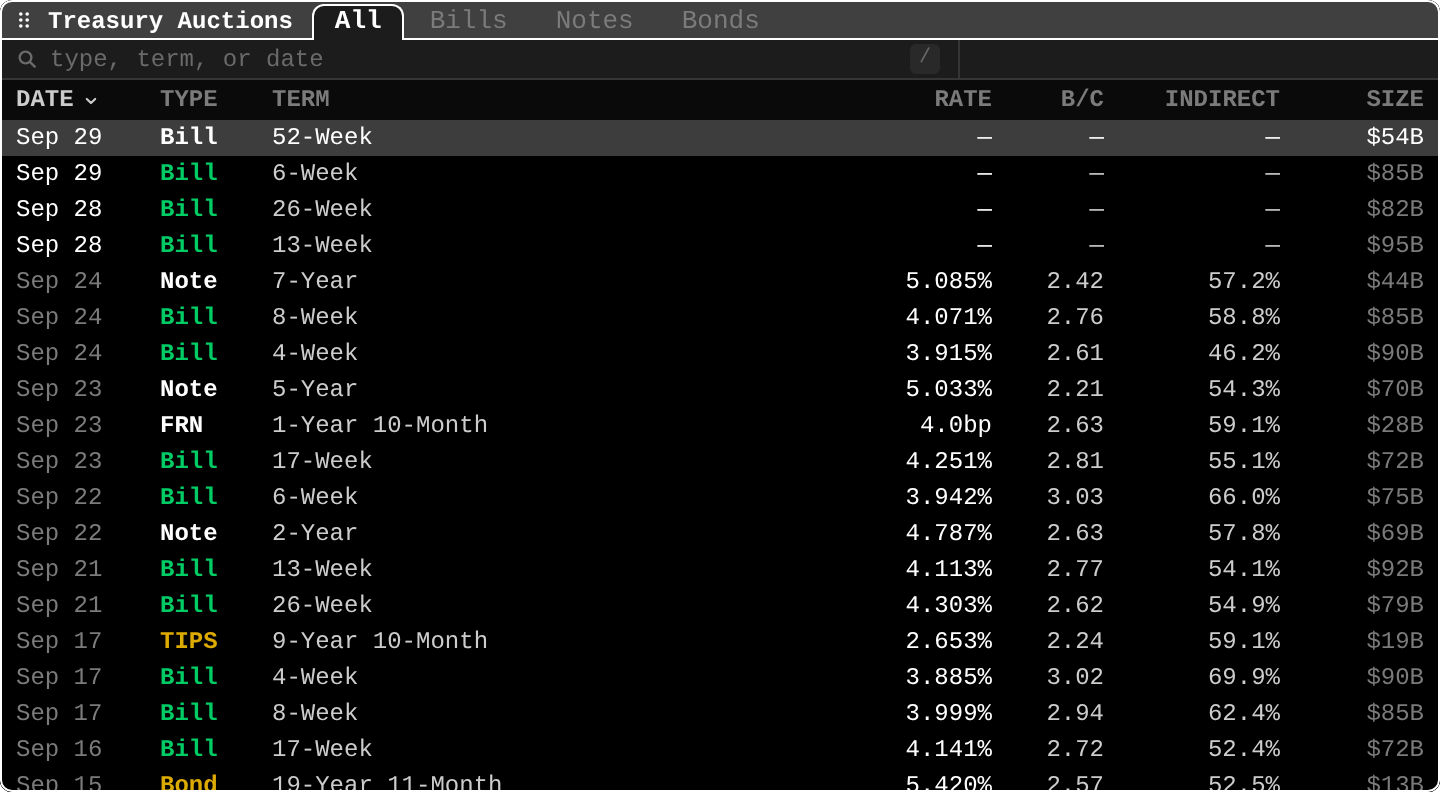
open ittype AUCT. Tabs: All, Bills, Notes, Bonds; / searches.
- Top rows
Sep 29 Bill 52-Week ... $54Bwith dashes: upcoming auctions, size announced, results not yet in. Sep 24 Note 7-Year 5.085% 2.42 57.2% $44B: the 7-year sold 44 billion at 5.085%, bids for 2.42 times the size, 57% to indirect bidders.Sep 23 FRN 4.0bp: a floating-rate note; its "rate" is the spread over the bill rate.Sep 17 TIPS 9-Year 10-Month 2.653%: a reopened TIPS; the yield is real (after inflation).- Bills cover much more (
3.03for the 6-week) than long notes: short paper is in high demand from money funds.
Practice and recap
Try it3 tasks
- Which recent auction had the highest bid-to-cover in the screenshot? (The 6-week bill on Sep 22, 3.03.)
- A note auctioned at 4.80% when it traded at 4.78% just before. Tail or stop-through? (A 2 bp tail.)
- Why might a TIPS yield (2.65%) be far below a nominal 10-year yield (5.3%)? (TIPS yields are real; the gap is roughly expected inflation plus premia.)
Common mistakes4 mistakes
- Judging an auction by its yield level alone; compare with the pre-auction yield.
- Reading a single low bid-to-cover as a crisis: compare with recent auctions of the same term.
- Forgetting that "9-Year 10-Month" means a reopening of an existing issue.
- Mixing up FRN spreads with yields.
Check yourself3 questions
- What is bid-to-cover?
- What is a tail?
- Who are indirect bidders, mostly?
Answers
- Total bids divided by the amount sold.
- The auction clearing at a higher yield than the market expected just before: a sign of weak demand.
- Foreign central banks and other institutions bidding through dealers.
Words in this lesson8 words
- auction
- The sale of new government debt to the highest bidders (lowest yields).
- high yield (auction rate)
- The yield all winning bidders receive.
- bid-to-cover
- Bids divided by the amount sold.
- indirect bidders
- Bidders through dealers, often foreign institutions.
- tail / stop-through
- Clearing above / below the expected yield.
- when-issued yield
- The market yield of a new issue before it is auctioned.
- FRN
- Floating-rate note.
- reopening
- Selling more of an existing issue.
Educational material about reading market data, not investment advice.