Prediction markets (PM)
In a prediction market a contract pays 1 dollar if an event happens and 0 if not, so its price in cents reads as the crowd's probability, and PM lists these markets by topic.
- 4 min
- 3 questions
- Lesson 3 of 4
Why you would care
What does the crowd think will happen, and how sure is it? "Markets price a 67% chance of a hike in October" can come from rate futures (chapter 08) or from a prediction market. When both agree, you have a cross-check; when they disagree, one of them is wrong or measures something different. Prediction markets also price events no other market covers: elections, court rulings, company announcements.
The idea from scratch
An event contract pays 1 dollar if the outcome happens and nothing otherwise. Its price is between 0 and 1 dollar.
Markets with several outcomes ("How many cuts this year: 0, 1, 2, 3+") have one contract per outcome; their prices should add up to about 100%.
What limits the reading:
- Spread: the gap between bid and ask in cents. A wide spread means the "probability" is fuzzy.
- Volume and liquidity: a thin market can be moved by one trader.
- Fees and the time value of money shift prices slightly.
- Rules: each market resolves on precise wording; read it.

See it in Gloom
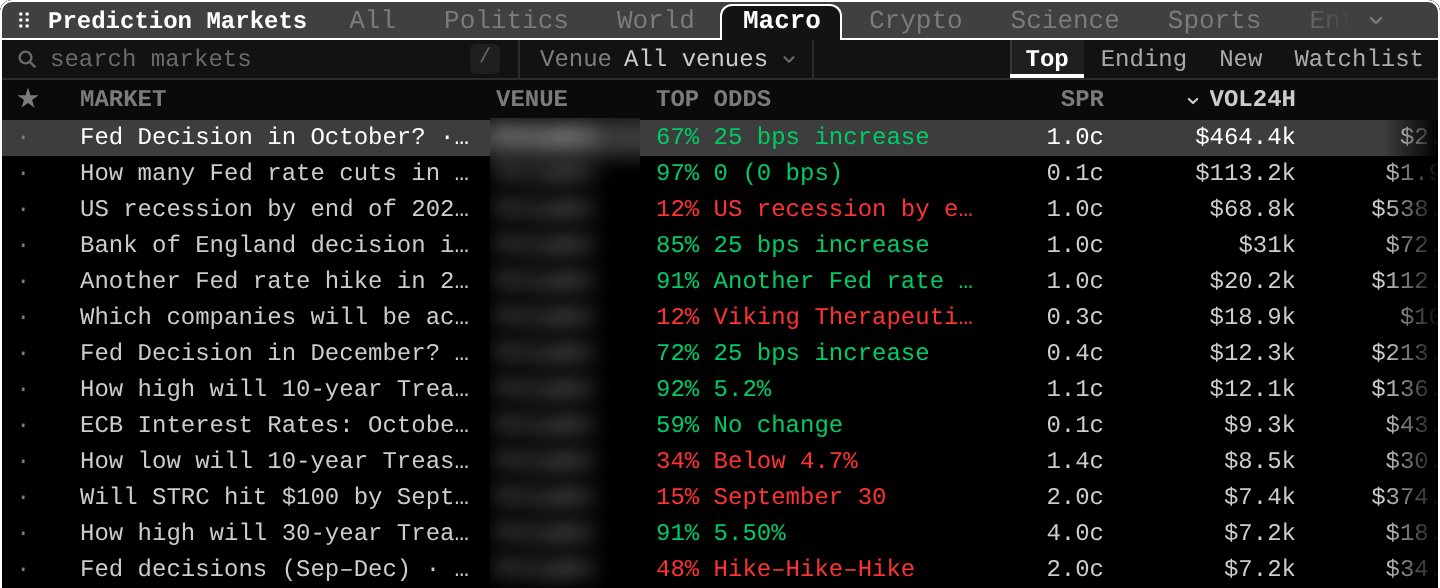
open ittype PM, or PM fed to search. Category tabs on top (h/l); views Top, Ending, New, Watchlist; a venue filter. Enter opens a market's order book, trades, outcomes, price history and resolution rules. PM is an official plugin: typing it offers to install it.
Fed Decision in October? 67% 25 bps increase: the most likely outcome and its implied probability.SPR 1.0c: a one-cent spread: a tight, liquid market.VOL24H $464.4k: money traded in 24 hours.US recession by end of 202… 12%: a 12% implied chance.How high will 10-year Trea… 92% 5.2%: a market on a bond yield level.
A market's price history can be plotted next to any other series in the chart composer (chapter 03).
Practice and recap
Try it3 tasks
- A YES contract trades at 23 cents. Implied probability? (23%.)
- Outcomes priced 50, 30 and 25 cents. What is odd? (They add to 105%: fees, spreads or mispricing.)
- Compare the October hike odds here (67%) with the Fed path lesson. What would you check? (Whether rate futures price a similar probability for the same meeting.)
Common mistakes4 mistakes
- Reading thin markets as reliable probabilities.
- Ignoring the exact resolution wording.
- Treating a probability as a forecast that "will" happen.
- Forgetting that some venues are not open to everyone everywhere.
Check yourself3 questions
- What does an event contract pay?
- How do you read a price of 40 cents?
- Why does the spread matter?
Answers
- 1 dollar if the event happens, nothing if not.
- A 40% implied probability.
- A wide spread means the implied probability is uncertain and costly to trade.
Words in this lesson5 words
- prediction market
- A market trading contracts on whether events happen.
- event contract
- Pays 1 dollar if the event happens, 0 if not.
- implied probability
- The chance a price suggests.
- resolution rules
- The exact wording that decides the outcome.
- liquidity
- How easily you can trade without moving the price.
Educational material about reading market data, not investment advice.