A fund's facts and official documents (ETF)
ETF shows a US fund's facts (fee, NAV, premium or discount, net assets), then lists its filings with the SEC (prospectus, holdings reports, shareholder reports) and opens any of them.
- 6 min
- 3 questions
- Lesson 3 of 4
Why you would care
What does this fund promise, what does it charge, and what does it actually hold? Two ETFs both say "S&P 500" on the label. One charges 0.03% a year, the other 0.50%. One holds the 500 stocks, the other uses swaps. The marketing page is a summary. The filings are what the fund is legally bound to.
The idea from scratch
An ETF (exchange-traded fund) is a fund whose shares trade on an exchange like a stock (chapter 01, Funds, ETFs and indices). Behind every US fund sits a legal entity that must file documents with the SEC, the US securities regulator.
The fund's key document is the prospectus: the rulebook. It states the fund's objective (for example "track the S&P 500"), how it invests, its risks, and its fees. The yearly fee, as a percentage of your money, is the expense ratio.
What a share is worth: NAV and premium
A fund's NAV (net asset value) per share is everything it holds, minus what it owes, divided by its shares. Its market price can differ: above NAV is a premium, below is a discount.
An ETF usually trades close to its NAV, because large traders can create or redeem shares when a gap opens. A closed-end fund has a fixed number of shares that only trade between investors, so its price can sit far from NAV for a long time.
The forms you will see
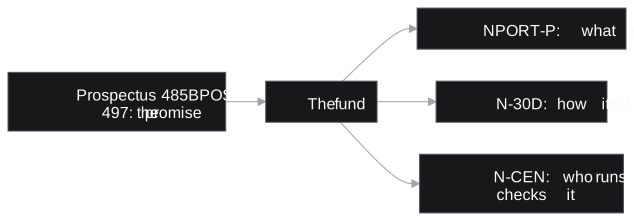
- 485BPOS
- An update to the fund's registration, usually the yearly refreshed prospectus
- 497
- A prospectus supplement: a change or correction to the prospectus
- NPORT-P
- A portfolio holdings report: every position the fund held at a month's end. The public ones come out quarterly, about two months later
- N-30D
- A report to shareholders (results, holdings, costs)
- N-CEN
- A yearly census of the fund: who runs it, who holds its assets, who audits it
- 24F-2NT
- A yearly notice of how many fund shares were sold, used to pay SEC fees
See it in Gloom
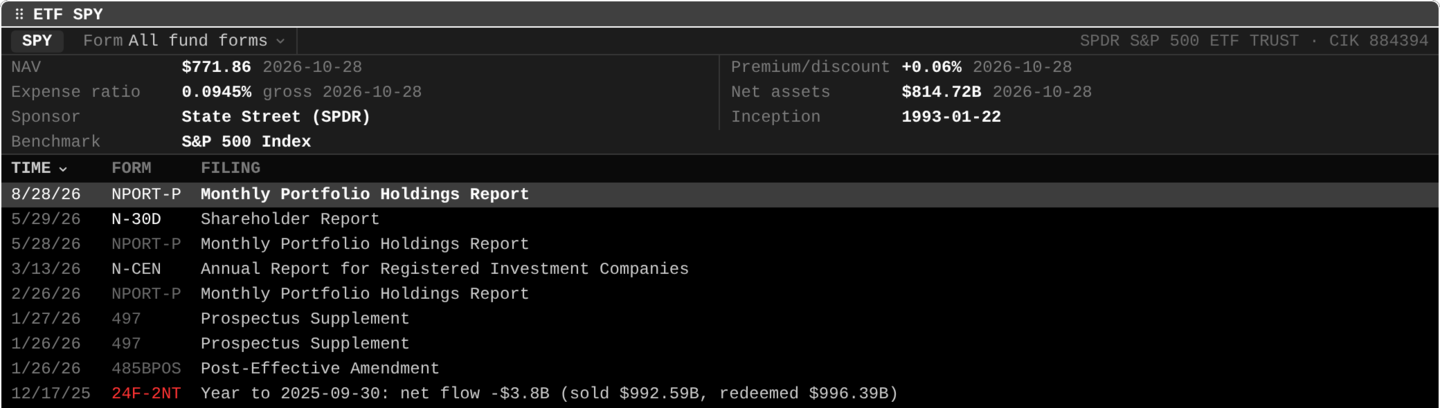
Open ittype ETF SPY.
SPDR S&P 500 ETF TRUST · CIK 884394: the legal fund behind the ticker, and its CIK, the SEC's ID number for every filer.- The facts, each with its date:
NAV $771.86,Premium/discount +0.06%(the price is almost exactly the NAV),Expense ratio 0.0945%,Net assets $814.72B. TIME,FORMandFILING: the filing date, newest first, the type and its title.NPORT-P Monthly Portfolio Holdings Reporton 8/28/26 is the latest public holdings snapshot.- The rhythm: NPORT-P in late February, May, August and November; the prospectus updates (485BPOS, 497) every January; N-CEN every March.
Enteropens a filing inside Gloom;oopens the original on the SEC website.
A closed-end fund reads differently:
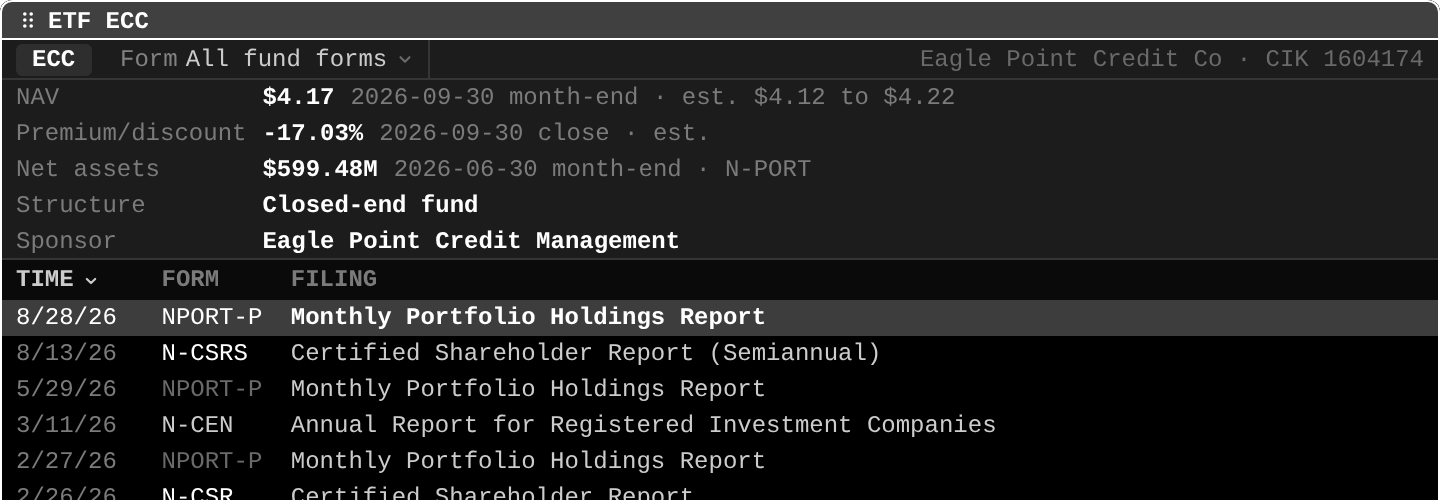
NAV $4.17 2026-09-30 month-end · est. $4.12 to $4.22: a closed-end fund's NAV is a month end's, here the middle of its sponsor's own estimate.Premium/discount -17.03% 2026-09-30 close · est.: the shares closed 17% below that NAV.est.because it is measured against an estimate.Structure Closed-end fund. A business development company, another fund that lends to private companies, readsBDC.
Practice and recap
Try it3 tasks
- In the screenshot, when was the most recent prospectus update (485BPOS)? (1/26/26.)
- What form would you open to see SPY's holdings at a quarter's end? (NPORT-P.)
- In the 24F-2NT row, did more money come into SPY or leave it in the year to 2025-09-30? (It left: $996.39B redeemed against $992.59B sold, a net flow of -$3.8B.)
Common mistakes5 mistakes
- Trusting the fund's name instead of its objective. Read the prospectus.
- Thinking the latest holdings report is today's portfolio. It is weeks or months old.
- Buying a closed-end fund for its discount alone. A discount can stay wide, or widen.
- Ignoring fees. A small yearly percentage compounds over decades.
- Using
ETFon a single stock. It is for funds; companies haveSEC(chapter 05).
Check yourself3 questions
- What is a prospectus?
- What does an expense ratio of 0.20% cost on 5,000 dollars per year?
- What is a CIK?
Answers
- The fund's legal rulebook: objective, strategy, risks and fees.
- About 10 dollars.
- The SEC's ID number for a filer.
Words in this lesson10 words
- filing
- A document a company or fund sends to the regulator, made public.
- prospectus
- A fund's legal rulebook: objective, strategy, risks, fees.
- objective
- What the fund tries to do, like tracking an index.
- expense ratio
- The fund's yearly fee as a % of your money.
- holdings report (NPORT-P)
- A list of every position the fund held at a date.
- CIK
- The SEC's ID number for a company or fund.
- NAV (net asset value)
- What a fund's holdings are worth, minus its debts, per share.
- premium / discount
- A fund's price above / below its NAV, in %.
- closed-end fund
- A fund with a fixed number of shares that trade between investors.
- BDC (business development company)
- A listed fund that lends to or invests in private companies.
Educational material about reading market data, not investment advice.