Insider trades (INS)
INS lists the trades company insiders must report on Form 4 within two business days (buys, sells, awards, gifts and tax payments) with name, size and price.
- 5 min
- 3 questions
- Lesson 2 of 4
Why you would care
Are the people who know the company best buying or selling? A CEO who buys a million dollars of her own company's stock with her own money is saying something. A CEO who sells shares she received as pay may just be paying taxes or buying a house. Reading insider activity well means telling the meaningful trades from the routine ones.
The idea from scratch
An insider, for these rules, is an officer (like the CEO or CFO), a director, or anyone owning more than 10% of a company's shares. US law (section 16 of the Securities Exchange Act) requires them to report every change in their holdings on a Form 4, filed with the SEC within two business days of the trade.
Not every row is a decision to buy or sell. The common transaction types:
| Type | Plain meaning | How informative |
|---|---|---|
| Buy (open-market purchase) | The insider pays cash at the market price | Strongest signal: there is one reason to buy |
| Sell | The insider sells shares in the market | Weak alone: taxes, diversification, a house, a planned sale |
| Award | Shares or options granted as pay, at no cost | Routine compensation |
| Tax/exercise payment | Shares withheld to pay tax when an award vests | Mechanical, not a decision |
| Gift | Shares given away, often to family or charity | Usually estate planning |
Many executives sell on a pre-set schedule under a 10b5-1 plan, a trading plan set up in advance precisely so the sales are not based on inside information.

See it in Gloom
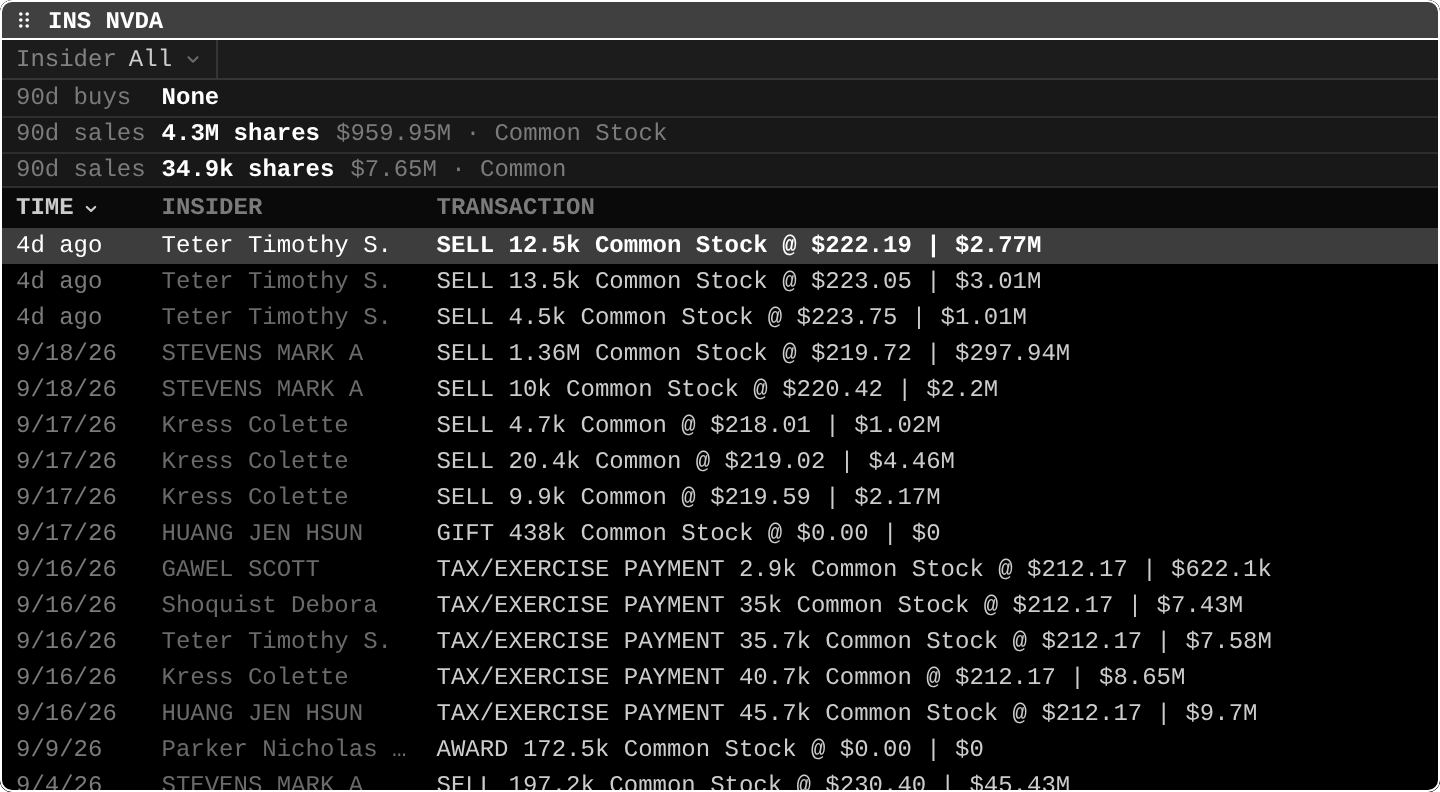
open ittype INS NVDA. Insider filter on top; f filters by insider (press it again to clear); Enter opens the filing.
90d buys None: no insider bought shares in the market over 90 days.90d sales 4.3M shares $959.95M: insiders sold about 960 million dollars of stock in 90 days. Large in dollars, small next to the company's 5-trillion market value.SELL 1.36M Common Stock @ $219.72 | $297.94M: one director's sale of 1.36 million shares.TAX/EXERCISE PAYMENT ... @ $212.17: several insiders on the same day (9/16/26): shares withheld for taxes as awards vested. Mechanical.GIFT 438k Common Stock @ $0.00: shares given away.AWARD 172.5k ... @ $0.00: shares granted as pay.
Practice and recap
Try it3 tasks
- In the screenshot, how many rows are open-market buys? (None: sales, tax payments, a gift and an award.)
- Why do several insiders have a tax payment on the same day at the same price? (Their awards vested that day; the company withheld shares at that day's price to cover tax.)
- Which would you weigh more: a CEO buying 2 million dollars of stock, or selling 20 million under a 10b5-1 plan? (The buy.)
Common mistakes4 mistakes
- Counting every sale as bearish. Most are routine.
- Missing the size relative to the insider's holdings: selling 1% of a stake is not selling out.
- Ignoring clusters: several insiders acting together says more than one.
- Forgetting that awards and tax rows are not decisions.
Check yourself3 questions
- Who counts as an insider for Form 4?
- How fast must a Form 4 be filed?
- What is a 10b5-1 plan?
Answers
- Officers, directors, and owners of more than 10% of the shares.
- Within two business days of the trade.
- A trading plan set in advance, so later sales follow a schedule rather than inside information.
Words in this lesson7 words
- insider
- An officer, director or owner of more than 10% of a company.
- Form 4
- The SEC filing an insider makes after trading the company's shares.
- open-market purchase
- Buying shares at the market price with one's own money.
- award (grant)
- Shares or options given as pay.
- vesting
- When granted shares become the employee's to keep.
- 10b5-1 plan
- A pre-arranged trading plan for insiders.
- cluster buying
- Several insiders buying around the same time.
Educational material about reading market data, not investment advice.