What a stock is
A share is a small slice of a company, so owning one means owning a tiny piece of everything the company has and earns.
- 6 min
- 3 questions
- Lesson 1 of 4
Why you would care
What exactly do you own when you buy NVDA? Someone at dinner says "I bought Nvidia". You nod. But what did they buy: a product, a loan, a promise? They bought a share. Every number on a terminal (price, market cap, dividend, earnings per share) comes back to that one idea. Get it right and the rest of the Academy is easy.
The idea from scratch
Imagine a pizza shop. It costs 100 dollars to start. You have 50, your friend has 50. You cut the ownership into 100 shares (equal slices of ownership) and each of you gets 50.
- A share is one slice. Stock is the general word for these slices ("Nvidia stock"), a share is one unit of it.
- A shareholder is anyone who holds at least one share. You and your friend are shareholders.
- A company that sells shares to the public, so that strangers can buy slices, is a public company. Its shares trade on an exchange (next lessons).
What a share gives you
- A claim on profits.If the shop earns 10 dollars this year, each of the 100 shares "owns" 10 cents of it. That is earnings per share (EPS): profit divided by the number of shares.
- Possibly cash.The company may send part of the profit to shareholders. That payment is a dividend. Many companies pay none and keep the money to grow.
- Usually, a vote.Shareholders vote on big decisions, like who sits on the board. Some companies issue more than one class of share, and some classes carry extra votes, fewer votes or none, so check before assuming.
- The right to sell your slice to someone else, at whatever price you both agree on.
Why the slice has a price
Nobody tells the price. The price is simply the last amount a buyer and a seller agreed on. If the shop is doing great, people will pay more for a slice. If it is failing, less.
Multiply price by the number of slices and you get the market capitalization (market cap): what all the shares are worth together at today's price. It is the value of the owners' part only. Someone buying the whole business would also take over its debts and keep its cash; chapter 04 adds those to get enterprise value.

See it in Gloom
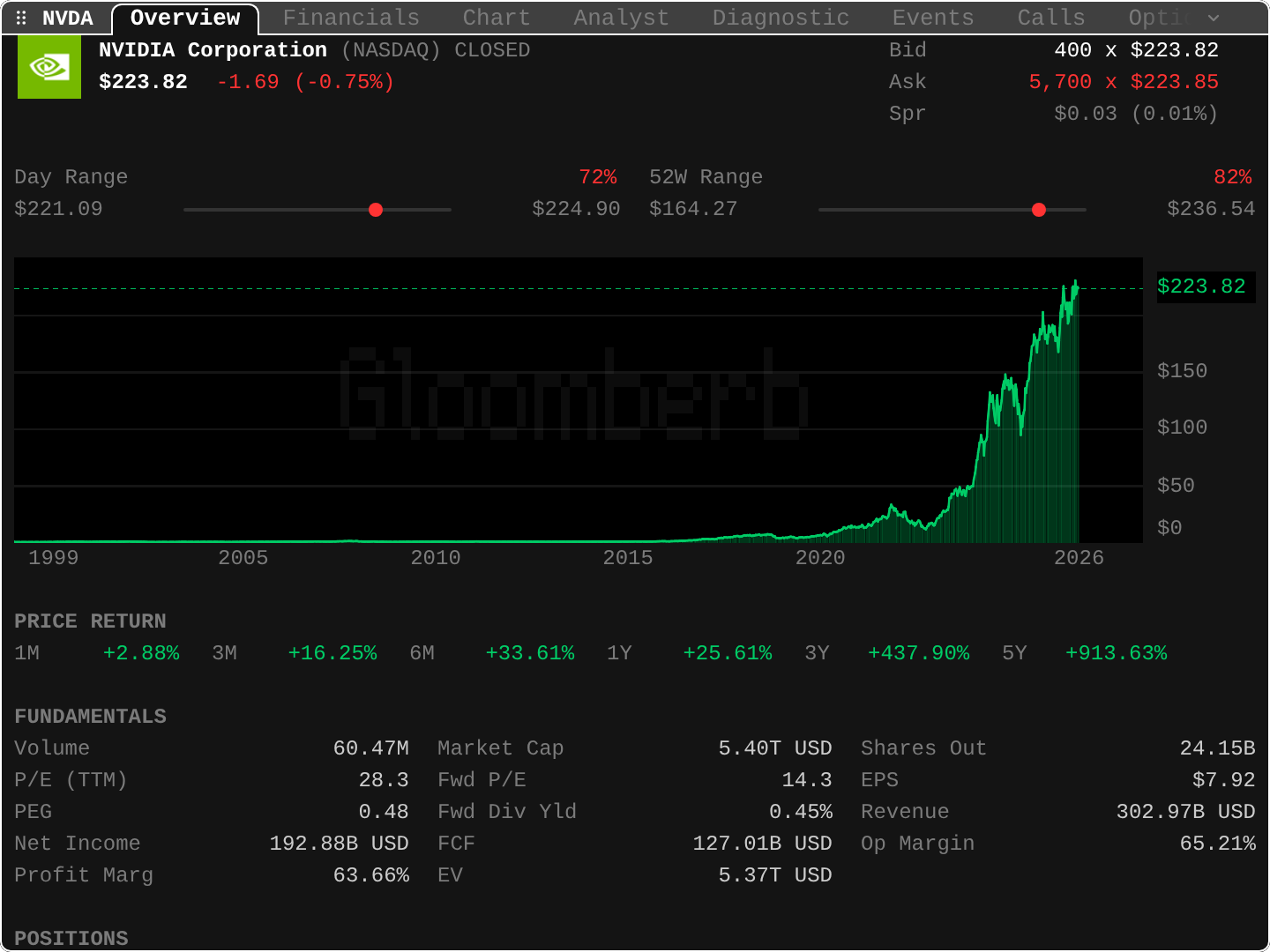
open ittype DES NVDA in the command bar. (DES is taught fully in The overview page (DES). Here we only read the "stock" numbers.)
- Top left:
$223.82is the price of one share at the time of the capture (historical example). Shares Out 24.15B: about 24.15 billion shares exist. B means billion.Market Cap 5.40T USD: 223.82 x 24.15 billion = about 5.4 trillion dollars. T means trillion. When the news says "Nvidia is worth 5.4 trillion", this is the number: the value of its shares.EPS $7.92: over the last year, the company earned about 7.92 dollars of profit for each share.Fwd Div Yld 0.45%: the expected dividend over the next year is about 0.45% of the price. Tiny: this company keeps most of its profit.
Practice and recap
Try it3 tasks
- With the screenshot above, check the multiplication: 223.82 x 24.15 billion. Is it close to 5.40 trillion? (Yes, about 5,405 billion.)
- Find the EPS. Divide the price by it: 223.82 / 7.92 = about 28. You just computed the P/E ratio ("price to earnings") shown as
P/E (TTM) 28.3. It is taught later; for now notice it is just price divided by profit per slice. - Imagine the company issued 24 billion more shares tomorrow without earning more. What happens to EPS? (It halves. Your slice got thinner.)
Common mistakes4 mistakes
- Comparing share prices between companies. 100 dollars vs 10 dollars tells you nothing; compare market caps.
- Thinking a dividend is "free money". On the ex-dividend day (the first day a new buyer no longer gets the payment), the price usually drops by about the dividend, because that cash is leaving the company.
- Confusing stock and bond. A stock is ownership (you share profits and losses). A bond is a loan (you are owed fixed payments). Bonds come later, in Bonds in one page.
- Assuming you can always sell at the last price. You sell at what the next buyer offers (Reading a quote).
Check yourself3 questions
- A company has 1,000 shares and the last trade was at 50 dollars. What is its market cap?
- Profit this year was 2,000 dollars. What is EPS?
- Your friend says "Company A at 3 dollars is cheaper than Company B at 300". What would you ask?
Answers
- 1,000 x 50 = 50,000 dollars.
- 2,000 / 1,000 = 2 dollars per share.
- "How many shares does each have?" Price per slice means nothing without the number of slices. Compare market caps (and later, profits).
Words in this lesson9 words
- stock
- The general word for ownership slices of a company.
- share
- One unit of stock, one slice.
- shareholder
- Someone who owns at least one share.
- public company
- A company whose shares anyone can buy on an exchange.
- earnings per share (EPS)
- Profit divided by the number of shares.
- dividend
- Cash a company pays to its shareholders out of profit.
- price
- The last amount a buyer and a seller agreed on.
- market capitalization (market cap)
- Price per share times the number of shares: the value of all the shares at today's price, before counting debt and cash.
- P/E ratio
- Price divided by earnings per share: how many dollars you pay for each dollar of yearly profit.
Educational material about reading market data, not investment advice.