Orders, long, short and margin
An order is your instruction to a broker, and long, short and margin say which way you bet and whether you borrowed to do it.
- 6 min
- 3 questions
- Lesson 1 of 3
Why you would care
What exactly happens when you press buy, and how can you lose more than you put in? A trader says "we're long NVDA, short AMD, on 2x margin". That is three ideas in one sentence. Once you know them, you can also spot the two classic traps: a stop order that sells far below its stop price, and a short that loses more than it ever made.
The idea from scratch
An order is an instruction
An order tells your broker (the firm that sends orders to the market for you) four things: which ticker, buy or sell, how many, and under what condition. The condition is the order type.
| Order type | What you say | Good | Risk |
|---|---|---|---|
| Market order | "Buy (or sell) now, at the best price available." | Almost always fills. | You get whatever the ask (or bid) is, worse if the market is thin. |
| Limit order | "Buy at 100 or less" (or "sell at 100 or more"). | You control the price. | It may never fill. |
| Stop order | "If the price falls to 90, sell at market." | Limits damage while you sleep. | The 90 is a trigger, not a promise. |
When an order meets an opposite order, a trade happens (also called a fill or an execution). A big order can fill in many small pieces.
Long: you own it
Being long means you own the asset and you make money if its price rises. Buy 1 share at 100, sell at 110: you made 10. Worst case, the price goes to 0 and you lose the 100 you paid. Never more.
Short: you borrowed it and sold it
Being short means you profit if the price falls. Like this:
- Borrow 1 share from someone (your broker arranges it, for a small fee).
- Sell it right away at 100. You hold 100 dollars of cash.
- Later, buy one share back and return it to the lender.
| Price when you buy back | You pay | Result |
|---|---|---|
| 80 | 80 | +20 profit |
| 100 | 100 | 0 |
| 250 | 250 | -150 loss |
Margin and leverage: borrowing to buy more
A margin account lets you borrow money from your broker to buy more than your cash allows. The shares you buy are the collateral: what the broker can sell if you do not pay back.
Leverage is the multiplier: how big your position is compared with your own money. Margin is the borrowing arrangement; leverage is its effect on your gains and losses.
The broker sets a minimum amount of your own money that must stay in the account. Drop below it and you get a margin call: add cash now, or the broker sells your shares for you, often at a bad moment.

See it in Gloom
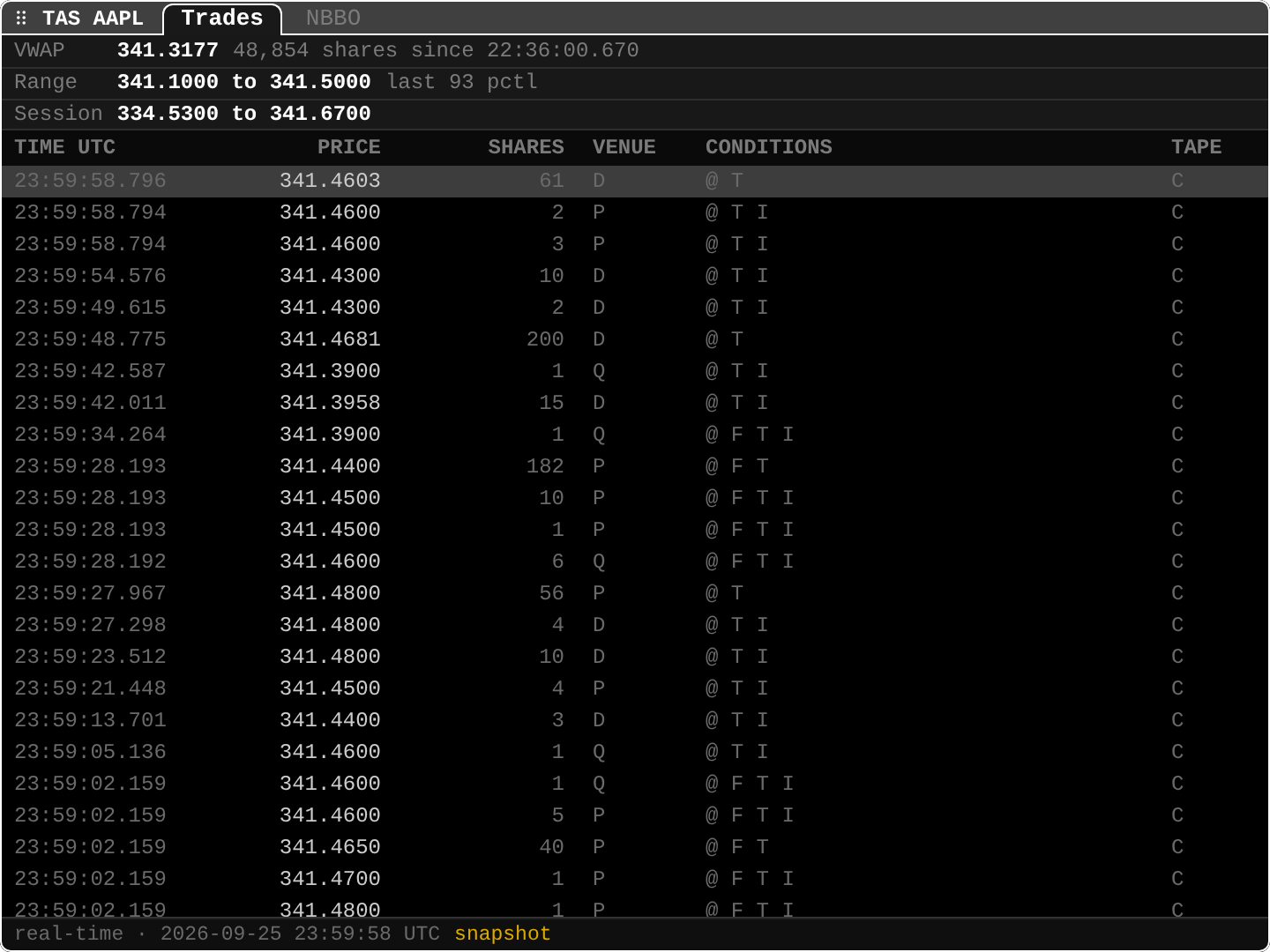
open ittype TAS AAPL in the command bar. (The tape is taught in chapter One company and its price.) Gloom is a research terminal: here you watch orders become trades.
TIME UTC: when each trade happened, to the millisecond, in UTC.PRICE: the price of that trade. Neighbouring trades differ by a cent or less.SHARES: how many shares changed hands, from 1 to 200 here. A large order is often split into many small fills like these.- Footer
real-time ... snapshot: how fresh the tape is. On the free plan the tape is about 15 minutes behind; on Pro it is real-time.
Practice and recap
Try it3 tasks
- Your limit order says "buy 100 shares at 341.40 or less". In the screenshot, would some recent trades have filled it? (Yes: a few trades printed at 341.39, which is below your limit.)
- You short 10 shares at 50. The price goes to 65. What is your loss? (10 x 15 = 150 dollars, plus fees.)
- You have 1,000 dollars, borrow 1,000 and buy 2,000 of stock. It falls 25%. What is left for you? (2,000 becomes 1,500; repay 1,000; you keep 500, a -50% loss.)
Common mistakes2 mistakes
- Using a market order in a thin stock or outside the regular session. You can be filled far from the last price.
- Mixing up margin and leverage. Margin is the loan setup; leverage is the magnifying glass.
Check yourself3 questions
- Which order type guarantees the price but not the fill?
- You are short 1 share sold at 40. It now trades at 100. What is your loss?
- With 3x leverage, the asset falls 10%. Roughly how much does your own money fall (before costs)?
Answers
- A limit order.
- 60 dollars (buy back at 100, you sold at 40), plus borrow fees. More than the 40 you received.
- About 30%.
Words in this lesson12 words
- order
- Your instruction to a broker: ticker, buy or sell, how many, under what condition.
- broker
- The firm that sends your orders to the market.
- market order
- Buy or sell now at the best available price.
- limit order
- Buy at or below, or sell at or above, a price you choose. May not fill.
- stop order
- Becomes a market order once the price touches your stop price.
- trade (fill, execution)
- What happens when two opposite orders meet.
- long
- You own the asset; you gain if the price rises.
- short
- You borrowed and sold the asset; you gain if the price falls.
- margin account
- An account where the broker lends you money against your holdings.
- collateral
- What you pledge so the lender can be repaid if you cannot pay.
- leverage
- Position size divided by your own money; it multiplies gains and losses.
- margin call
- The broker's demand for more cash when your own money in the account falls too low.
Educational material about reading market data, not investment advice.