The AI infrastructure map (TBO)
TBO opens a partner's research database on the physical build-out of AI and semiconductors: curated lists of companies by niche, physical sites, and dated research notes.
- 3 min
- 3 questions
- Lesson 7 of 8
Why you would care
Who supplies each layer of the AI build-out? The AI boom is also a construction boom: chip factories, packaging plants, data centers, power and cooling. Thousands of companies, many small and listed abroad, supply a narrow piece of it. A map organized by niche helps you find who else is exposed when one piece gets scarce or crowded.
The idea from scratch
Think of an AI data center as a stack of layers, each with its own suppliers:
| Layer | Examples of what companies make |
|---|---|
| Chips | Leading-edge logic foundries, custom AI silicon, memory (DRAM, HBM, NAND) |
| Packaging | Advanced packaging, substrates, assembly and test (OSAT) |
| Equipment | Lithography, etch, deposition, metrology, test and burn-in |
| Materials | Silicon wafers, critical minerals, bonding materials |
| Connectivity | Optical transceivers, co-packaged optics, fiber, switches |
| Sites | Fabs and data centers under construction |
A niche list groups the companies in one layer, often across many countries, with their combined market value.
Like all research databases, it reflects the publisher's choices: which companies, which niches, how fresh.

See it in Gloom
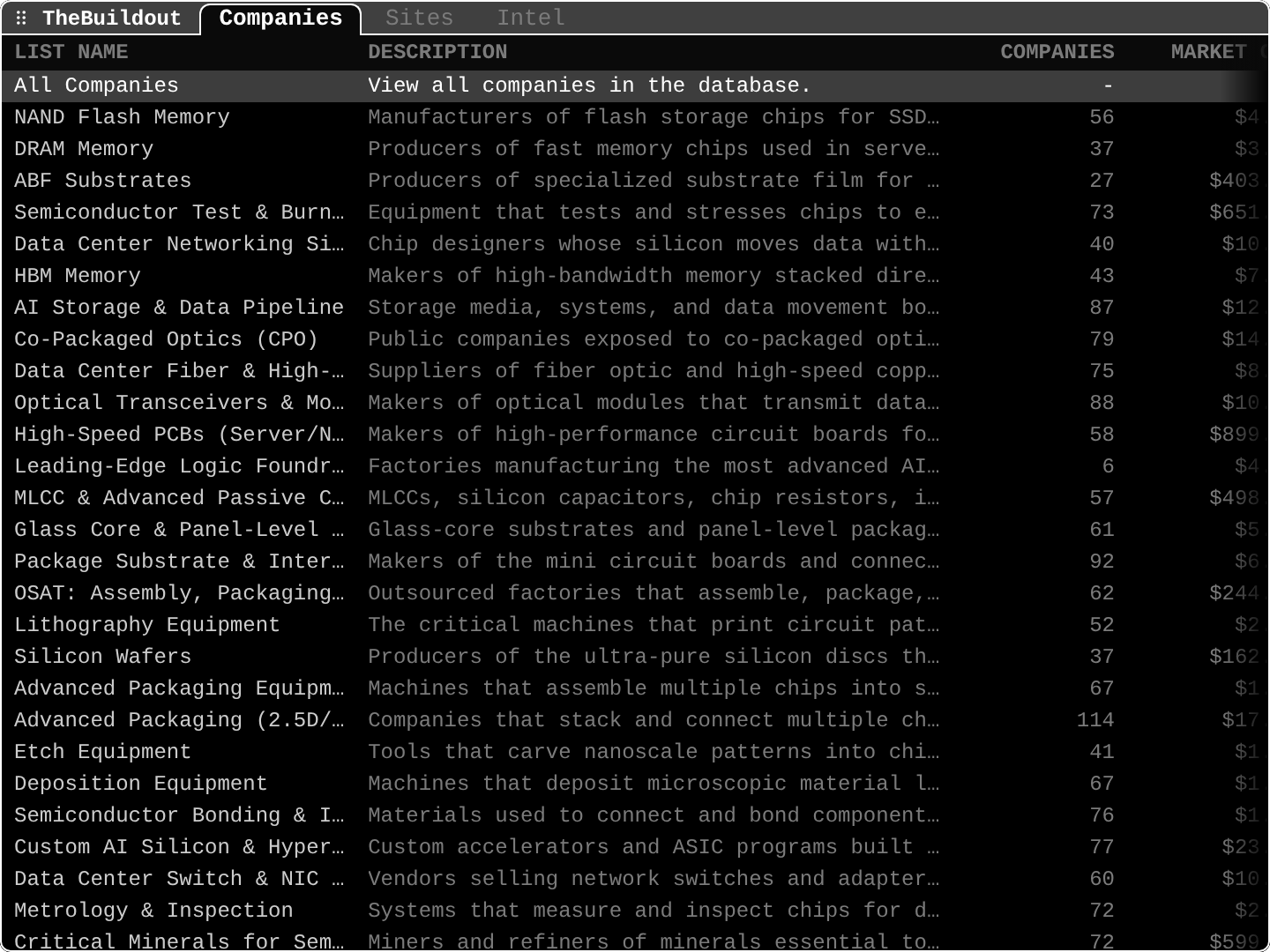
open ittype TBO. Tabs: Companies, Sites, Intel.
All Companies: the whole database.HBM Memory Makers of high-bandwidth memory... 43: a niche list with 43 companies.Leading-Edge Logic Foundr... 6: very few companies can make the most advanced chips.Advanced Packaging (2.5D/...) 114: a crowded niche.MARKET(cut off at the right edge): the combined market value of each list.Siteslists physical projects;Intellists dated research notes.
Practice and recap
Try it3 tasks
- Which niche in the screenshot has the fewest companies? (Leading-edge logic foundries, 6.)
- Why might a niche with few companies matter more in a shortage? (Fewer suppliers means more pricing power and more risk if one fails.)
- Name two layers an AI data center depends on besides chips. (Any two: packaging, equipment, materials, optics and networking, power.)
Common mistakes4 mistakes
- Treating membership of a list as a measure of exposure; some companies earn little from that niche.
- Forgetting the lists are curated, not exhaustive.
- Ignoring the delay on intelligence notes.
- Comparing combined market values across niches as if they measured the niche's revenue.
Check yourself3 questions
- What is a niche list?
- What is HBM?
- What do the Sites and Intel tabs show?
Answers
- A curated group of companies supplying one layer of the build-out.
- High-bandwidth memory: memory stacked next to AI chips for fast data access.
- Physical projects being built, and dated research notes.
Words in this lesson5 words
- build-out
- The construction of physical capacity: factories, data centers, power.
- foundry
- A factory that manufactures chips designed by others.
- HBM
- High-bandwidth memory used with AI chips.
- OSAT
- Outsourced semiconductor assembly and test.
- substrate
- The base layer a chip package is built on.
Educational material about reading market data, not investment advice.