Supply chains and scenario exposure (SPLC, EXPO)
SPLC maps a company's customers, suppliers, competitors and investees from filings, announcements and calls with evidence, and EXPO estimates a portfolio's exposure to a shock along those links.
- 4 min
- 3 questions
- Lesson 6 of 8
Why you would care
Who does this company depend on, and how exposed are your holdings? A chip shortage in one country, a big customer cutting orders, a tariff on one supplier: shocks travel along supply chains. Investors who knew a company's dependencies saw the hit coming. These panes turn scattered disclosures into a map, with the evidence behind every line.
The idea from scratch
Relationships
For a company, four kinds of links:
- Customer
- Buys from the company
- Supplier
- Sells to the company
- Competitor
- Sells to the same customers
- Investee
- A company it owns a stake in
US companies must disclose customers above 10% of revenue (chapter 03, lesson on RIPL), often without naming them ("Customer A"). Other links come from annual reports, announcements, calls and reporting, each with an evidence tier: filings first, then company statements and calls, then reported news, then unconfirmed leads (kept apart).
Direction matters: "NVDA says" lists what NVIDIA's own disclosures state; "Names NVDA" lists what others say about NVIDIA.
Exposure to a scenario
A scenario is a hypothetical shock (for example, all output from one country stops). Exposure estimates how much of each holding's revenue or supply depends on it, directly or through a chain of links (a hop is one step). Because disclosures are incomplete, the result is often a range and marked as incomplete.

See it in Gloom
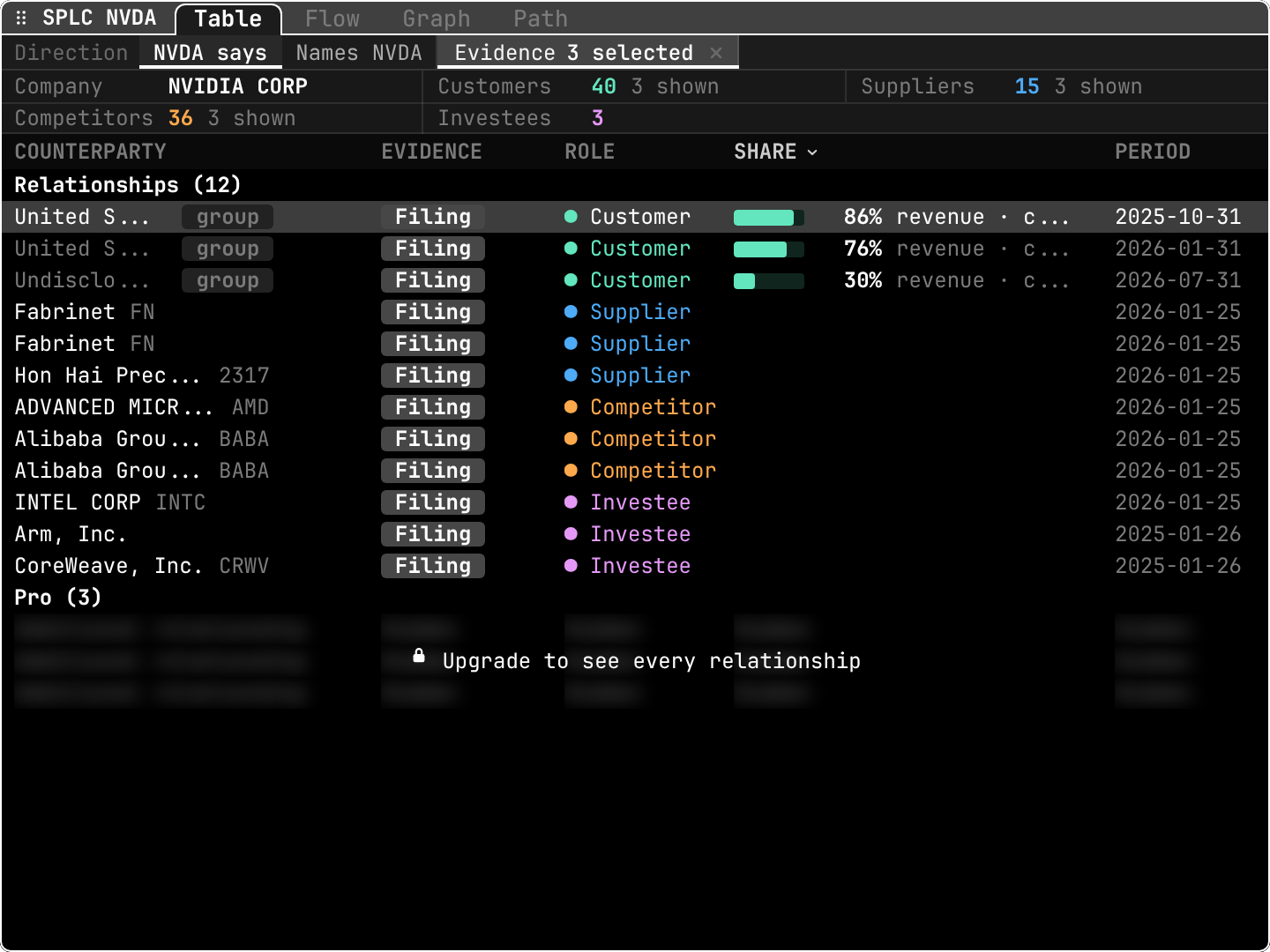
open themSPLC NVDA (tabs Table, Flow, Graph, Path); EXPO "NVDA=60% XOM=40%" or EXPO PORT:<portfolio>.
- Counts:
Customers 40,Suppliers 15,Competitors 36,Investees 3, with3 shownon the free plan. United S... group Filing Customer 86% revenue: an undisclosed customer group making up 86% of a segment's revenue (anonymous groups appear in muted text).Fabrinet FN Supplier,Hon Hai 2317 Supplier: named suppliers from filings.AMD,BABA: competitors named in filings;INTC,CRWV: investees.Names NVDA: switch direction to see what others' filings say about NVIDIA.
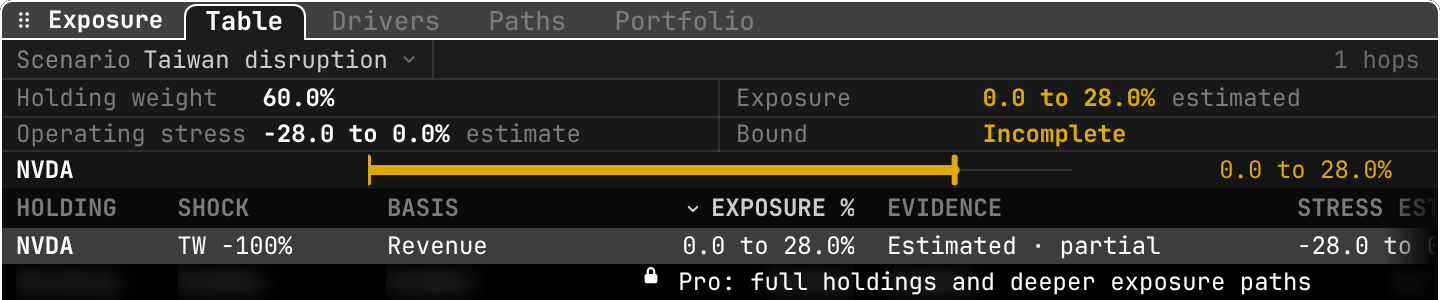
- EXPO:
Holding weight 60.0%,Exposure 0.0 to 28.0% estimated,Bound Incomplete: a wide range because evidence is partial.
Practice and recap
Try it3 tasks
- In SPLC, which evidence type supports every visible row? (Filing.)
- Why are some customers shown as "group"? (Companies often disclose customer concentration without naming the customer.)
- In EXPO, why is the exposure a range? (Disclosures do not say exactly how much revenue runs through the scenario, so the estimate has a low and a high bound.)
Common mistakes4 mistakes
- Treating an absent link as no exposure.
- Mixing up whose revenue a share refers to.
- Reading competitor links as certain overlaps of products.
- Treating exposure ranges as predictions of losses.
Check yourself3 questions
- Name the four relationship roles.
- What is a hop?
- What does "NVDA says" vs "Names NVDA" change?
Answers
- Customer, supplier, competitor, investee.
- One step along a chain of company links.
- Whose disclosures are read: NVIDIA's own, or other companies' statements naming NVIDIA.
Words in this lesson6 words
- supply chain
- The network of suppliers and customers around a company.
- investee
- A company another company owns a stake in.
- evidence tier
- How a link is supported: filing, company, call, reported, unconfirmed.
- hop
- One step along a chain of links.
- scenario
- A hypothetical shock used to test exposure.
- exposure
- How much of a holding depends on the shock.
Educational material about reading market data, not investment advice.