Central bank rates around the world (CBR)
CBR lists the policy rates of the G20 central banks with the current level, the last move and its date, and where each rate sits in its past year.
- 4 min
- 3 questions
- Lesson 3 of 6
Why you would care
Who is raising, who is cutting, and where is money expensive? Money flows toward higher rates, and currencies follow. When the US hikes while Japan holds, the dollar tends to strengthen against the yen; carry traders borrow where rates are low and invest where they are high. One table shows the whole world's monetary policy at a glance.
The idea from scratch
Each country (or currency area) has a central bank that sets a policy rate: the short-term interest rate that anchors all others (chapter 01, The macro machine). Names differ:
- the US Federal Reserve sets a target range for the fed funds rate,
- the European Central Bank's key rate here is the deposit facility rate,
- others set a single policy rate (Bank of England Bank Rate, Bank of Japan's short-term rate...).
What to read:
Level
how expensive money is.
Last move
the size and direction of the last change, usually in steps of 25 bp.
Direction over time
a hiking cycle (raising to fight inflation) or a cutting cycle (lowering to support growth).
The rate differential between two countries is a big driver of their exchange rate.

See it in Gloom
open ittype CBR. It also sits in the Rates and FX & macro desks.
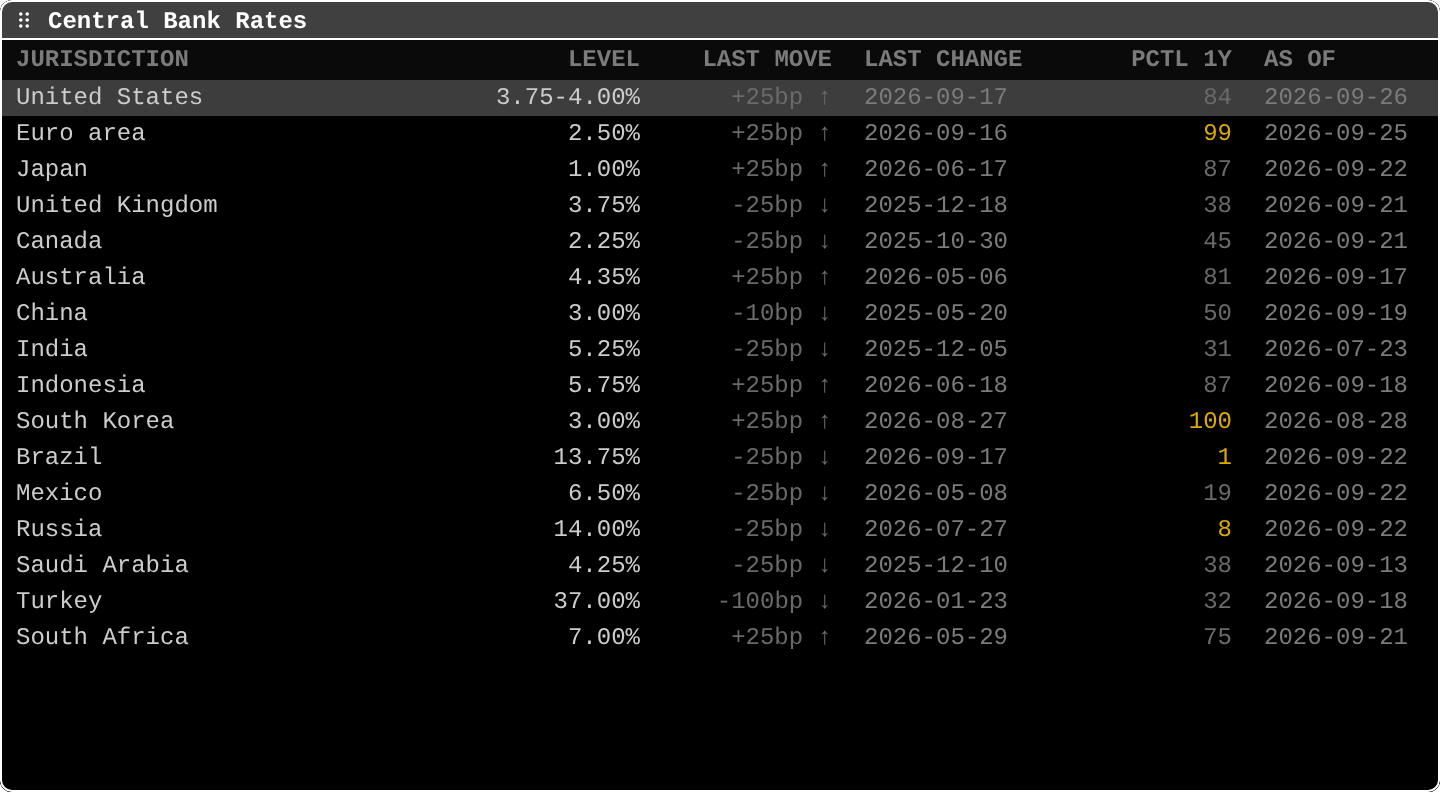
United States 3.75-4.00% +25bp ↑ 2026-09-17: the Fed's target range, last raised by 25 bp.Euro area 2.50% +25bp ↑ PCTL 1Y 99: the ECB's rate at the top of its past year.Japan 1.00% +25bp ↑: low, but rising.Turkey 37.00% -100bp ↓: very high rates against high inflation, being cut.Brazil 13.75% PCTL 1Y 1: at the lowest of its past year after cuts.AS OF: each bank's latest observation; some lag by days or weeks.
Practice and recap
Try it3 tasks
- Which central banks raised rates most recently in the screenshot? (US on 2026-09-17, Euro area on 2026-09-16.)
- Rate differential between the US (midpoint 3.875%) and Japan? (About 2.9 points.)
- Which countries are in a cutting cycle by their last move? (UK, Canada, China, India, Brazil, Mexico, Russia, Saudi Arabia, Turkey.)
Common mistakes4 mistakes
- Comparing nominal rates without inflation: 37% in a country with 40% inflation is a negative real rate.
- Treating the last move as the next move.
- Ignoring that the US figure is a range, not one number.
- Forgetting publication lags.
Check yourself3 questions
- What is a policy rate?
- What is a hiking cycle?
- Why do rate differentials matter for currencies?
Answers
- The short-term interest rate a central bank sets, which anchors other rates.
- A period of repeated rate increases, usually to fight inflation.
- Money moves toward higher returns, so a widening differential tends to support the higher-rate currency.
Words in this lesson5 words
- policy rate
- The rate a central bank sets.
- deposit facility rate
- The ECB's rate on banks' overnight deposits.
- hiking / cutting cycle
- A series of rate increases / decreases.
- rate differential
- The gap between two countries' rates.
- carry trade
- Borrowing in a low-rate currency to invest in a high-rate one.
Educational material about reading market data, not investment advice.