The macro machine
"Macro" is the economy as a whole (output, inflation and jobs) plus the interest rate the central bank sets to steer them, and it is why one number can move every market at once.
- 6 min
- 3 questions
- Lesson 3 of 3
Why you would care
Why does one inflation number move every market at 8:30 am? On some mornings everything moves at once: stocks, bonds, the dollar, gold. Usually a government statistic just came out, or a central bank spoke. Macro is the weather every company lives in. You do not need to forecast it, but you need to know which gauges people watch and why.
The idea from scratch
Think of the economy as a big machine with three gauges and one lever.
The three gauges
GDP (gross domestic product)
the value of everything a country produces in a period. Growing GDP means a growing economy. Two quarters in a row of shrinking GDP is a common rule of thumb for a recession.
Inflation
how fast prices rise on average. The best-known measure in the US is the CPI (consumer price index), a basket of what households buy, priced every month. 3% inflation means the basket costs 3% more than a year ago.
Jobs
how many people work. The unemployment rate is the share of people who want a job and do not have one. The monthly US jobs report also counts how many jobs were added.
The lever: the central bank's rate
A central bank manages a country's money. In the US it is the Federal Reserve (the Fed). Its main tool is a short-term interest rate, the policy rate: the price of borrowing money overnight between banks. Every other rate builds on it.
The Fed's job, set by law, is maximum employment and stable prices. It aims for 2% inflation.

- Inflation too high: the bank raises rates to cool things down.
- Economy too weak: the bank cuts rates to encourage borrowing.
Why markets care so much
Interest rates touch every price:
Bonds
when rates rise, existing bond prices fall (Bonds in one page).
Stocks
a dollar of profit in ten years is worth less today when rates are high, because safe bonds pay well in the meantime. Fast-growing companies, whose profits are far in the future, are hit hardest.
Currencies
higher rates often attract money from abroad, pushing the currency up. The exchange rate between two currencies is called FX (foreign exchange).
Commodities
oil and metals follow growth, and gold often moves with real interest rates and fear.
So a surprise in one inflation number changes what traders expect the Fed to do, which changes rates, which changes everything else. Again, it is the surprise versus the forecast that moves prices (How information reaches prices).
See it in Gloom
open ittype CPI. (Taught in Inflation, chapter 09.)
- Top line:
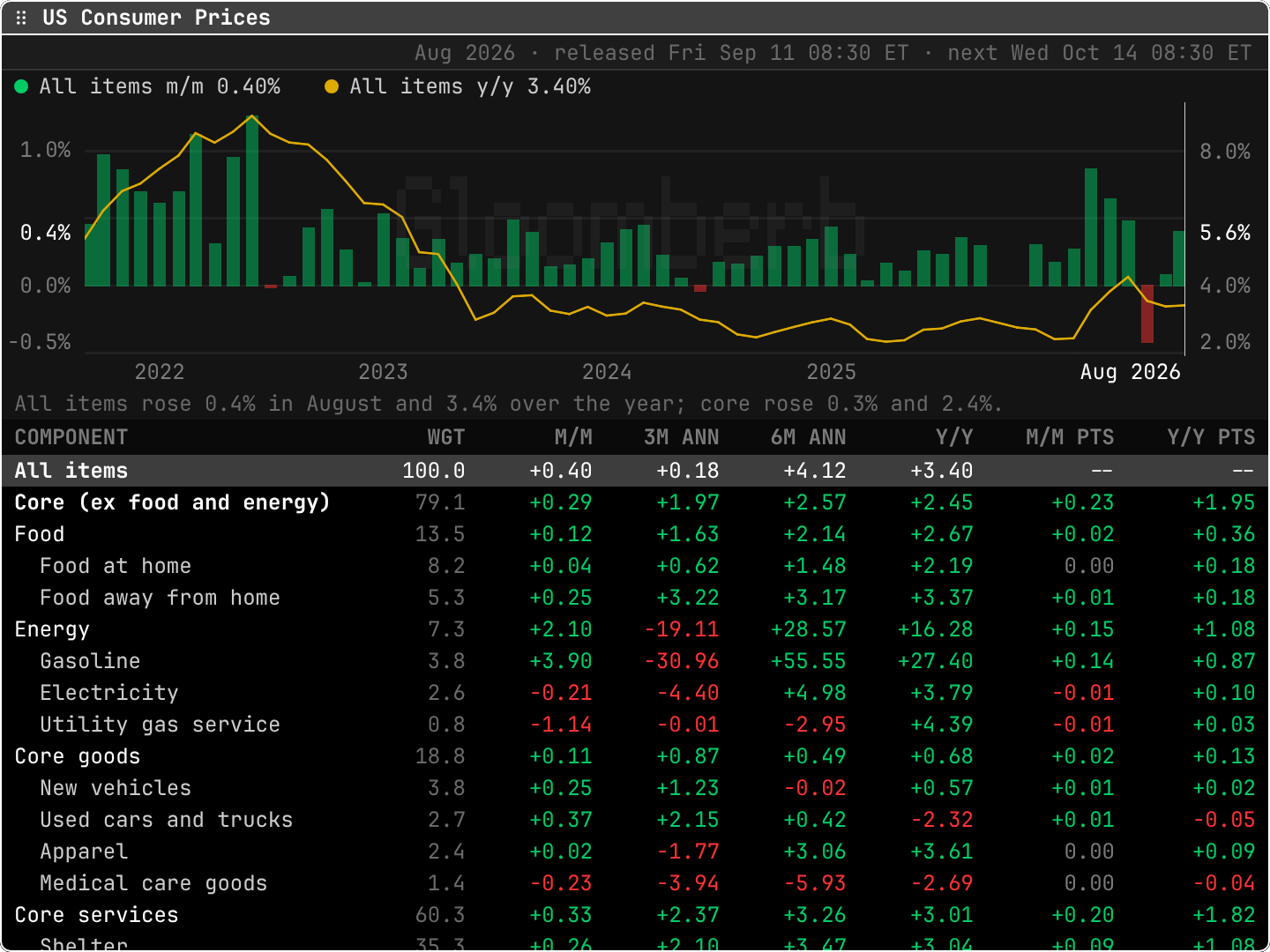
Aug 2026 · released Fri Sep 11 08:30 ET · next Wed Oct 14 08:30 ET. The month measured, when it came out, and when the next one comes. Releases are scheduled weeks ahead. All items m/m 0.40%andy/y 3.40%: prices rose 0.4% in one month (m/m, month over month) and 3.4% over a year (y/y, year over year).- The yellow line: yearly inflation over time. It peaked in 2022, fell, and rose again in 2026.
Core (ex food and energy): inflation without the two most jumpy parts. Central banks watch it because it shows the trend better.WGT: each part's weight in the basket. Shelter (housing) is about 35%; food about 13.5%.
Practice and recap
Try it3 tasks
- Is yearly inflation in the screenshot above or below a 2% target? (Above: 3.4%.)
- Which part had the biggest yearly rise? (Gasoline, +27.40%.)
- Core rose 2.45% over the year and all items 3.40%. What pushed all items above core? (Energy, mostly gasoline.)
Common mistakes4 mistakes
- Confusing m/m and y/y. 0.4% in one month is about 5% if it continued for a year.
- Thinking the central bank sets all interest rates. It sets a short-term one; markets set the rest.
- Reading a single month as a trend. Monthly data is noisy; look at several months.
- Forgetting the forecast. "Inflation is 3%" means little without "and 2.8% was expected".
Check yourself3 questions
- Inflation is well above target. What does the central bank usually do?
- Why do higher rates hurt fast-growing companies' stocks most?
- What does "core" inflation leave out, and why?
Answers
- It raises rates (or keeps them high) to slow spending and cool prices.
- Their profits are mostly far in the future, and future money is worth less today when rates are high.
- Food and energy, because they swing a lot and hide the underlying trend.
Words in this lesson12 words
- macro
- The economy as a whole.
- GDP
- The value of everything a country produces in a period.
- recession
- A broad fall in economic activity; rule of thumb: two quarters of shrinking GDP.
- inflation
- The average rise in prices over time.
- CPI
- The consumer price index: a monthly price of a typical household basket.
- core inflation
- Inflation without food and energy.
- m/m, y/y
- Change over one month / over one year.
- unemployment rate
- The share of people who want a job and do not have one.
- central bank
- The public institution that manages a country's money and sets its policy rate.
- Federal Reserve (Fed)
- The US central bank.
- policy rate
- The short-term interest rate the central bank sets.
- FX (foreign exchange)
- Currencies and the rates between them.
Educational material about reading market data, not investment advice.