The Greeks in plain words (OVME)
The Greeks say how an option's price reacts when the stock moves (delta, gamma), when time passes (theta) or when expected swings change (vega), and OVME computes them for any option you describe.
- 6 min
- 3 questions
- Lesson 3 of 5
Why you would care
You bought a call for $3. The stock went up $1 and your call only gained 53 cents. The next day nothing moved and you lost 5 cents. Neither is a bug: the Greeks predicted both. Traders talk in Greeks all day ("I'm long delta", "short gamma"), so you need the four basic ones.
The idea from scratch
An option's price depends on a few inputs: the stock price, the strike, the days left, interest rates and how much the stock is expected to swing (its volatility, next lesson). A Greek is just "how much the price moves when one input moves a little, the others held still".
All examples below use one call (illustrative numbers): stock $100, strike $100, 30 days, volatility 25%, rate 4%. Its price is $3.02 per share.
| Greek | Question it answers | Our call | Read it as |
|---|---|---|---|
| Delta | Stock +$1, option moves how much? | +0.53 | The call gains about 53 cents |
| Gamma | Stock +$1, delta moves how much? | 0.055 | Delta goes from 0.53 to about 0.59 |
| Theta | One day passes, option moves how much? | -0.053 | The call loses about 5 cents a day |
| Vega | Volatility +1 point, option moves how much? | +0.114 | At 26% vol the call is worth about $3.13 |
Delta: the speed
Delta runs from 0 to 1 for a call and from 0 to -1 for a put (a put gains when the stock falls). At the money it sits near 0.5. Deep in the money it nears 1: the option moves like the stock. Far out of the money it nears 0.
Traders also use delta as a rough chance that the option ends in the money. A 0.25-delta call is "about a 1 in 4 shot".
Gamma: the acceleration
Delta is not fixed. As the stock rises, a call's delta rises too, so each extra dollar pays more than the last. Gamma measures that change. It is largest at the money and near expiry, where the option flips fast between "worth something" and "worth nothing".
Theta: the rent
Time value melts every day (see Value and payoff). Theta is the daily melt. Option buyers pay it, option sellers collect it. It speeds up in the last weeks.
Vega: the fear dial
When the market expects bigger swings, every option gets more expensive, calls and puts alike. Vega says by how much per 1 point of volatility (25% to 26%).
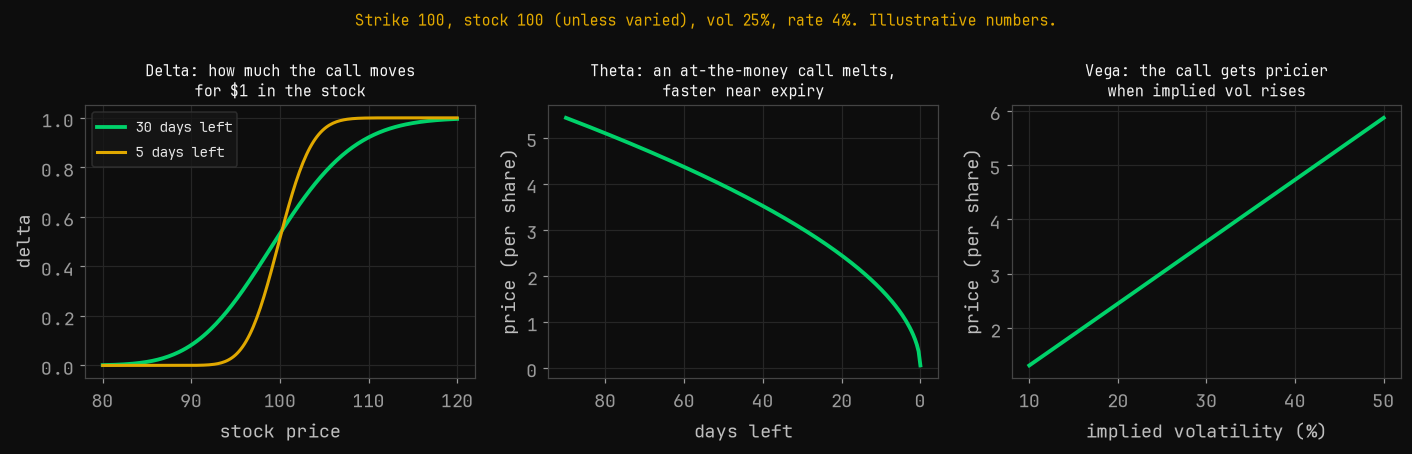
Left: delta rises from 0 to 1 as the stock passes the strike, and steeper with 5 days left (that steepness is gamma). Middle: the call loses value as days pass, faster at the end (theta). Right: a higher volatility makes the call dearer (vega).
Go deeper: rho, and what the price model is
Rho is the fifth Greek: the change for a 1 point rise in interest rates. It matters little for short options.
The price itself comes from a formula. Black-Scholes (European exercise) is the classic one. For American options a binomial tree (CRR) walks the price up and down in small steps and checks at each step whether exercising early is worth it.
See it in Gloom
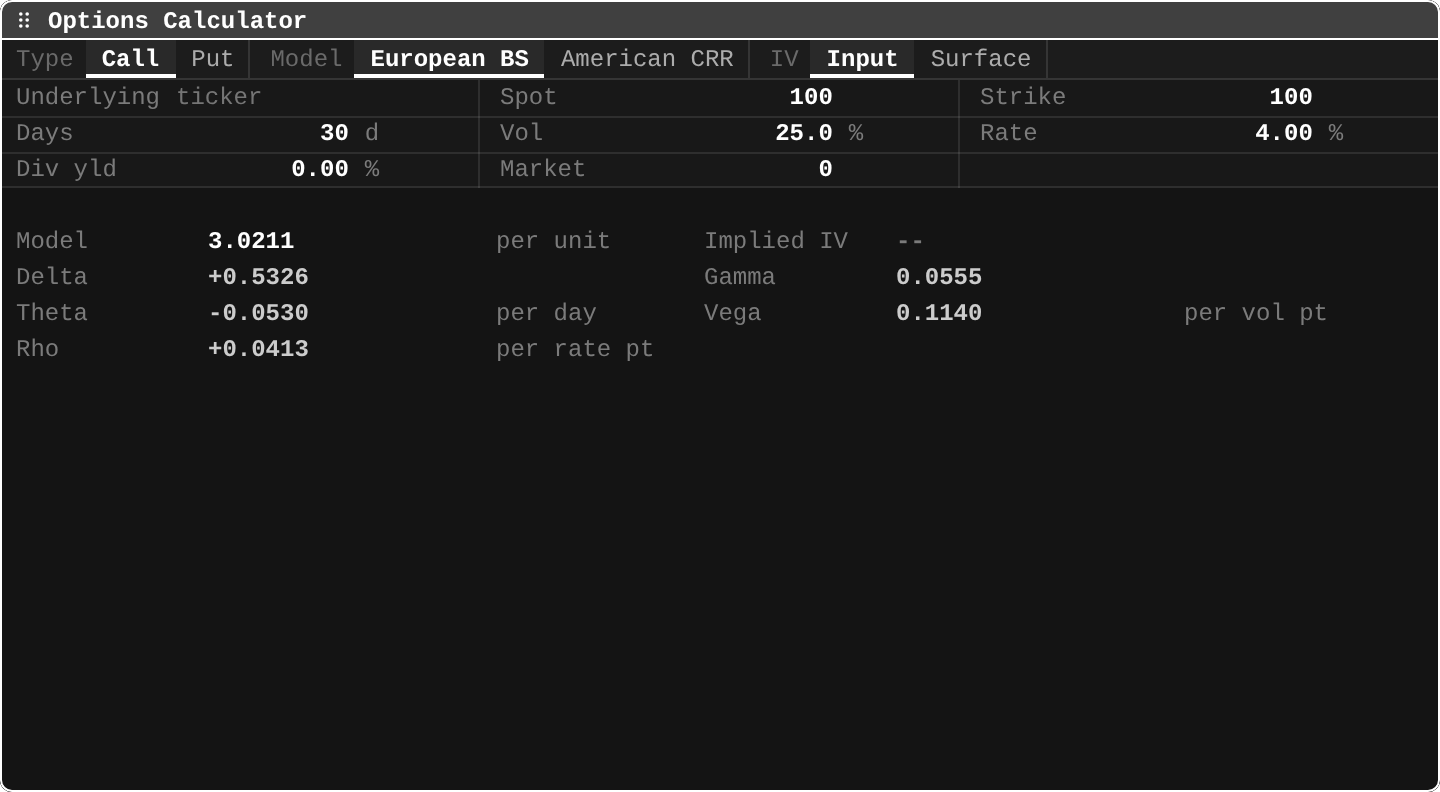
Look at the bottom block: the same call as above, with price 3.0211 and the four Greeks, each with its unit beside it.
open ittype OVME in the command bar. It opens an empty calculator; you type the inputs.
- Top tabs.
Typepicks Call or Put.Modelpicks European BS (Black-Scholes) or American CRR.IVpicks where volatility comes from: what you type (Input) or the stock's fitted volatility surface (Surface). - Inputs. Spot (stock price), Strike, Days, Vol, Rate, Div yld (dividend yield). Here: 100, 100, 30 days, 25%, 4%, 0%.
- Model. 3.0211 "per unit": the price of the option for one share. One contract is 100 times that, about $302.
- The Greeks. Delta +0.5326, Gamma 0.0555, Theta -0.0530 "per day", Vega 0.1140 "per vol pt", Rho +0.0413 "per rate pt".
- Market and Implied IV. Type a real option price in Market and the calculator works the volatility backwards. Here Market is 0, so Implied IV shows
--.
Keys from the help card: e edit a field, m switch model, v switch the volatility source, t set the underlying ticker. Data: about 15 minutes behind on the free plan, real-time on Pro (when you pull volatility from a ticker's surface). In OMON (the chain) the c key opens the calculator on the contract you selected.
Practice and recap
Try it3 tasks
- With the screenshot, predict the call's price if the stock jumps to $101. (About 3.02 + 0.53 = 3.55. The exact answer is 3.58: gamma adds a little.)
- Predict the price tomorrow if nothing moves. (3.02 - 0.05 = about 2.97.)
- Predict the price if volatility rises from 25% to 30%. (3.02 + 5 x 0.114 = about 3.59.)
Common mistakes4 mistakes
- Reading delta as dollars per contract. It is per share: x100 for one contract (0.53 delta is about $53 per $1 move).
- Forgetting gamma. Delta is a speed at this instant, not for the whole trip.
- Thinking theta is steady. It speeds up near expiry, mostly for at-the-money options.
- Forgetting vega. An option can lose money when the stock moves your way, if volatility falls at the same time (common right after earnings).
Check yourself3 questions
- A put has delta -0.40. The stock rises $2. Roughly what happens to the put?
- Which option has more gamma: at the money with 3 days left, or deep out of the money with 3 months left?
- You own an option with theta -0.08 and vega 0.20. One quiet day passes and volatility rises 1 point. Net change?
Answers
- It loses about 2 x 0.40 = $0.80 per share.
- At the money with 3 days left.
- -0.08 + 0.20 = about +$0.12 per share.
Words in this lesson8 words
- Greeks
- Numbers that say how an option's price reacts to one input
- delta
- Price change for a $1 move in the stock
- gamma
- Change in delta for a $1 move in the stock
- theta
- Price change for one day passing
- vega
- Price change for a 1 point rise in volatility
- rho
- Price change for a 1 point rise in interest rates
- Black-Scholes
- The classic formula for pricing a European option
- binomial tree (CRR)
- A step-by-step pricing method that handles early exercise
Educational material about reading market data, not investment advice.