Red and green flags (DIAG)
DIAG turns a company's filings and numbers into a short verdict and lists of red flags, green flags and items to watch, each with the fact, a reading and its source filing.
- 5 min
- 3 questions
- Lesson 3 of 5
Why you would care
What should worry you, or reassure you, about this company? A 10-K is often more than 100 pages. The warning signs hide in footnotes: a big guarantee, a customer that pays slower and slower, profits that never turn into cash. Analysts call this forensic accounting: reading the numbers for trouble.
DIAGgives you a first pass and points you to the page.
The idea from scratch
A red flag is a fact that could signal a problem. A green flag is a fact that signals strength. Neither is a verdict on its own.
Classic red flags, in plain words:
| Red flag | Why it worries analysts |
|---|---|
| Receivables growing much faster than sales | Customers are paying later, or sales are being pulled forward |
| Profit up, operating cash flow flat or down | Profit that does not become cash may not be real |
| Inventory piling up | Products may not be selling |
| Lots of new shares issued | Each existing share owns less (dilution) |
| A change of auditor, a late filing, a restatement | The books may need fixing |
| Big guarantees or off-balance-sheet obligations | Hidden debts that appear only if something goes wrong |
| Large one-off gains in profit | The "beat" may not repeat |
Green flags: strong cash generation, falling debt, steady margins, profits consistently above cash costs, shareholder returns paid from cash flow.
How DIAG builds its read
DIAG is generated automatically by a language model that reads the latest filings and statement numbers. Each item has:
- Observed: the fact, with numbers.
- Reading: what it may mean.
- a confidence score and the source (a 10-Q, an 8-K, a statement), which you can open.

See it in Gloom
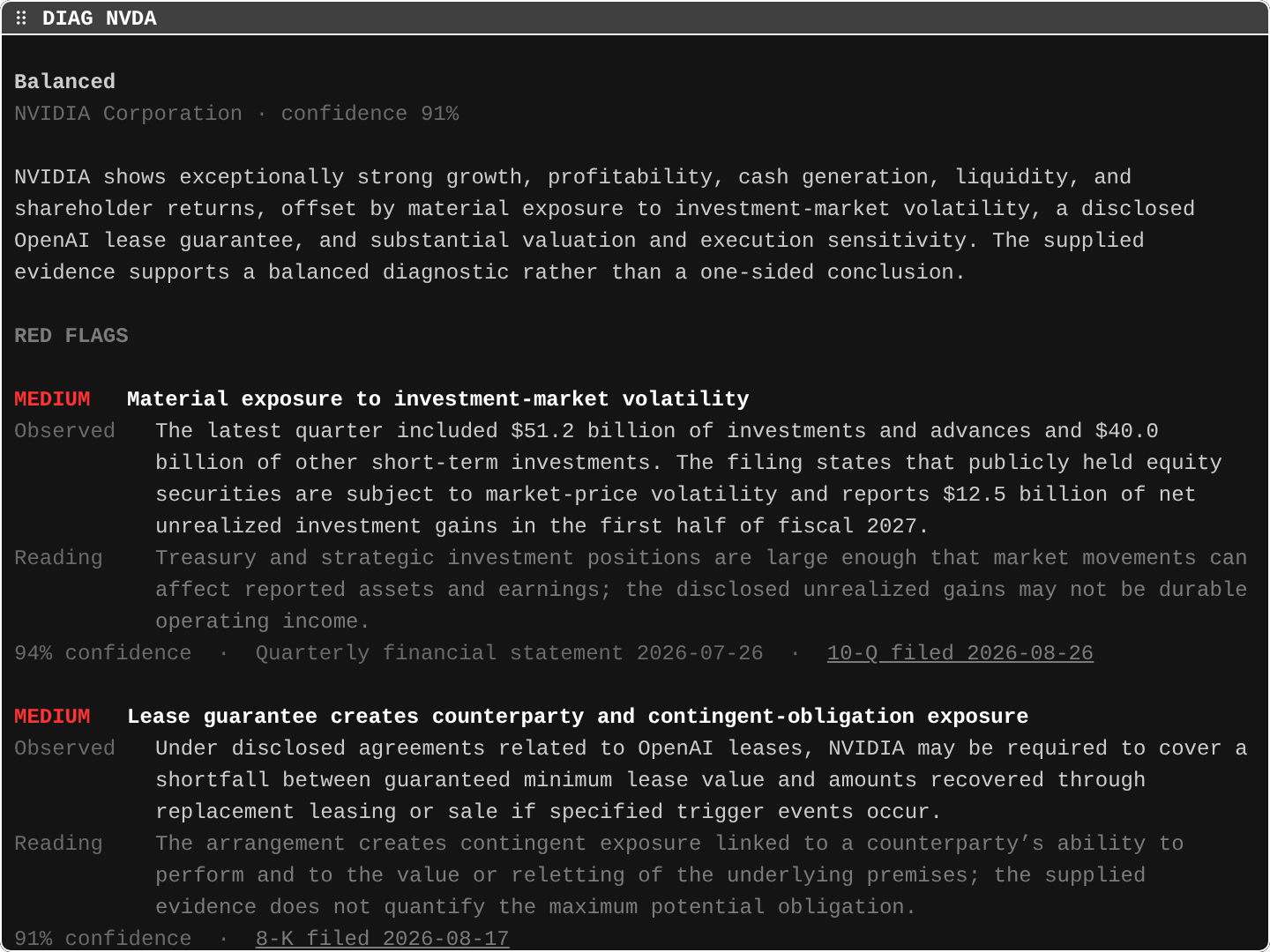
open ittype DIAG NVDA. o opens the source of the selected item.
Balanced NVIDIA Corporation · confidence 91%: the overall verdict and how confident the read is.- The summary paragraph: strengths (growth, profitability, cash) against risks (investment volatility, a lease guarantee, valuation).
RED FLAGS,MEDIUM Material exposure to investment-market volatility: severity and title.Observed: 51.2 billion of investments and advances, 12.5 billion of unrealized gains.Reading: those gains may not be durable operating income.94% confidence · Quarterly financial statement 2026-07-26 · 10-Q filed 2026-08-26: where it came from, with a link.- Second flag: a lease guarantee from an 8-K, whose maximum cost the filing does not quantify.
Practice and recap
Try it3 tasks
- In the screenshot, which flag comes from an 8-K, and what is an 8-K? (The lease guarantee; an 8-K is a notice of an important event.)
- Why might "unrealized investment gains" be flagged even in a strong company? (They are paper gains that can reverse; they are not profit from selling products.)
- Take Lemonade Co. from The three financial statements: net income 180, operating cash flow 210. Red or green flag? (Green: cash is above profit.)
Common mistakes4 mistakes
- Reading one red flag as "sell". Every company has some; severity and trend matter.
- Skipping the source. The filing often explains the context.
- Trusting the confidence score as a probability of being right.
- Ignoring green flags. Balance is the point.
Check yourself3 questions
- Name two classic red flags.
- What is dilution?
- What three parts does each DIAG item show?
Answers
- Any two: receivables outrunning sales, profit without cash, inventory build-up, heavy share issuance, auditor change or restatement, hidden guarantees, one-off gains.
- New shares being issued, so each existing share owns a smaller part of the company.
- What was observed, a reading of what it may mean, and its source with a confidence score.
Words in this lesson7 words
- red flag / green flag
- A fact that may signal a problem / strength.
- forensic accounting
- Reading financial statements for warning signs.
- receivables
- Money customers owe for sales already made.
- dilution
- Each share owning less because new shares were issued.
- restatement
- A company correcting financial statements it already published.
- unrealized gain
- A paper gain on something not yet sold.
- guarantee (contingent obligation)
- A promise to pay if something goes wrong; a hidden potential debt.
Educational material about reading market data, not investment advice.