Futures from zero (FUT)
A futures contract is a standard, exchange-traded promise to buy or sell a set quantity on a set month at a price agreed today, settled with daily margin, and FUT shows the front months across markets.
- 4 min
- 3 questions
- Lesson 1 of 7
Why you would care
What is the market paying today for delivery later? Oil, gold, corn and even the S&P 500 trade around the clock as futures. When someone says "oil is at 93", they almost always mean a futures price. Futures are also how desks hedge and how big investors move exposure fast and cheaply.
The idea from scratch
A futures contract fixes four things (chapter 01, Derivatives in one page has the farmer and the cereal maker):
What
the underlying (WTI crude oil, gold, the S&P 500 index...).
How much
the contract size. One crude oil contract is 1,000 barrels; one gold contract 100 troy ounces; one E-mini S&P 500 contract is 50 dollars times the index.
When
the contract month (the month it ends). The nearest active one is the front month.
How it ends
physical delivery (oil, grain actually change hands) or cash settlement (index futures pay the difference in cash).
Daily margin: mark to market
Both sides post initial margin, a deposit. Every day the exchange's clearing house compares the contract with the new settlement price and moves cash: winners receive, losers pay. This is marking to market. If your account falls below the maintenance margin, you get a margin call.
Price units
Each contract has its own quote convention: dollars per barrel (oil), dollars per ounce (gold), index points (ES), cents per bushel (corn, written like 519.75c), price per 100 of face value (Treasury note futures). The smallest price step is the tick.

See it in Gloom
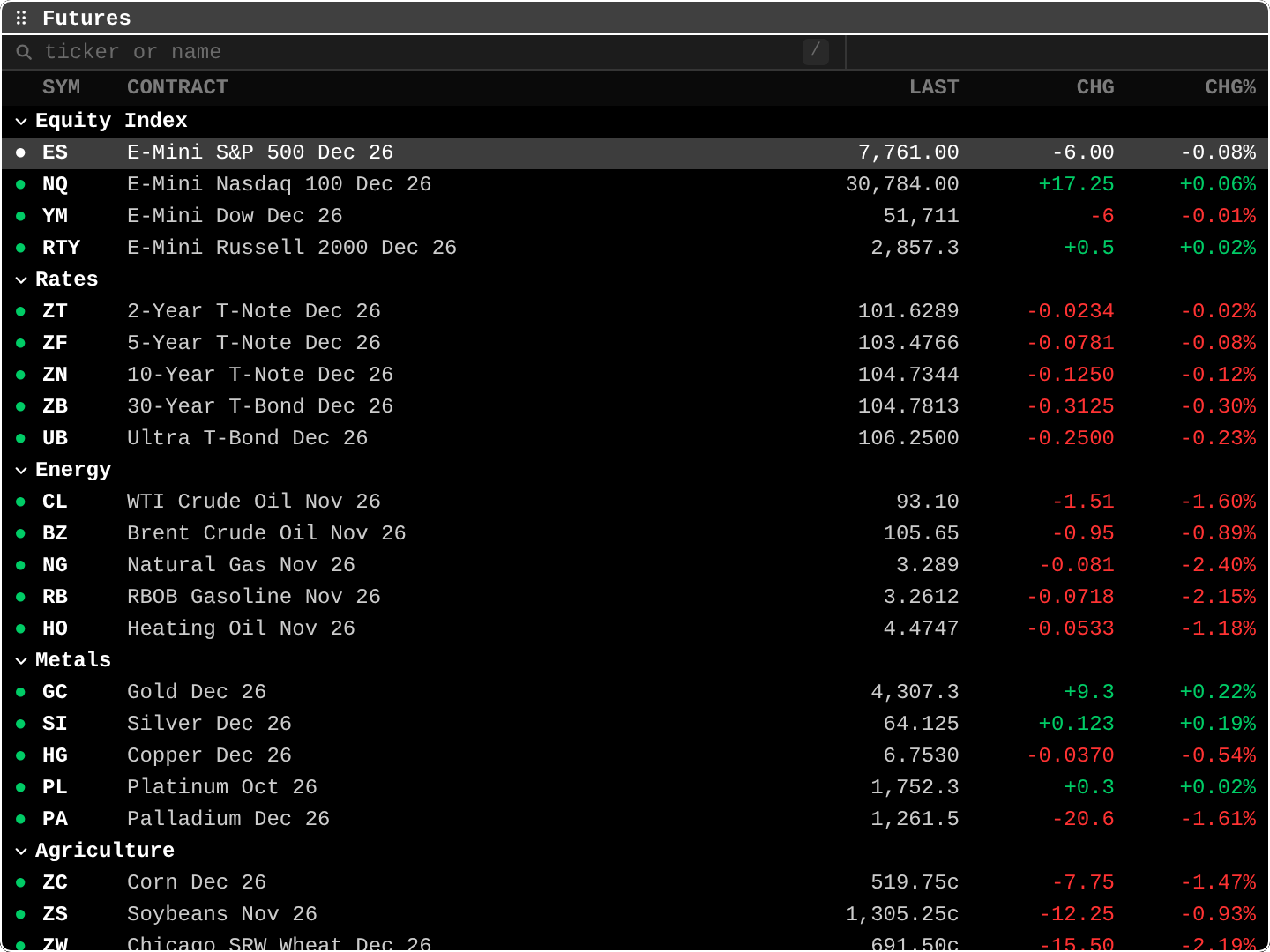
open ittype FUT. / searches; Enter opens a contract. The futures desk (DESK futures) puts it next to a crude oil chart, the curve and positioning.
ES E-Mini S&P 500 Dec 26 7,761.00 -6.00: index points; one contract is worth 50 x 7,761 ≈ 388,000 dollars.ZN 10-Year T-Note Dec 26 104.7344: a bond future, quoted as a price; it falls when yields rise.CL WTI Crude Oil Nov 26 93.10 -1.51 -1.60%: dollars per barrel; oil runs a contract every month.NG Natural Gas Nov 26 3.289: dollars per million British thermal units (MMBtu).GC Gold Dec 26 4,307.3: dollars per troy ounce.ZC Corn Dec 26 519.75c: cents per bushel, so 5.1975 dollars.
Practice and recap
Try it3 tasks
- One gold contract is 100 ounces. Gold rises 9.3 dollars. Gain per contract? (930 dollars.)
- Corn at 519.75c: price in dollars per bushel? (5.1975.)
- Why is the S&P 500 future quoted in index points while oil is in dollars? (Each contract has its own quote convention and multiplier.)
Common mistakes4 mistakes
- Forgetting the contract size: a 1-dollar move in oil is 1,000 dollars per contract.
- Reading a futures price as today's spot price.
- Forgetting physical delivery: holding an oil contract into its last days is not for individuals.
- Ignoring daily margin calls on losing positions.
Check yourself3 questions
- What four things does a futures contract fix?
- What is marking to market?
- What is the front month?
Answers
- The underlying, the quantity, the contract month and how it ends (delivery or cash).
- Settling gains and losses in cash every day against the new settlement price.
- The nearest active contract month.
Words in this lesson8 words
- futures contract
- A standard promise to buy or sell later at today's price, on an exchange.
- contract size (multiplier)
- The quantity one contract covers.
- front month
- The nearest active contract month.
- physical delivery / cash settlement
- The goods change hands / only the price difference is paid.
- initial / maintenance margin
- The deposit to open / the minimum to keep a position.
- settlement price
- The official daily price used for margin.
- mark to market
- Daily cash settlement of gains and losses.
- tick
- The smallest price step of a contract.
Educational material about reading market data, not investment advice.