Congress trades (CG)
CG lists the trades members of Congress must disclose within 45 days, with the member, the asset, buy or sell, the amount band, the owner and how late it was reported.
- 4 min
- 3 questions
- Lesson 3 of 4
Why you would care
What have lawmakers been trading, and how late do you find out? Lawmakers vote on rules that move industries. Their trades are public, and some investors watch them closely. Reading this data well means knowing its two big limits: amounts are ranges, and the information arrives weeks after the trade.
The idea from scratch
The STOCK Act (2012) requires members of the House and the Senate to report each trade of stocks, bonds and other securities over 1,000 dollars in a periodic transaction report (PTR). The deadline: 30 days after they learn of the trade, and no later than 45 days after it.
What a report contains:
- the member and the owner: the member, their spouse, a joint account, or a dependent child,
- the asset: a stock ticker, but also municipal bonds, Treasuries, funds, private companies,
- the side: buy or sell,
- the amount as a band, not an exact figure: 1k-15k, 15k-50k, 50k-100k, 100k-250k, 250k-500k, 500k-1M and up.
The lag is the number of days between the trade and the filing. A 40-day lag means you learn about a trade more than a month later.

See it in Gloom
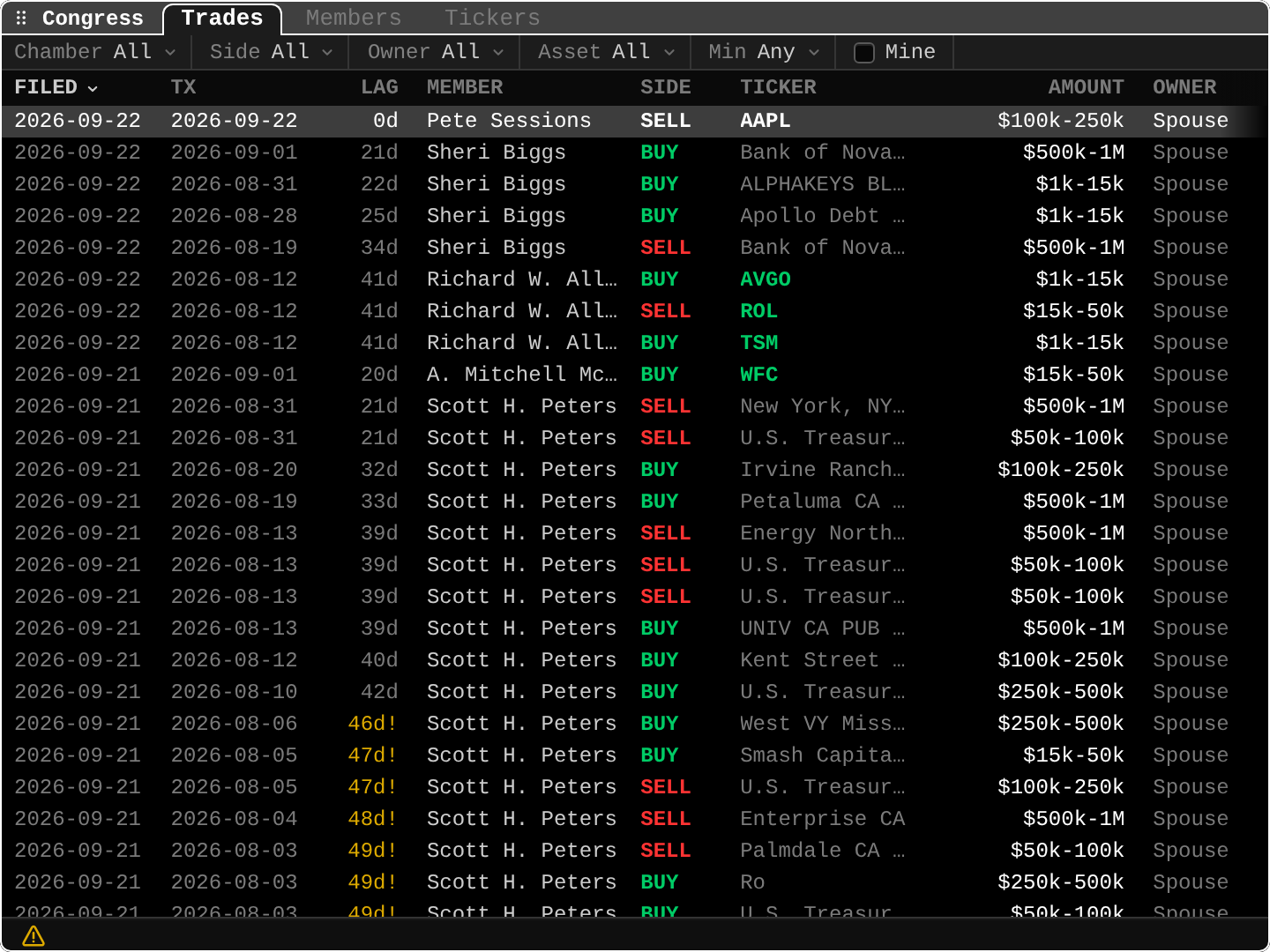
open ittype CG, or CG NVDA for one stock. Tabs: Trades, Members, Tickers. Filters on top: Chamber, Side, Owner, Asset, Min (amount), Mine (only tickers in your lists). Keys: f filters, m member, t ticker, Enter opens the report.
FILED 2026-09-22 TX 2026-09-22 LAG 0d: a sale of AAPL reported the same day.$100k-250k Spouse: the band and the owner. Many reported trades belong to spouses.Bank of Nova…,U.S. Treasur…,UNIV CA PUB …: not only stocks: bank shares, Treasuries, municipal bonds.- Lags of 20 to 40 days are common.
46d!to49d!in yellow: filed after the 45-day limit.- Green tickers (
AVGO,TSM,WFC) are listed stocks you can open; grey names are other assets.
ALRT, Events tab, can alert you when a named member files a new trade (see Alerts).
Practice and recap
Try it3 tasks
- In the screenshot, how many days late was the latest-flagged report beyond the 45-day limit? (The 49d! rows: four days.)
- A trade is reported as 50k-100k. What is the smallest and largest it could be? (50,001 to 100,000 dollars.)
- Why are bands a problem for measuring a member's portfolio? (The exact amounts are unknown; a band can be off by a factor of two.)
Common mistakes4 mistakes
- Reading the filing date as the trade date.
- Treating a band as an exact amount.
- Assuming every trade is the member's own decision: many are spouses' or managed accounts.
- Treating hindsight returns as a strategy you could have followed.
Check yourself3 questions
- Which law requires these reports?
- What is the reporting deadline?
- What does the LAG column show?
Answers
- The STOCK Act of 2012.
- No later than 45 days after the trade (30 days after the member learns of it).
- The number of days between the trade and its filing.
Words in this lesson6 words
- STOCK Act
- The 2012 US law requiring members of Congress to disclose trades.
- periodic transaction report (PTR)
- The filing that discloses a member's trade.
- amount band
- A range like 15k-50k reported instead of the exact amount.
- owner (in a disclosure)
- Whose account traded: member, spouse, joint, child.
- lag
- Days between a trade and its disclosure.
- hindsight return
- A price move measured after the fact; not something anyone could have captured.
Educational material about reading market data, not investment advice.