Derivatives in one page
A derivative is a contract whose value comes from something else (a stock, an index, oil, an interest rate), and the three big families are futures, options and swaps.
- 6 min
- 3 questions
- Lesson 1 of 2
Why you would care
What is this contract, and what does it depend on? "We hedge with futures." "The vol desk sells options." "The bank has 400 trillion in swaps." Derivatives are where much of Wall Street's trading happens. You do not need the math to follow the conversation. You need to know what each contract promises.
The idea from scratch
A derivative is a contract between two sides. It holds no asset itself. Its value is derived from the price of something else, called the underlying: a share, an index, a barrel of oil, a currency, an interest rate.
Why would anyone want that?
Hedging
reduce a risk you already have. An airline worried about fuel prices locks in a price today.
Speculating
bet on a move with less cash up front. Many derivatives need only a deposit, so they carry leverage (gains and losses bigger than the cash you put in).
Shaping a bet
"I think it goes up, but I only want to lose a fixed amount if I'm wrong." Options do that.
Family 1: futures (an agreement to trade later)
A future is a promise to buy or sell a fixed amount of something on a set future date, at a price agreed today.
Futures trade on exchanges, in standard sizes, with a monthly calendar of contract months (the month when the contract ends). Each side posts margin, a deposit that is topped up or paid out every day as the price moves. A forward is the same idea agreed privately between two parties.
Family 2: options (a right, not a duty)
An option gives its buyer the right, but not the obligation, to buy (a call) or sell (a put) at a fixed price (the strike) before a date (the expiry). The buyer pays a fee called the premium.
- Buyer: the worst case is losing the premium.
- Seller: collects the premium, and carries the risk.
Options get a whole chapter later: What an option is.
Family 3: swaps (trading streams of payments)
A swap is an agreement to exchange two streams of payments for years.
Interest rate swap
I pay you a fixed rate, you pay me a rate that moves with the market. Companies use it to turn a floating-rate loan into a fixed one.
Credit default swap (CDS)
I pay you a small yearly fee; if a company defaults on its debt, you pay me for the loss. Insurance on a borrower.
Swaps mostly trade over the counter (OTC): privately between two parties, usually a bank and a client, instead of on an exchange.

Notional: the big scary number
The notional is the size of the underlying a contract refers to, not the money at stake. A swap on 100 million dollars of debt has 100 million notional, but the payments that change hands are a small slice of that. Headlines about "trillions in derivatives" are notional.
See it in Gloom
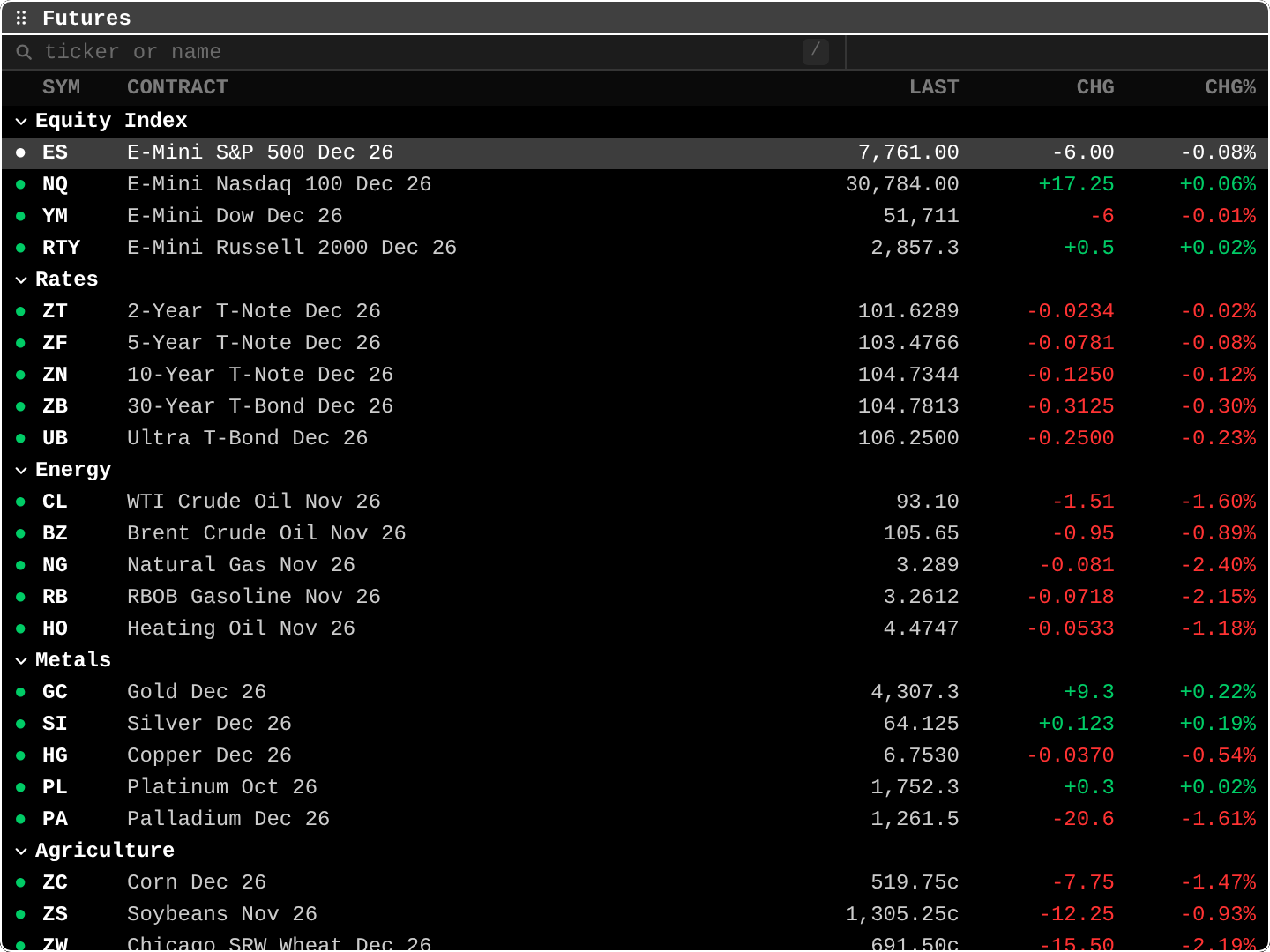
open ittype FUT. (Futures are taught in chapter 07, Futures, commodities and energy.)
- Groups:
Equity Index,Rates,Energy,Metals,Agriculture. Futures exist on almost everything. ES E-Mini S&P 500 Dec 26: a future on the S&P 500 index that ends in December 2026.ESis its short code.CL WTI Crude Oil Nov 26 93.10: oil for November delivery, in dollars per barrel.ZN 10-Year T-Note: a future on a US government bond. Its price is not a yield; it falls when yields rise.ZC Corn 519.75c: grains are quoted in cents per bushel. Same corn as in the farmer example, in different units.
Practice and recap
Try it3 tasks
- Find the contract month of the gold future in the screenshot. (December 2026,
GC Gold Dec 26.) - Which group fell most in percent on that day? (Energy: natural gas -2.40%, gasoline -2.15%.)
- Classify: an airline locking in jet fuel prices; a trader buying a call because they think a stock will rise. (Hedging; speculating.)
Common mistakes4 mistakes
- Thinking a derivative is "fake". It is a legal contract with real payments.
- Reading notional as money at risk.
- Forgetting that the option seller, not the buyer, carries the big risk.
- Treating a future's price as today's price.
Check yourself3 questions
- What is the underlying of a crude oil future?
- What does an option buyer risk at most?
- Where do most swaps trade?
Answers
- Crude oil, a set amount delivered in the contract month.
- The premium they paid.
- Over the counter: privately between two parties, usually a bank and a client.
Words in this lesson14 words
- derivative
- A contract whose value depends on something else.
- underlying
- The thing a derivative depends on.
- hedging
- Taking a position to reduce a risk you already have.
- future
- An exchange-traded promise to buy or sell later at a price agreed today.
- forward
- The same promise, agreed privately.
- contract month
- The month when a futures contract ends.
- margin (futures)
- A deposit each side posts, adjusted daily as the price moves.
- option, call, put
- A right to buy (call) or sell (put) at a fixed price before a date.
- strike, expiry, premium
- The fixed price, the end date, and the price paid for an option.
- swap
- An agreement to exchange two streams of payments.
- interest rate swap
- Fixed-rate payments exchanged for floating-rate payments.
- credit default swap (CDS)
- Insurance-like contract that pays if a borrower defaults.
- over the counter (OTC)
- Traded privately between two parties, not on an exchange.
- notional
- The size of the underlying a contract refers to; not the money at stake.
Educational material about reading market data, not investment advice.