Mergers and acquisitions (MA)
MA lists pending, rumored and closed takeover deals with their terms, their stage and, for listed targets, the arbitrage spread between the offer and the market price.
- 4 min
- 3 questions
- Lesson 3 of 3
Why you would care
A takeover offer usually lifts the target's price by 20% to 50% overnight. After that, the price hovers a little below the offer until the deal closes or breaks. That small gap, the spread, is the market's way of saying how risky the deal is. Hedge funds trade it for a living.
The idea from scratch
In a merger or acquisition (M&A), the acquirer (buyer) takes over the target. The terms say what target shareholders get per share:
Cash
"8.00 dollars per share".
Stock
"0.0966 acquirer shares for each share" (the exchange ratio).
Cash and stock
a mix.
CVR (contingent value right)
an extra payment only if something happens later, such as a drug approval.
The road to closing
- Rumored
- Reported, not confirmed
- Announced / pending
- Agreed, not yet done
- Go-shop
- A period when the target may look for a better offer
- Tender offer
- The buyer offers to buy shares directly from shareholders
- Shareholder vote
- Owners approve or reject
- Regulatory review
- Competition authorities check it does not hurt competition (antitrust)
- Awaiting close
- Approved, final steps
- Closed / terminated
- Done / broken
The arbitrage spread
Merger arbitrage means buying the target after the announcement to collect the gap to the offer price when the deal closes.
A wide spread means the market doubts the deal (antitrust, financing, a shareholder revolt). A spread near zero means it looks certain, or a higher bid is expected.

See it in Gloom
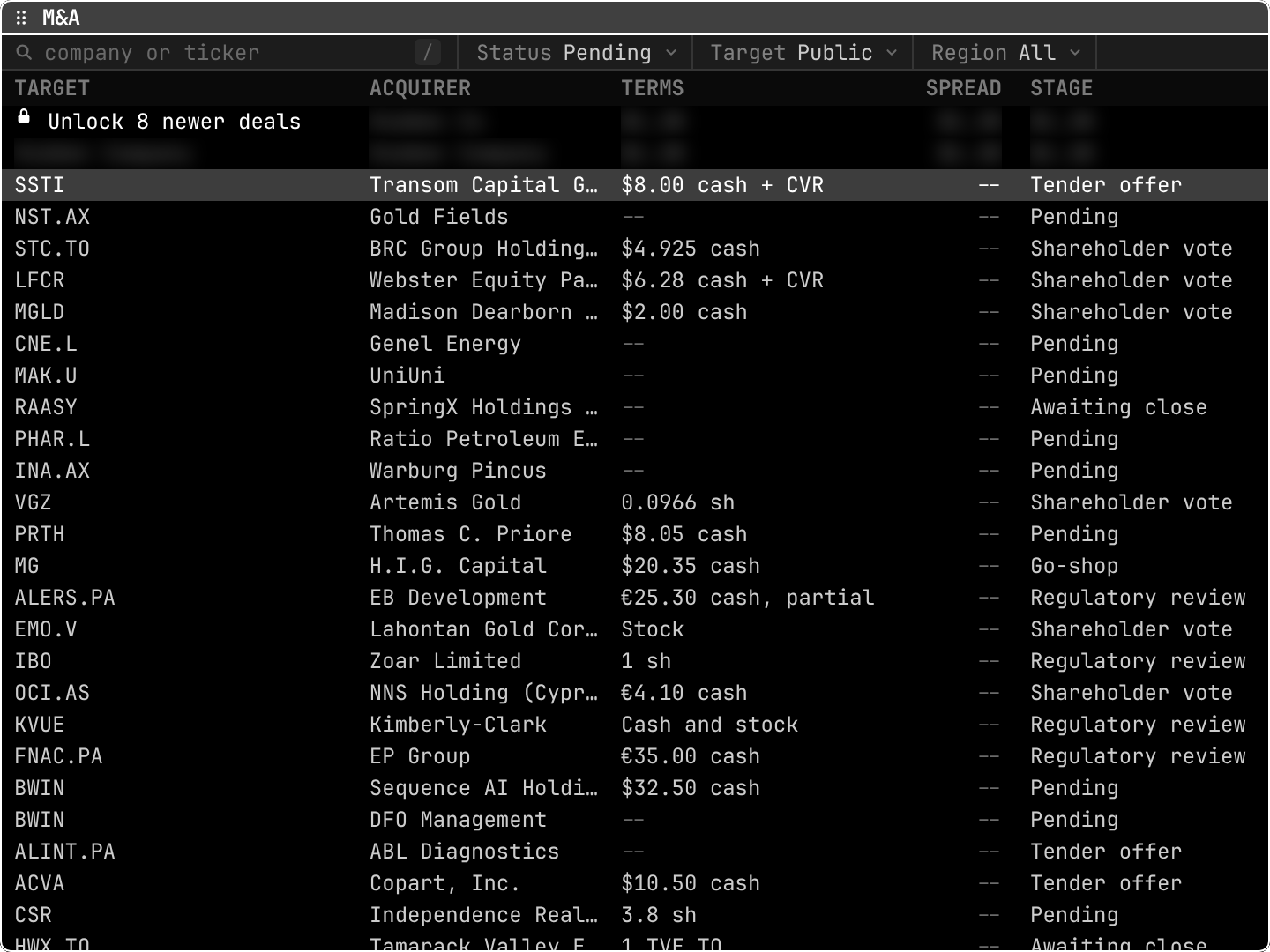
open ittype MA, or MA NVDA for one company. Filters on top: search, Status, Target (public or private), Region. Keys: / search, s status, t target, o open the source.
Unlock 8 newer deals: on the free plan, deal news arrives 7 days late; Pro sees deals as announced.SSTI Transom Capital G… $8.00 cash + CVR Tender offer: a cash offer plus a contingent payment, done by tender offer.VGZ Artemis Gold 0.0966 sh: a stock deal: each VGZ share becomes 0.0966 of an Artemis Gold share.KVUE Kimberly-Clark Cash and stock Regulatory review: a large deal waiting for competition authorities.SPREAD --: no spread in this signed-out capture; the help card says spreads are live on Pro.- Targets from many markets:
.AX(Australia),.TO(Toronto),.L(London),.PA(Paris).
Practice and recap
Try it3 tasks
- Offer 30 dollars cash, target at 29. Spread? (1 / 29 = about 3.4%.)
- In the screenshot, find a deal in a go-shop period. (MG, H.I.G. Capital, 20.35 dollars cash.)
- A stock deal at 0.5 acquirer shares; the acquirer trades at 80. What is the offer worth per target share? (40 dollars, and it moves with the acquirer's price.)
Common mistakes4 mistakes
- Assuming an announced deal will close. Some break, and the target falls hard.
- Reading a stock deal's value as fixed. It moves with the acquirer's share price.
- Ignoring the time to close when comparing spreads.
- Trading on deal news on the free plan, where it is 7 days late.
Check yourself3 questions
- What is the difference between an acquirer and a target?
- What does a wide arbitrage spread suggest?
- What is a CVR?
Answers
- The acquirer buys; the target is bought.
- The market doubts the deal will close as agreed.
- A contingent value right: an extra payment if a future condition is met.
Words in this lesson9 words
- M&A
- Mergers and acquisitions: companies combining or buying each other.
- acquirer / target
- The buyer / the company being bought.
- terms
- What target shareholders receive per share.
- exchange ratio
- Acquirer shares given per target share in a stock deal.
- CVR
- Contingent value right: a payment only if a later condition is met.
- tender offer
- An offer to buy shares directly from shareholders.
- go-shop
- A period when the target may seek a better offer.
- merger arbitrage
- Buying a target to collect the gap to the offer price.
- deal spread
- The gap between the offer value and the target's price.
Educational material about reading market data, not investment advice.