Futures curves and rolling (CTM)
A futures curve lines up every contract month of one commodity, rising (contango) when storing costs money and falling (backwardation) when it is scarce now, and CTM shows it with the cost of rolling.
- 4 min
- 3 questions
- Lesson 2 of 7
Why you would care
What does the shape of the curve say, and what does holding futures cost? An oil fund can lose money in a year when oil prices barely moved. The reason is the curve: it kept selling cheap expiring contracts and buying more expensive later ones. The shape of the curve also tells you about supply: a steep backwardation in oil means barrels are wanted now.
The idea from scratch
The curve
Each contract month has its own price. Plot them by month: that is the futures curve (or term structure).
Contango
later months cost more. Normal for storable goods: someone holding gold or oil until later pays storage, insurance and the interest on the money tied up. This is the cost of carry.
Backwardation
later months cost less. Happens when the commodity is scarce today: buyers pay a premium to have it now.
Rolling
A futures position ends at its contract month. To keep exposure, you roll: sell the expiring month, buy a later one.
- In contango you sell low and buy high: rolling costs you (negative roll yield).
- In backwardation you sell high and buy low: rolling earns you (positive roll yield).
Month codes: futures tickers carry a letter for the month: F Jan, G Feb, H Mar, J Apr, K May, M Jun, N Jul, Q Aug, U Sep, V Oct, X Nov, Z Dec. GCZ26 is December 2026 gold.

See it in Gloom
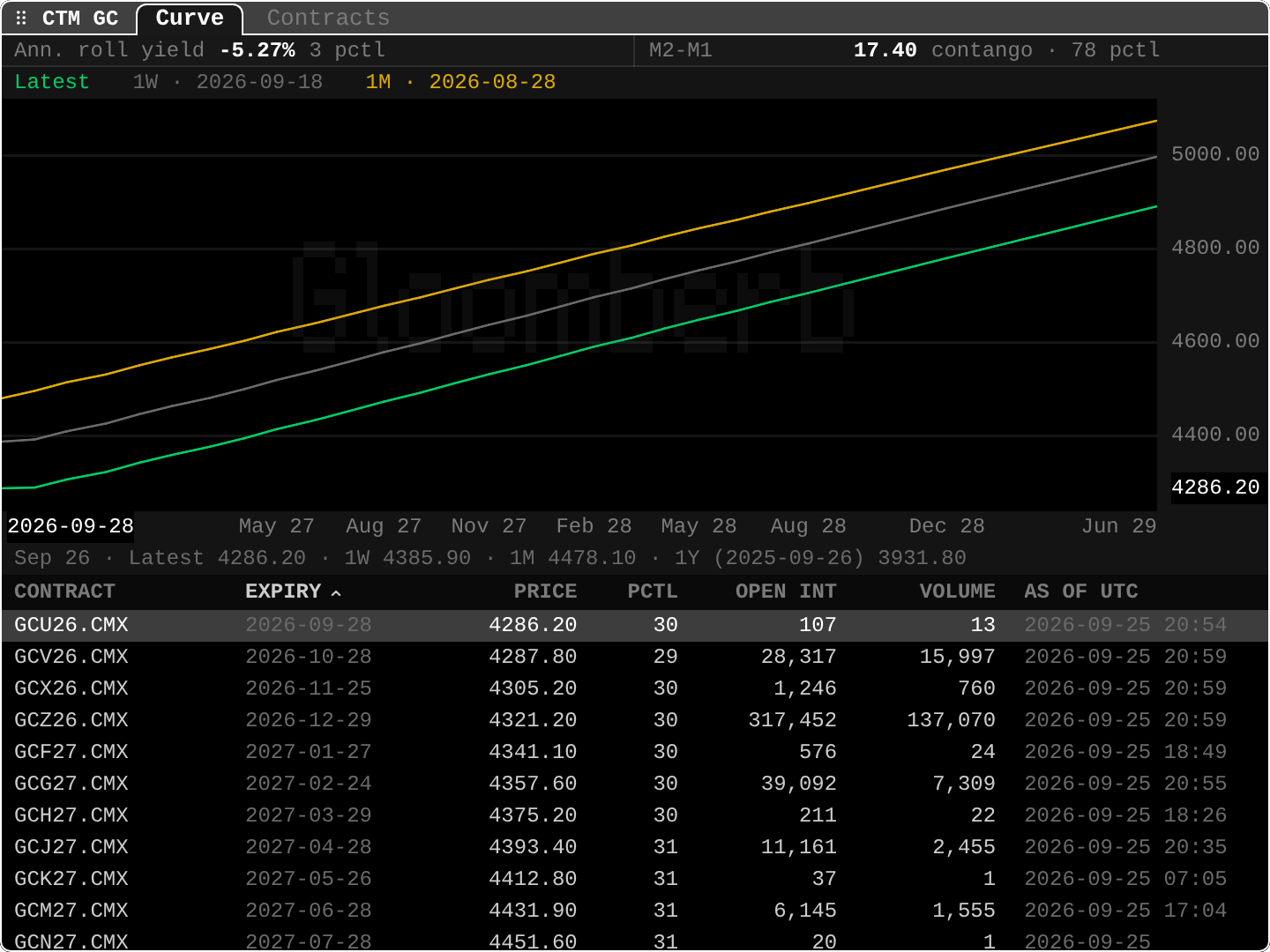
open ittype CTM GC (gold) or CTM CL (crude oil). Tabs: Curve, Contracts. Lines: Latest, 1W, 1M ago.
M2-M1 17.40 contango · 78 pctl: the second month is 17.40 dollars above the first; a steeper contango than 78% of the past year.Ann. roll yield -5.27%: rolling a long gold position along this curve would cost about 5.3% a year.- The curves slope up to mid-2029: contango all the way. The whole curve moved down over the month (orange above green).
- Rows:
GCV26.CMX 2026-10-28 4287.80,GCZ26.CMX ... 4321.20 317,452 open interest: December is the most traded contract. AS OF UTC: each contract's quote time; thin months update rarely.
Practice and recap
Try it3 tasks
- Is the gold curve in contango or backwardation? (Contango.)
- GCZ26 at 4,321.20 and GCG27 at 4,357.60: two months apart. Difference? (36.40 dollars.)
- Which contract has the most open interest, and why might that be? (GCZ26: December is the main liquid gold month.)
Common mistakes4 mistakes
- Reading the front month as "the" price of the commodity for all horizons.
- Ignoring roll costs when holding commodity funds for years.
- Treating backwardation as a forecast that prices will fall.
- Comparing contracts with very low volume as if their prices were as reliable as the front month's.
Check yourself3 questions
- What is contango?
- Why does rolling a long position in contango cost money?
- What does the letter Z in a futures ticker mean?
Answers
- A curve where later contract months cost more than earlier ones.
- You sell the cheaper expiring contract and buy the more expensive later one.
- December.
Words in this lesson6 words
- futures curve
- Prices of all contract months of one commodity.
- contango / backwardation
- Later months higher / lower than nearer months.
- cost of carry
- Storage, insurance and financing costs of holding a commodity.
- roll
- Sell the expiring contract, buy a later one.
- roll yield
- The gain or loss from rolling along the curve, often annualized.
- month code
- The letter for a contract month (F Jan ... Z Dec).
Educational material about reading market data, not investment advice.