Exchanges, hours and tickers
An exchange is the marketplace where shares change hands during set hours, and every listed security has a short code called a ticker.
- 6 min
- 3 questions
- Lesson 3 of 4
Why you would care
Where, when and under what name does NVDA trade? You open a quote at 8 pm and the price is not moving. Is the app broken? No: the market is closed. Someone writes "long META on NASDAQ". Three words, three concepts: an order side, a ticker, an exchange. This lesson gives you two of them.
The idea from scratch
The exchange: the marketplace
An exchange is an organized place where buyers and sellers meet and trades are recorded. Think of a farmers' market with strict rules: fixed opening hours, a list of approved sellers, and a clerk who writes down every sale.
Today the clerk is a computer. The big US exchanges are the NYSE and NASDAQ. Europe and Asia have their own (London, Frankfurt, Tokyo, Hong Kong). A company picks one exchange to list on: to be allowed to have its shares traded there.
Hours: the session
The exchange is open for a fixed block called the regular session. For the big US exchanges it is 9:30 am to 4:00 pm New York time, Monday to Friday, except holidays.
Premarket
trading allowed before the regular session, with fewer participants.
After-hours
trading allowed after the close, same idea.
Overnight
most trading stops. A few alternative venues and brokers now trade popular US stocks through the night, but volume is tiny, so the price on your screen is usually the last one recorded.
The last trade of the regular session is the close (closing price). It is the number used in daily charts, daily returns and most statistics, because everyone agrees on it.

Tickers: the short name
A ticker (or symbol) is the short code an exchange assigns to a listed thing: NVDA for NVIDIA, AAPL for Apple, SPY for the S&P 500 ETF. One to five letters in the US. Indices have codes too (SPX for the S&P 500) even though you cannot buy them.
Why it matters: you type tickers, not names, in a terminal. And the same letters can mean different things on different exchanges, so a precise reference is "ticker plus exchange".
Time zones
A terminal is used all over the world, so times are often shown in UTC (the reference time zone, no daylight saving). New York is UTC minus 4 or minus 5 depending on the season. When you see a time with no zone, ask.
See it in Gloom
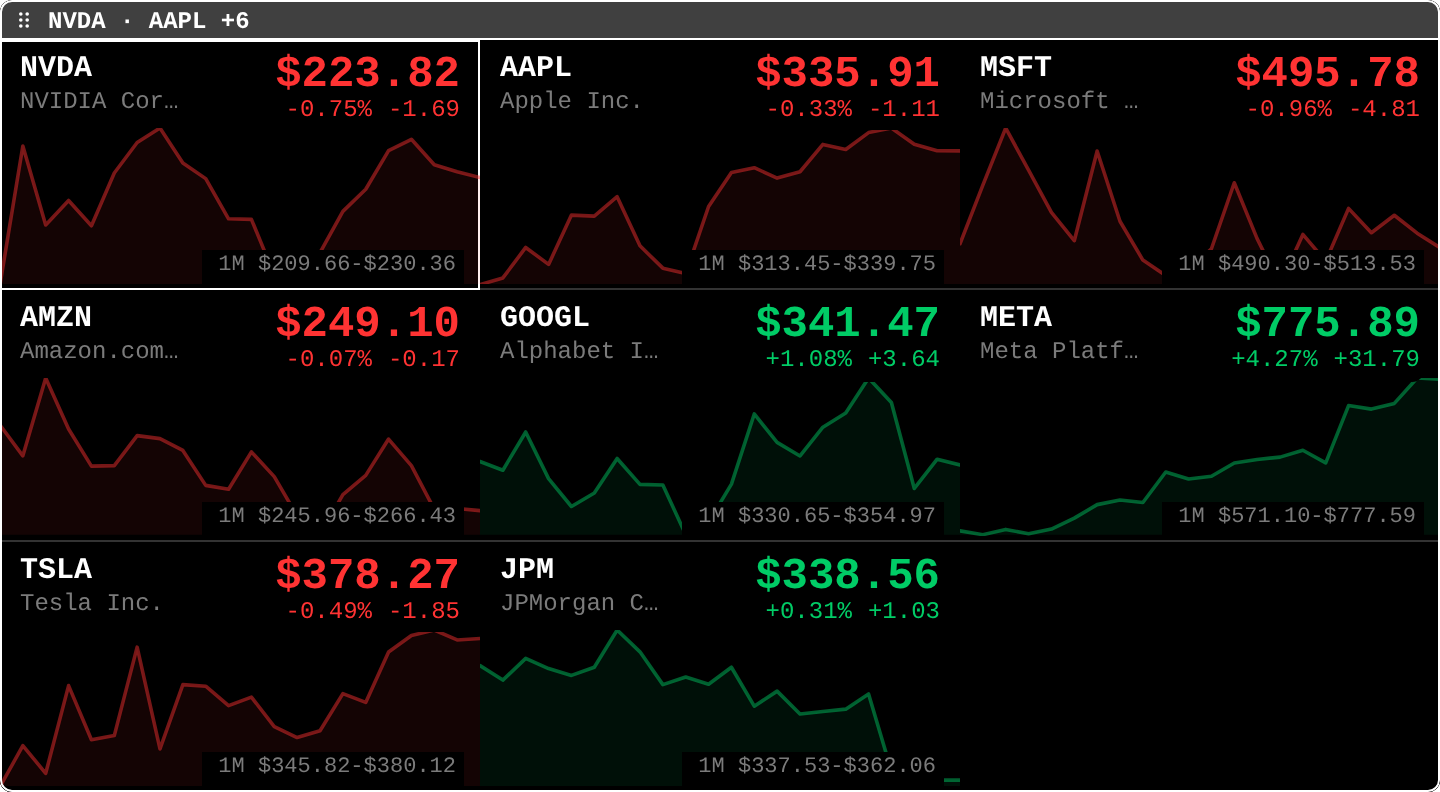
open ittype QQ NVDA, AAPL, MSFT in the command bar. (QQ is taught in A board of quotes (QQ).)
NVDAon top,NVIDIA Cor…below: ticker first, name second. The terminal thinks in tickers.$223.82 -0.75% -1.69: last price, change in percent, change in dollars since the previous close.- The small chart with
1M $209.66-$230.36: the price path over one month and its low to high range. - Not on this screen: bid and ask (next lesson). A quote board shows last prices only.
- Session status lives on the overview page: in
DES NVDAthe header reads(NASDAQ) CLOSED, the exchange and whether it is open. TheWEIpage (Funds, ETFs and indices) shows OPEN or CLOSED per index, with the time in UTC.
Practice and recap
Try it3 tasks
- On the overview screenshot from What a stock is, find the exchange name and the session status in the header line. (NASDAQ, CLOSED.)
- On the
WEIscreenshot from Funds, ETFs and indices, find which markets were open at the capture time. (Nikkei, ASX, Sensex, the dollar index.) - Convert: a US close at 16:00 New York in winter is what time in UTC? (21:00.)
Common mistakes4 mistakes
- Thinking a flat price means a broken feed. Check the session status first.
- Trusting a premarket move as if it were a regular-session move. Volume is thin.
- Mixing a ticker with a company name in a search.
APPLEis not a ticker;AAPLis. - Forgetting the time zone of a timestamp. "Published at 14:30" is useless without the zone.
Check yourself3 questions
- It is 10:00 in Paris on a Tuesday. Is the NYSE regular session open?
- What is "the close" and why does everyone use it?
- Your colleague says "SPX closed at 7,704". Can she have bought SPX?
Answers
- No. 10:00 Paris is 4:00 or 5:00 in New York; the regular session starts at 9:30 New York time.
- The last trade of the regular session. It is the one price everyone agrees on for the day, so daily charts and statistics use it.
- No. SPX is the ticker of an index (a ruler). She could buy an ETF that tracks it, like SPY.
Words in this lesson9 words
- exchange
- The organized marketplace where shares are traded and every trade is recorded.
- NYSE, NASDAQ
- The two large US stock exchanges.
- listing
- Being approved to have your shares traded on an exchange.
- regular session
- The main trading hours; 9:30 am to 4:00 pm New York for the big US exchanges.
- premarket
- Trading before the regular session; thin.
- after-hours
- Trading after the regular session; thin.
- close (closing price)
- The last price of the regular session; the daily reference number.
- ticker (symbol)
- The short code for a listed thing, like NVDA.
- UTC
- The reference time zone used on many screens; New York is 4 or 5 hours behind.
Educational material about reading market data, not investment advice.