Reading a quote
A quote is not one price but five numbers (last trade, best bid, best ask, the spread between them, and volume) that together tell you what you would really pay to trade now.
- 5 min
- 3 questions
- Lesson 4 of 4
Why you would care
Your screen says NVDA is 223.82. You press buy and get filled at 223.85. Nobody cheated you: you paid the ask, and the screen showed the last trade. Learning the five numbers of a quote stops a hundred small surprises like this one.
The idea from scratch
Picture a market stall with a line of buyers on the left and sellers on the right. Each buyer holds a sign: "I pay up to X". Each seller holds a sign: "I sell from Y".
- The bid is the highest buyer sign right now: the most anyone will pay. If you want to sell immediately, this is your price.
- The ask (or offer) is the lowest seller sign: the least anyone will accept. If you want to buy immediately, this is your price.
- The spread is ask minus bid. The cost of being impatient, paid on each round trip.
- The last price is the price of the most recent trade. It is history, not an offer.
- Volume is the number of shares traded so far in the session. It tells you how busy the stall is.
Size: how much is on the sign
Next to a bid or ask there is usually a size: how much is waiting at that price. "400 x 223.82" means buyers want up to 400 shares at 223.82. For US stocks the size is counted in shares and is always a whole number of round lots: the standard block of shares, 100 for most stocks and smaller (40, 10 or 1) for stocks priced above $250. Older data and some other markets count lots instead of shares, so check the label.
A big order eats through the first sign and gets worse prices on the next ones.
Liquidity: how easy it is to trade
Liquidity is how much you can buy or sell quickly without moving the price. Signs: a narrow spread, large sizes, high volume. A liquid stock trades millions of shares a day with a one-cent spread; an illiquid one trades a few thousand with a wide spread.

See it in Gloom
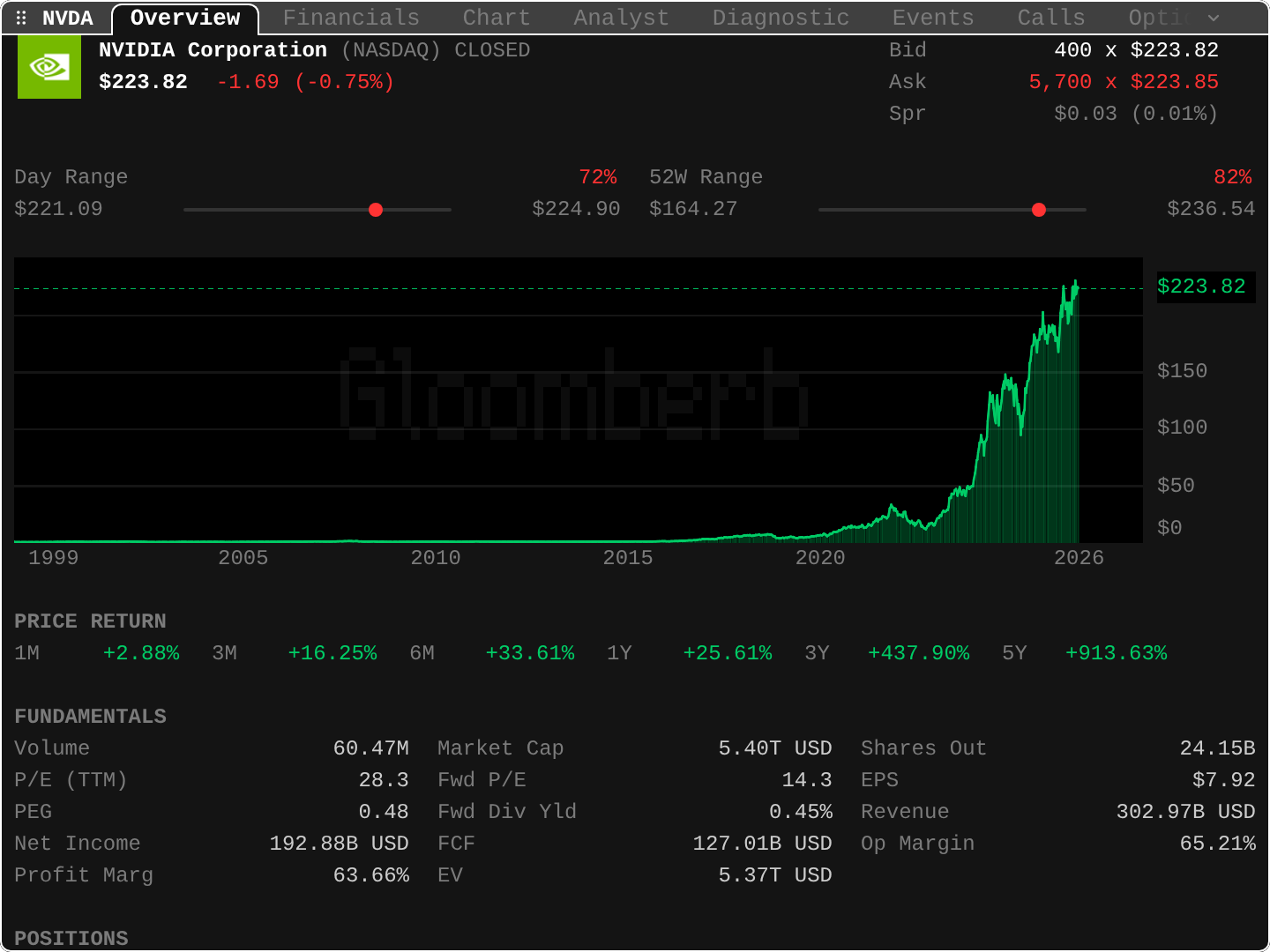
open ittype DES NVDA. (DES itself is taught in The overview page (DES).)
$223.82 -1.69 (-0.75%): the last trade, and how far it is from the previous close in dollars and in percent.Bid 400 x $223.82: the best buyer pays 223.82, for a size of 400.Ask 5,700 x $223.85: the best seller wants 223.85, for a size of 5,700.Spr $0.03 (0.01%): the spread, 3 cents, or 0.01% of the price. Very liquid.Volume 60.47M: about 60.47 million shares traded in the session. M means million.- Header
CLOSED: the market was closed at capture; these are the last quotes of the session.
Practice and recap
Try it3 tasks
- On the screenshot: if you sold 100 shares right now, at what price? (About 223.82, the bid.) If you bought? (About 223.85, the ask.)
- Compute the round-trip cost of impatience on 1,000 shares: 1,000 x 0.03 = 30 dollars.
- Imagine a stock with bid 10.00 and ask 10.50. What is the spread in percent? (5%. You would need the price to rise 5% just to break even on a quick round trip.)
Common mistakes4 mistakes
- Treating the last price as an offer. It is the past; the bid and ask are the present.
- Ignoring the spread on small stocks. A 2% spread turns a "small trade" into a real cost.
- Reading volume without context. 60 million is huge for one company and tiny for another. Compare with that stock's usual day.
- Reading a quote outside the session as live. Check OPEN or CLOSED.
Check yourself3 questions
- Bid 50.00, ask 50.20, last 50.05. You must sell now. What do you get?
- What is the spread in percent of the price?
- A stock shows volume 2,000 for the day and a spread of 1 dollar on a 20 dollar price. Liquid or not?
Answers
- About 50.00, the bid (the best buyer).
- 0.20 / 50 = 0.4%.
- Not liquid: tiny volume, 5% spread. Any real order would move the price.
Words in this lesson10 words
- quote
- The current set of numbers for a stock: last, bid, ask, spread, volume.
- last price
- The price of the most recent trade. History, not an offer.
- bid
- The highest price a buyer is willing to pay right now. Where you sell.
- ask (offer)
- The lowest price a seller will accept right now. Where you buy.
- spread
- Ask minus bid; the cost of trading immediately.
- size
- How much is waiting behind a bid or ask; for US stocks, a number of shares.
- round lot
- The standard block of shares: 100 for most US stocks, fewer for stocks priced above $250.
- volume
- Shares traded so far in the session.
- liquidity
- How much you can trade quickly without moving the price.
- M, B, T
- Million, billion, trillion, as shown on screens.
Educational material about reading market data, not investment advice.