Dealer gamma (GEX)
Dealer gamma (GEX) estimates how much option dealers would trade per 1% move to stay hedged, under an assumption about who holds which option, and where that estimate flips sign.
- 4 min
- 3 questions
- Lesson 2 of 3
Why you would care
"We're above the gamma flip, expect chop." "Below the flip, moves get violent." Market commentary is full of gamma talk. The idea is real; the numbers are estimates built on an assumption. This lesson gives you both.
The idea from scratch
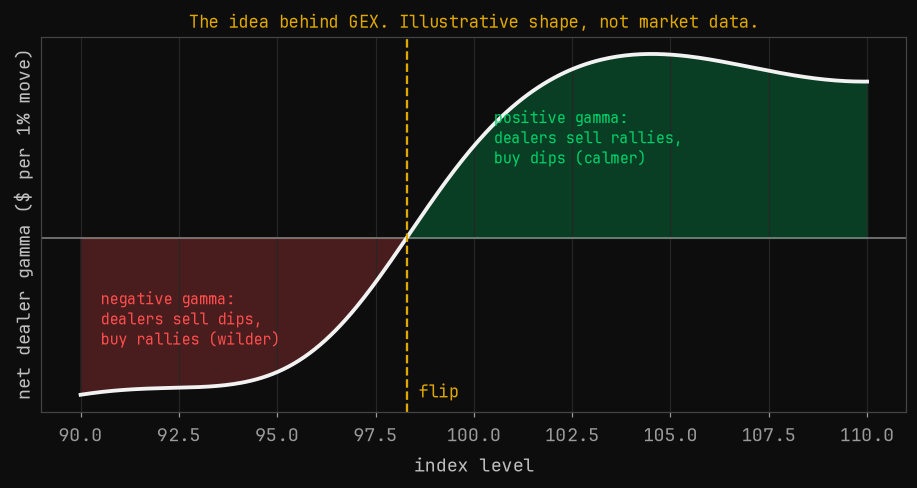
From What a volatility desk does: a dealer who holds options delta-hedges them. How much it must trade as the price moves depends on gamma.
- If dealers are long gamma (they own the options), hedging means selling when the price rises and buying when it falls: they lean against moves. Markets tend to be calmer.
- If dealers are short gamma (they sold the options), hedging means buying when the price rises and selling when it falls: they chase moves. Markets can swing harder.
The assumption
Nobody publishes who holds which option. GEX uses a convention: customers buy puts for protection and sell calls for income, so dealers are assumed long calls and short puts. Then:
- Net GEX = gamma from calls (positive) - gamma from puts (negative), in dollars per 1% move.
- The flip is the price where the net would change sign.
Because the convention can be wrong, Gloom also shows a dealer range: the result if dealers held only 25% to 75% of the open interest.

See it in Gloom
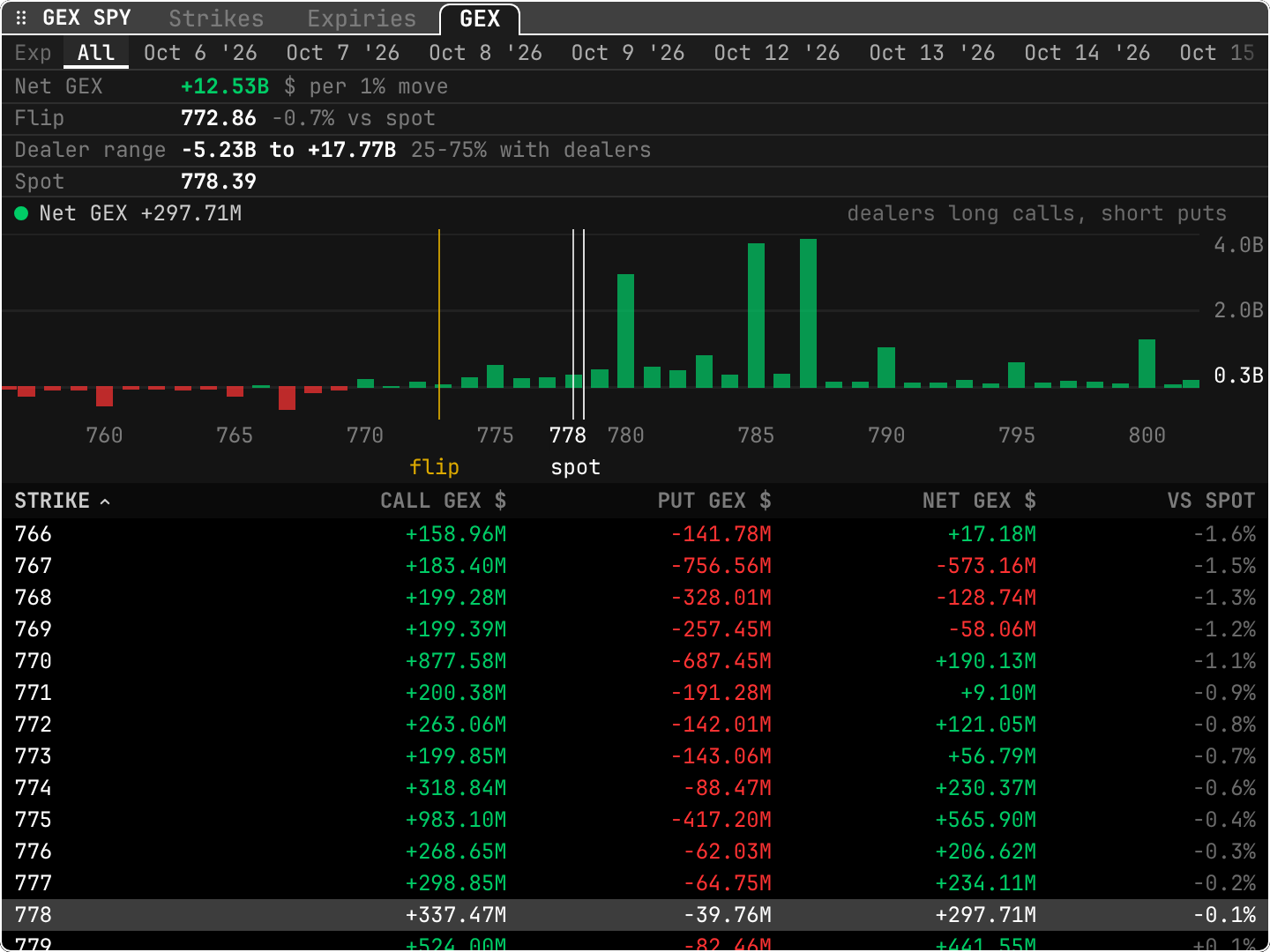
open ittype GEX SPY, or OPX SPY and the GEX tab. Expiry tabs: All or one date.
Net GEX +12.53B $ per 1% move: on this convention, dealers would trade about 12.5 billion dollars against a 1% move: positive, a stabilizing setup.Flip 772.86 -0.7% vs spot: below about 773, the estimate turns negative.Dealer range -5.23B to +17.77B 25-75% with dealers: if dealers held a different share, the total could even be negative. Treat the sign with care.- The bars: big green bars at 780, 785 and 787 (call-heavy strikes above spot); red bars below the flip.
- Table row
767 +183.40M -756.56M -573.16M: heavy put gamma at a strike below spot makes the net negative there.
Practice and recap
Try it3 tasks
- Spot drops from 778 to 770 in this screenshot. Which side of the flip is that? (Below it: negative gamma territory on this estimate.)
- Why does the dealer range matter? (It shows how much the answer depends on the assumption about who holds the options.)
- In positive gamma, do hedgers buy or sell into a rally? (Sell.)
Common mistakes4 mistakes
- Treating GEX as observed data. It is a model on top of open interest.
- Expecting the flip to act like a hard floor or ceiling.
- Ignoring that open interest is a day old.
- Applying index logic to single stocks where customer positioning can be the opposite.
Check yourself3 questions
- What does positive dealer gamma do to market moves, in theory?
- What is the flip level?
- What assumption does GEX make?
Answers
- It dampens them: hedging sells rallies and buys dips.
- The price at which estimated net dealer gamma changes sign.
- That dealers hold the other side of customers: long calls, short puts.
Words in this lesson5 words
- dealer gamma (GEX)
- Estimated dealer hedging per 1% move, from open interest and gamma.
- flip level
- The price where estimated net dealer gamma changes sign.
- dealer range
- The result if dealers held 25% to 75% of open interest.
- positive / negative gamma regime
- Dealers lean against / chase price moves.
- hedging flow
- Buying or selling done to stay hedged, not to bet.
Educational material about reading market data, not investment advice.