The cheat sheet
The whole chapter on one page, to re-read before a meeting: a 100-word summary, the numbers to remember and who is who.
- 4 min
- 3 questions
Why you would care
You have five minutes in a taxi before meeting a trader. You will not reread twelve lessons. Read this.
The idea from scratch
The chapter in 100 words
A stock is a slice of a company; a bond is a loan; a fund pools money; an index is a ruler, not a thing you own. Exchanges match buyers and sellers in sessions. A quote shows the bid (where you sell), the ask (where you buy) and the spread between them. Orders say how you trade: market, limit, stop. Long profits when prices rise, short when they fall; leverage magnifies both. Returns compound; volatility, drawdown, correlation and beta measure risk. The buy side invests, the sell side serves it. Prices move on surprises. Rates drive everything.
Numbers to remember
| Rule | Example |
|---|---|
| Percent change = (new - old) / old | 100 to 110 is +10% |
| Losses need bigger gains to recover | -20% needs +25%; -50% needs +100% |
| Rule of 72: years to double ≈ 72 / yearly return in % | 8% a year doubles in about 9 years |
| 1 basis point (bp) = 0.01% | 25 bp = 0.25% |
| Spread cost = ask - bid, paid on every round trip | 0.10 spread on 1,000 shares = 100 dollars |
| Leverage 2:1 doubles your % moves | asset -10% means your equity -20% |
| Bond price and yield move in opposite directions | rates up, bond prices down |
| m/m to yearly, roughly x12 | 0.4% a month is about 5% a year |
Who is who, in one line each
Buy side
asset managers, pension funds, hedge funds. They invest.
Sell side
banks and brokers. They sell research, trading and access.
Market makers
always quote a bid and an ask.
Clearing house
stands between buyer and seller and guarantees the trade.
Regulators
SEC (securities), CFTC (futures and swaps), FINRA (brokers), the Fed (banks and money).
Desks
equities, volatility, rates, credit, FX, commodities.

See it in Gloom
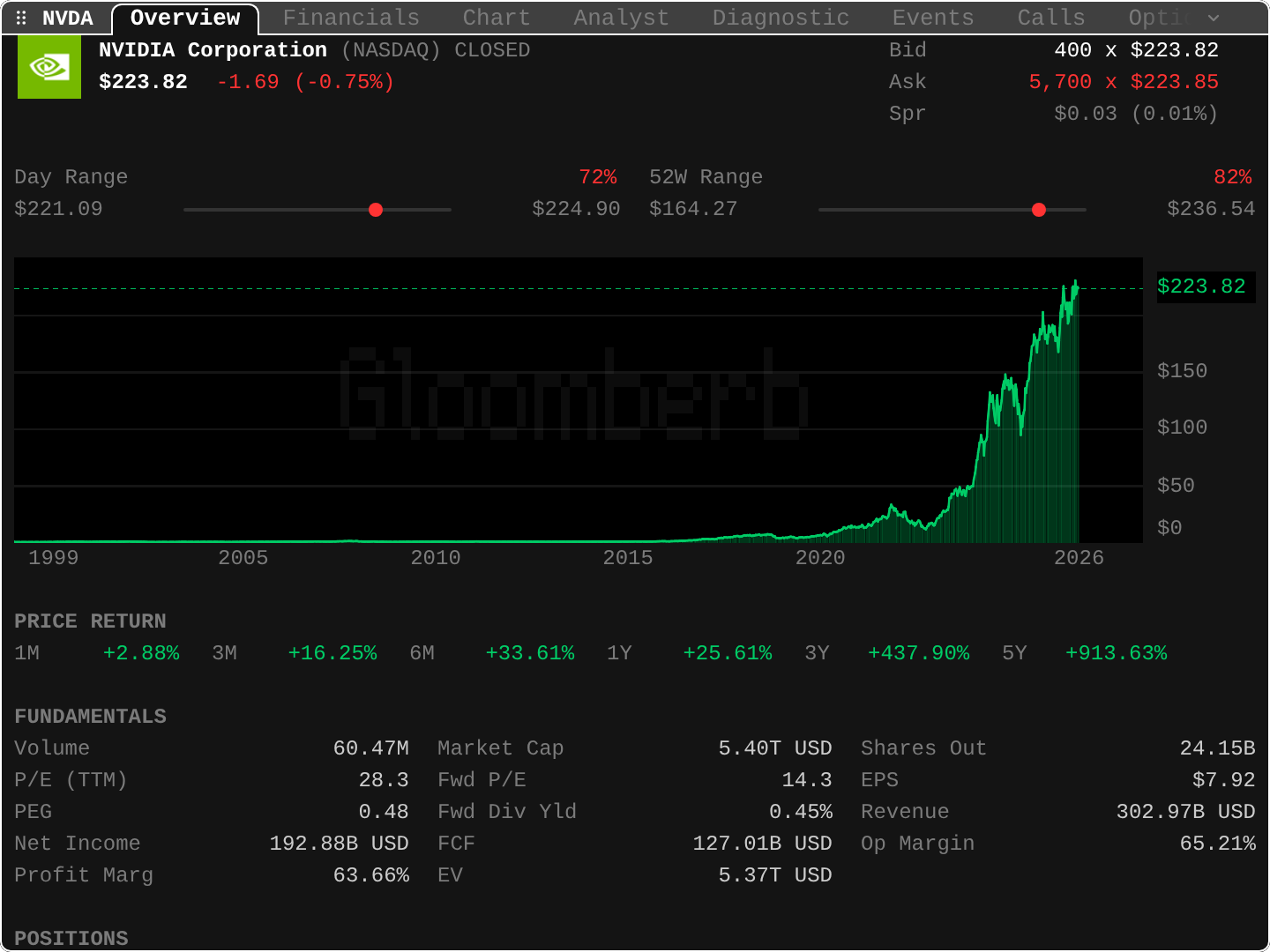
open ittype DES NVDA. Then check that you can name, without looking back:
- The last price and the change in percent.
- The bid and the ask, and which one you get when you buy.
- The spread, in dollars and in percent.
- The volume, and what M means.
- Whether the market was open or closed at capture.
Practice and recap
Try it3 tasks
- Explain to someone, in two sentences, why a price can fall on good news.
- Say the difference between coupon and yield out loud.
- Compute: a stock falls from 50 to 40. What gain gets it back to 50? (+25%.)
Common mistakes4 mistakes
- Treating an index level as a price you can buy at.
- Treating the last price as an offer.
- Adding percentages instead of compounding them.
- Calling every fund a hedge fund, or every derivative "fake".
Check yourself3 questions
- You own a stock with a beta of 1.5. The market falls 2%. Roughly how much do you expect your stock to move?
- You want to buy now. Which side of the quote do you pay?
- A bond's price rises. What happened to its yield?
Answers
- About -3% (1.5 x -2%), as a rough average relationship, not a promise.
- The ask.
- It fell.
Words in this lesson8 words
- stock / bond / fund / index
- Ownership / a loan / a pooled pot of money / a measuring rule.
- bid / ask / spread
- Best buyer / best seller / the gap between them.
- long / short
- Profit if the price rises / if it falls.
- leverage
- Using borrowed money or deposits so gains and losses are bigger than your cash.
- volatility / drawdown
- How much a price swings / the fall from a peak.
- correlation / beta
- How two things move together / how much a stock moves with the market.
- basis point
- 0.01%.
- surprise
- The gap between news and what was expected.
Educational material about reading market data, not investment advice.