Credit default swaps (CDS, CDX, SOVR)
A credit default swap is insurance on a borrower's default, and CDS, CDX and SOVR show reported trades on companies, the main indices and 5-year country spreads.
- 4 min
- 3 questions
- Lesson 2 of 3
Why you would care
How much does it cost to insure against this borrower defaulting? CDS are the purest price of default risk: no bond coupon or maturity to adjust for, just "how much to insure this name for five years". When a company's or a country's CDS jumps, professionals notice immediately. They are also how hedge funds bet against a borrower without selling its bonds.
The idea from scratch
In a credit default swap:
- The protection buyer pays a yearly premium, quoted as a spread in basis points of the amount insured (the notional).
- The protection seller pays the buyer the loss if a credit event happens (default, bankruptcy, failure to pay, sometimes restructuring).
The most traded maturity is 5 years. Contracts roll to a new 5-year date twice a year (March 20 and September 20), so a "5Y spread" history steps at each roll.
Spread and default probability: roughly, annual default probability ≈ spread / (1 - recovery rate). At 95 bp and a 40% recovery, that is about 1.6% a year. A rough rule, not a forecast.
Indices and sovereigns
- A CDS index (like CDX IG, CDX HY, iTraxx Main) insures a basket of about 100 names in one trade: the market's broad credit gauge.
- Sovereign CDS insure government debt, usually in dollars, mostly emerging markets.
Where the data comes from, in plain terms
Since the 2008 crisis, US rules require swap trades to be reported and published anonymously. Gloom shows those publicly reported trades, so names that rarely trade show few prints and gaps.

See it in Gloom
open themCDS (or CDS NVDA for one issuer), CDX, SOVR. The rates and credit desk (DESK rates) shows CDX and SOVR together.
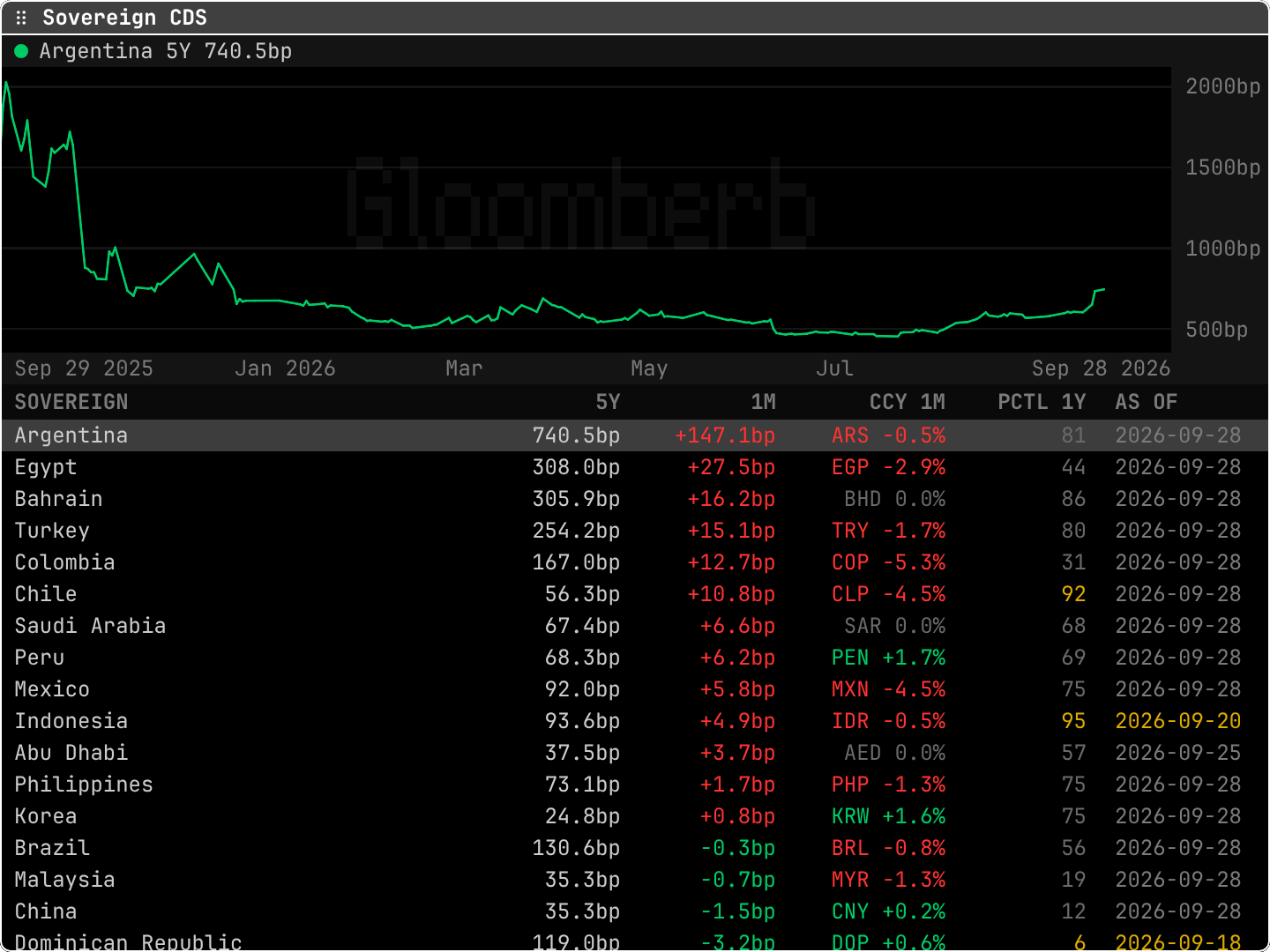
Argentina 5Y 740.5bp +147.1bp(1 month): insuring Argentina costs 7.4% a year, up sharply this month.CCY 1M ARS -0.5%: the currency's move next to the credit move.Egypt 308.0bp,Turkey 254.2bp,Chile 56.3bp,China 35.3bp: the range from risky to very safe borrowers.PCTL 1Y: Indonesia at 95: its CDS near the top of its year.- The chart: Argentina fell from about 2,000 bp a year earlier to under 500 bp, then rose again from August.
In CDS, the list shows issuers by number of reported trades and the last spread when the trade reports one: European names trade most; many rows show -- because a print's spread is not always disclosed in usable units.
Practice and recap
Try it3 tasks
- Insuring 5 million dollars at 300 bp costs how much a year? (150,000 dollars.)
- With 40% recovery, what yearly default probability does 300 bp roughly imply? (3% / 0.6 = 5%.)
- In the screenshot, which country's CDS rose most over the month? (Argentina, +147.1 bp.)
Common mistakes4 mistakes
- Reading a spread as a yield: it is an insurance premium.
- Treating implied default probability as precise.
- Comparing a name that trades daily with one that traded once a month.
- Forgetting the roll steps in a 5Y history.
Check yourself3 questions
- Who pays whom in a CDS?
- What is a credit event?
- What is a CDS index?
Answers
- The buyer pays a yearly spread; the seller pays the loss if a credit event happens.
- A default, bankruptcy, failure to pay or (sometimes) restructuring that triggers the payout.
- One contract that insures a basket of many names, used as a broad credit gauge.
Words in this lesson8 words
- credit default swap (CDS)
- Insurance on a borrower's default.
- protection buyer / seller
- Pays the premium / pays out on default.
- CDS spread
- The yearly premium, in bp of the notional.
- credit event
- The default-type event that triggers a payout.
- recovery rate
- The share of value recovered after default.
- CDS index
- A contract covering a basket of names (CDX, iTraxx).
- sovereign CDS
- CDS on a country's debt.
- roll (CDS)
- The twice-yearly move to a new 5-year maturity.
Educational material about reading market data, not investment advice.