What a volatility desk does
A bank's volatility desk makes markets in options, hedges away direction every day, and keeps a book of exposures to movement (gamma) and to volatility (vega), earning the spread and, on average, implied above realized volatility.
- 5 min
- 3 questions
- Lesson 5 of 5
Why you would care
In a meeting with a derivatives desk, nobody says "I think the stock goes up". They say "we're short gamma into the print" or "vol looks cheap here". This lesson decodes that language.
The idea from scratch
Making markets
Clients (asset managers, hedge funds, companies) want to buy or sell options. The vol desk (equity derivatives desk) quotes a bid and an ask for them and takes the other side. It earns the spread, but it now holds options it did not choose.
Hedging the direction: delta hedging
The desk does not want to bet on direction. If it is short a call with delta 0.5 on 100 shares, it buys 50 shares, so a small move up or down roughly cancels out. As the stock moves, delta changes (that is gamma), so the desk re-hedges, usually every day. This is delta hedging.
What is left: gamma and vega
After hedging direction, the desk still carries:
Gamma
exposure to how much the stock moves. Long gamma (owning options) makes money when the stock moves a lot, because re-hedging means buying low and selling high. Short gamma (having sold options) makes money when the stock is calm, and loses on big moves.
Theta
the price of gamma. Long gamma pays time decay every day; short gamma collects it.
Vega
exposure to implied volatility itself. Long vol gains if implied vol rises.
Where the money comes from
- The bid-ask spread on client trades.
- On average, implied above realized volatility (the volatility risk premium from the previous lesson), for the parts of the book that are short options.
- Relative value: buying volatility where it is cheap (one expiry, one strike, one stock) against selling where it is rich.
What it fears
Gaps (earnings, news, market crashes), vol spikes, and crowded positions where every desk must hedge the same way at once (the topic of dealer gamma).

See it in Gloom
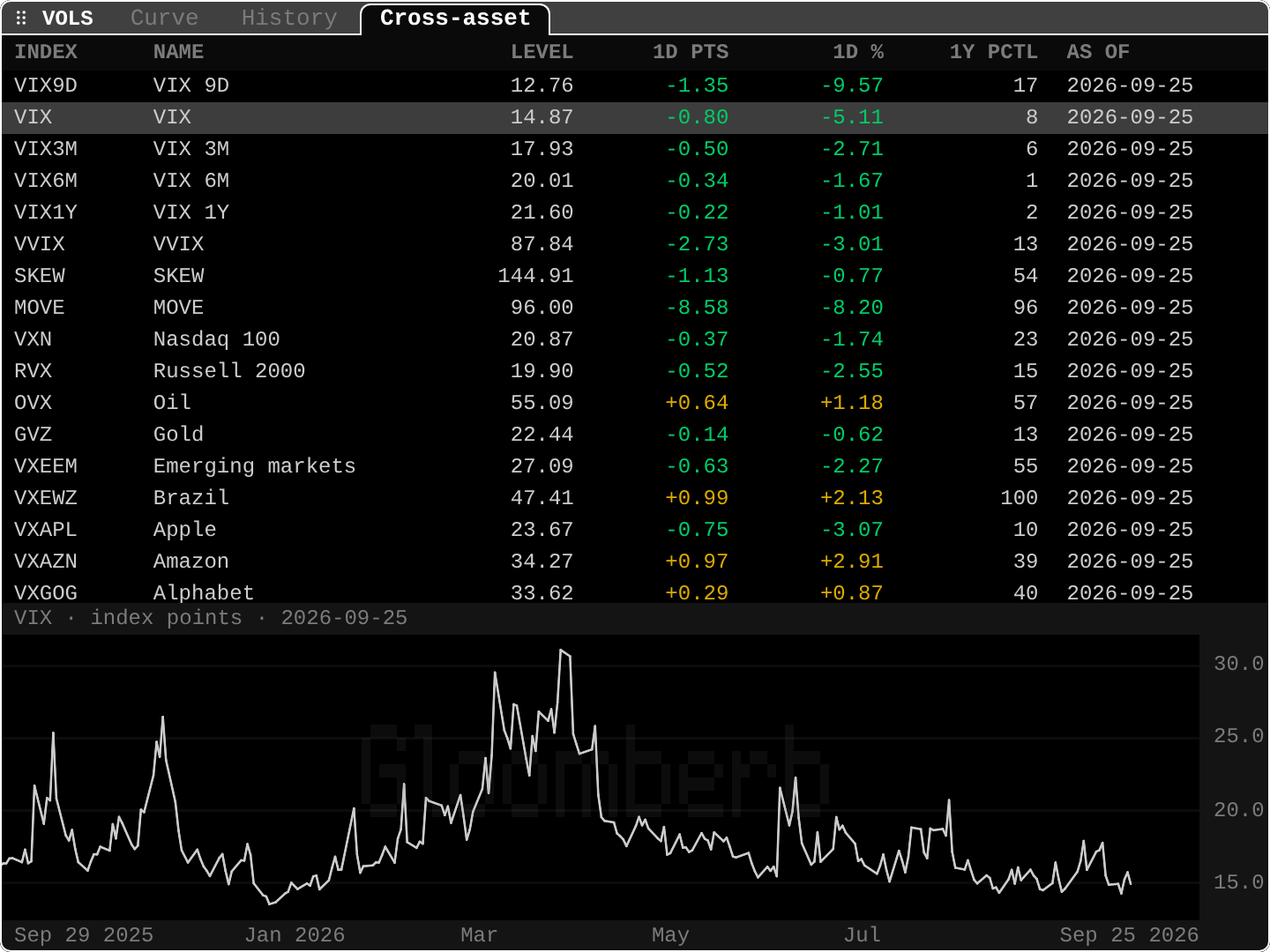
open ittype VOLS. (Taught in VIX and volatility indices.)
VIX 14.87,1Y PCTL 8: S&P 500 implied vol near the bottom of its past year. Calm.VIX9D 12.76belowVIX 14.87belowVIX3M 17.93: short-term implied vol below longer-term. A normal, calm shape.MOVE 96.00 1Y PCTL 96: bond-market volatility near its yearly high, while stock vol is low. A desk notices the contrast.VVIX 87.84: the volatility of VIX itself.- Single names:
VXAPL 23.67,VXAZN 34.27: implied vol for Apple and Amazon.
Practice and recap
Try it3 tasks
- A trader says "I'm long gamma". Does she want a quiet day or a wild one? (Wild: she gains from re-hedging big moves.)
- Who collects theta, the long-gamma or the short-gamma book? (Short gamma.)
- From the screenshot, which market's volatility is unusually high? (Rates: MOVE at the 96th percentile.)
Common mistakes4 mistakes
- Thinking a vol desk bets on direction. It hedges direction away.
- Confusing "long vol" (vega) with "long gamma": related but not the same horizon.
- Forgetting that short gamma looks like steady income until the day it is not.
- Reading low VIX as "safe". It means options are cheap, not that nothing will happen.
Check yourself3 questions
- What is delta hedging?
- What does a short-gamma book fear most?
- Name two sources of a vol desk's profit.
Answers
- Trading the stock (or futures) so the option book's sensitivity to small price moves stays near zero.
- Large sudden moves (gaps), which re-hedging cannot keep up with.
- Any two: the bid-ask spread, implied vol above realized on average, relative-value trades between strikes, expiries or names.
Words in this lesson7 words
- vol desk (equity derivatives desk)
- The bank team that trades options and volatility.
- delta hedging
- Trading the underlying to cancel the book's direction exposure.
- long / short gamma
- Gains from big moves / from calm, after delta hedging.
- long / short vol (vega)
- Gains if implied volatility rises / falls.
- re-hedging
- Adjusting the delta hedge as the price moves.
- gap
- A sudden jump in price with no trading in between.
- VVIX
- The volatility of the VIX index itself.
Educational material about reading market data, not investment advice.