Funds, ETFs and indices
A fund is a basket you can own, an index is a ruler that measures a basket, and an ETF is a fund that trades like a stock.
- 6 min
- 3 questions
- Lesson 2 of 4
Why you would care
When someone says the S&P 500 is up 1%, what went up, and can you buy it? "The market was up today." "SPY is down." "We benchmark against the Nasdaq." These three sentences use three different things: an index, an ETF, and a benchmark. If you know which is a ruler and which is a basket, you will never ask "how do I buy the S&P 500?" in a room full of traders (you cannot, directly).
The idea from scratch
A fund: one basket, many slices
Instead of buying one pizza shop, you and 999 strangers each put 100 dollars in a pot. The pot (100,000 dollars) buys slices of 50 different shops. The pot is a fund. Each of you owns 1/1,000 of the pot.
Why bother? Diversification: if one shop burns down, you lose 1/50 of the pot instead of everything. Spreading across many assets so that one bad event cannot ruin you.
The person who chooses what the pot buys is the fund manager. They charge a fee, a yearly percentage of the pot (for example 0.1% or 1%).
An index: a ruler, not a basket
An index is a number computed from a list of prices, by a rule. Example of a rule: "take about 500 large US companies, weight each by its market cap, add it all up, scale to a base". That is roughly the S&P 500 (in reality a committee picks the members using size and profit rules, and the weights count only the shares available to trade).
An index has no cash, no shares, no manager. It is a measuring stick. You cannot buy it, in the same way you cannot buy "the average temperature of Paris".
A benchmark is an index chosen as the comparison for a fund: "did my manager beat the S&P 500 this year?"
An ETF: a fund that trades like a stock
An ETF (exchange-traded fund) is a fund whose shares are listed on an exchange, so you buy and sell them all day with a ticker, like NVDA. SPY is a famous ETF that tries to copy the S&P 500 index.
So the chain is: the index (ruler) is defined by a rule; an ETF (basket) buys the same shares to copy it; you buy a share of the ETF.

See it in Gloom
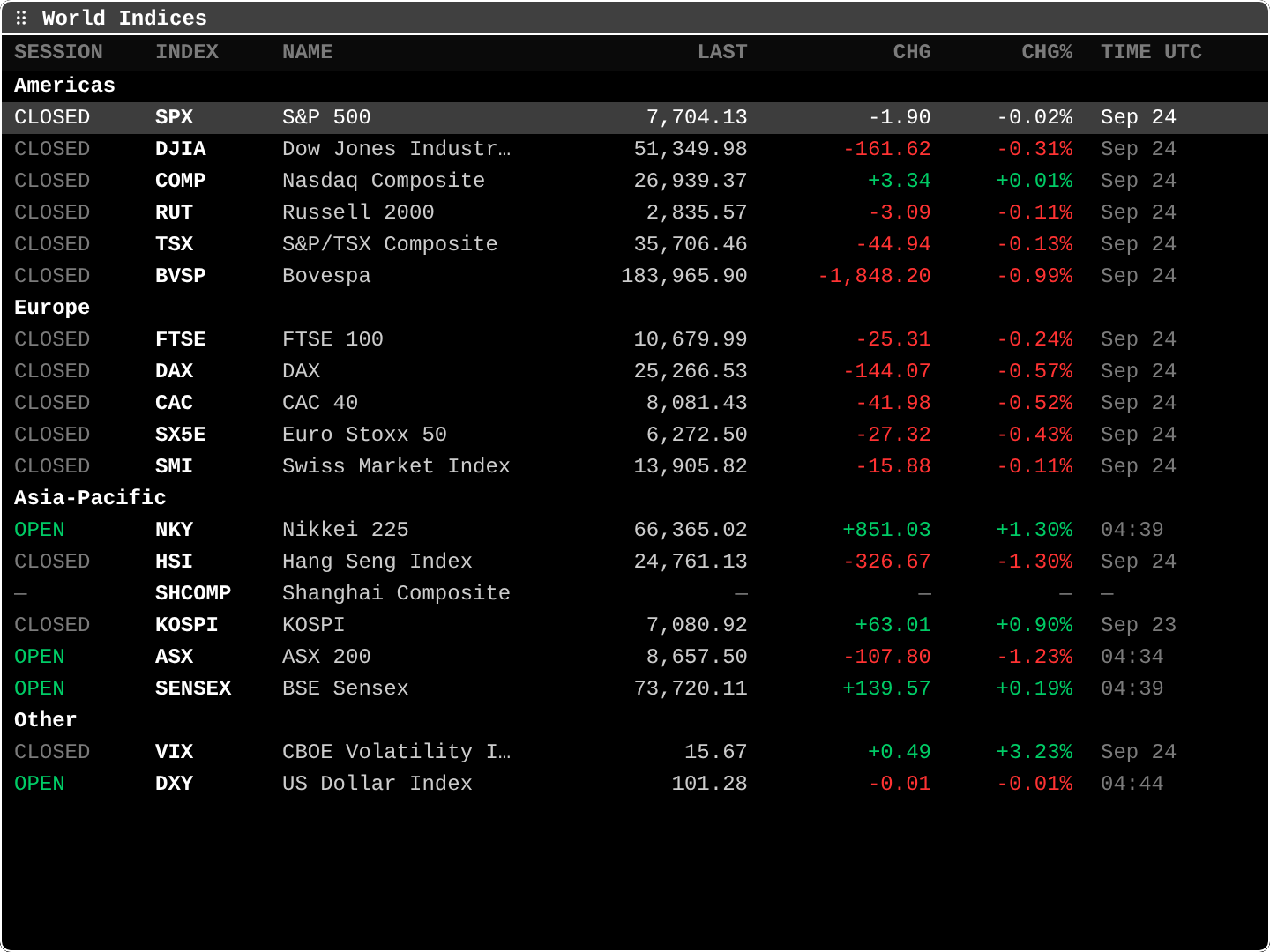
open ittype WEI in the command bar. (WEI is taught in World indices and venues.) Here we only read the shape.
SPX S&P 500 7,704.13: the level of the index at the capture. The number itself means nothing alone; its change does.CHG -1.90andCHG% -0.02%: it fell 1.90 points, which is 0.02% of 7,704. Percent is the one to compare across indices.DJIA 51,349.98vsSPX 7,704: different rulers have different scales. A bigger number is not a bigger market, just a different base and rule.- The Other block:
VIXis an index too, but it measures expected movement, not price (Understanding risk and the volatility chapter). - All numbers are historical examples from the capture date.
Practice and recap
Try it3 tasks
- On the screenshot, find which index moved most in percent. (Nikkei 225 and Hang Seng, each about 1.3%, in opposite directions.)
- Pick two indices with very different levels, say
CAC 40at about 8,000 andBovespaat about 184,000. Ask: can I compare the point changes? (No. CompareCHG%.) - Say out loud the difference between "the S&P 500" and "SPY". (Ruler vs basket that copies the ruler.)
Common mistakes4 mistakes
- "I bought the index." You bought a fund or ETF that copies it. Close, not the same: fees and small tracking errors exist.
- Reading index levels as prices. 7,704 is not dollars; it is a scaled sum.
- Assuming every ETF is a broad, calm basket. Check what it holds.
- Comparing a fund's return to the wrong benchmark. A tech fund measured against a bond index looks like a genius or a fool for no reason.
Check yourself3 questions
- A friend says "I want to buy the Nasdaq 100 index". What do they actually need to buy?
- Company A is worth 900, B is worth 100. In a market-cap-weighted index of the two, A rises 1% and B rises 10%. What does the index do?
- Is an ETF always diversified?
Answers
- A fund or ETF that tracks the Nasdaq 100 (for example one with the ticker QQQ). The index itself cannot be bought.
- Weights: A 90%, B 10%. Index change = 0.9 x 1% + 0.1 x 10% = 0.9% + 1% = +1.9%.
- No. Some hold one commodity, one sector, or use leverage. Always check what is inside.
Words in this lesson9 words
- fund
- A pot of money from many people, invested in a basket of assets; each person owns a share of the pot.
- diversification
- Spreading money across many assets so one bad event cannot ruin you.
- fund manager
- The person or company that decides what the fund buys, for a fee.
- fee
- The yearly percentage of a fund that goes to the manager.
- index
- A number computed by a rule from a list of prices. A ruler, not a product.
- S&P 500
- An index of about 500 large US companies, weighted by market cap.
- benchmark
- The index a fund is compared with.
- ETF (exchange-traded fund)
- A fund whose shares trade on an exchange like a stock.
- market-cap weighted
- Bigger companies count more in the index, in proportion to their size.
Educational material about reading market data, not investment advice.