IPOs (IPO)
IPO lists upcoming, priced and recent initial public offerings on the main US, Asia-Pacific and European venues, with size, price range and first-day performance.
- 3 min
- 3 questions
- Lesson 5 of 6
Why you would care
Which companies are coming to market, and how did recent ones trade? IPOs are how private companies become stocks you can buy. A busy IPO calendar signals strong investor appetite; broken deals (trading below their offer price) signal caution. Big IPOs also move their sector: a hot listing can reprice its listed peers.
The idea from scratch
How an IPO works
- The company hires underwriters (investment banks) and files a registration statement (an S-1 in the US) with financial details.
- The bankers market the deal to investors (the roadshow) and set a price range.
- The night before trading, they set the offer price based on demand, and allocate shares.
- The stock starts trading on its exchange. The first-day return is the first close against the offer price.
Many US "IPOs" at exactly 10.00 dollars are SPACs (special purpose acquisition companies): empty shells that raise cash to buy a private company later. They usually trade near 10.00 until a deal is announced.
- File S-1
- Roadshow, price range
- Pricing: offer price
- First trade on the exchange
- First-day return vs offer
See it in Gloom
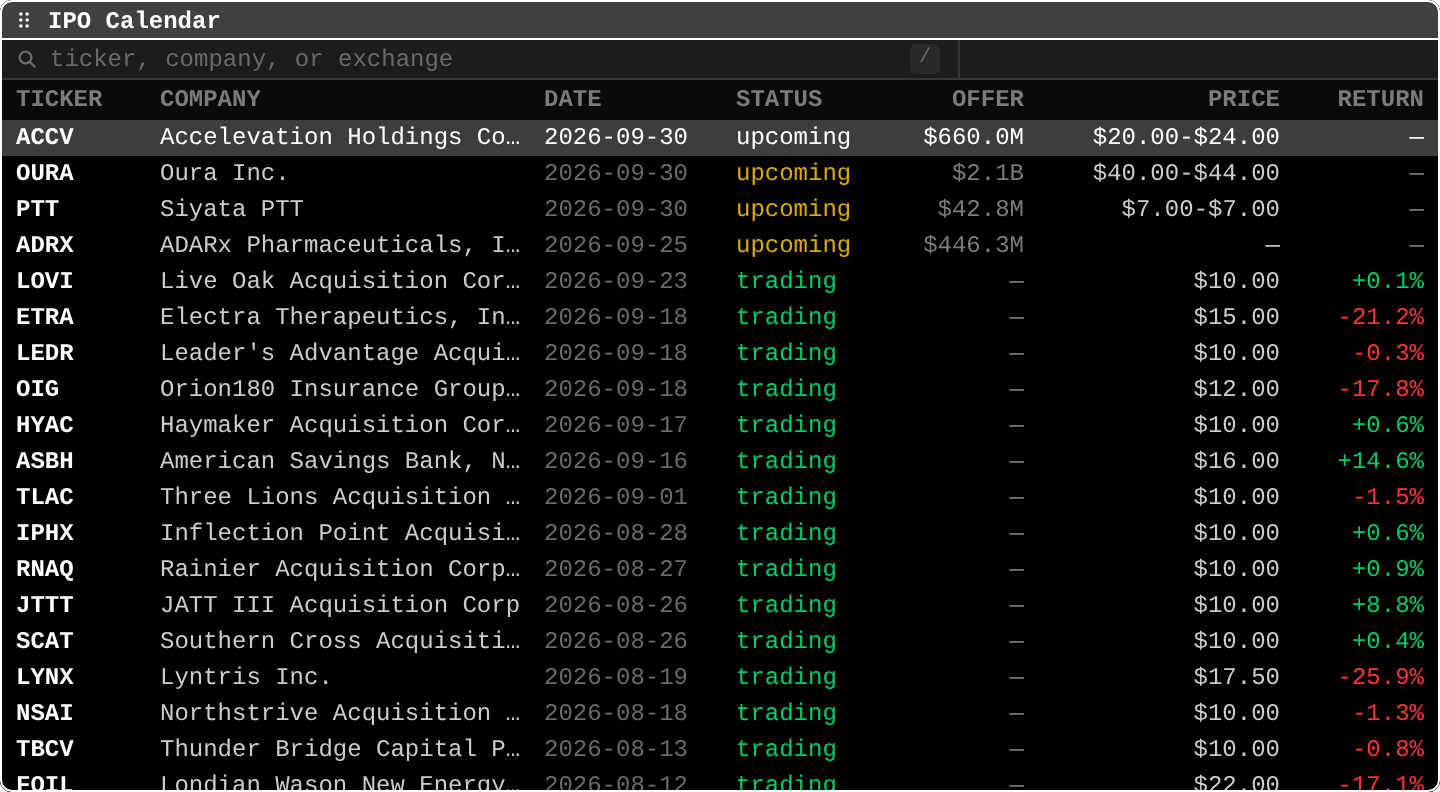
open ittype IPO. Tabs: All, US, APAC, Europe; / searches; Enter opens a listed deal's ticker on its exchange.
OURA Oura Inc. 2026-09-30 upcoming $2.1B $40.00-$44.00: a large upcoming deal and its price range.ACCV ... $660.0M $20.00-$24.00: money to be raised and the range.ETRA Electra Therapeutics trading $15.00 -21.2%: a recent IPO trading well below its offer price.- Many
... Acquisition Corp $10.00: SPACs priced at 10 dollars, trading near it. ASBH American Savings Bank $16.00 +14.6%: a deal trading above its offer.- Dates in the venue's own calendar, dimmed while only expected.
Practice and recap
Try it3 tasks
- Offer 15, first close 12. First-day return? (-20%.)
- Why do many recent IPOs show exactly 10.00 dollars? (They are SPACs, which list at 10.)
- What is the midpoint of Oura's range? (42 dollars.)
Common mistakes4 mistakes
- Assuming IPOs always pop: many trade below their offer.
- Treating a SPAC like an operating company.
- Comparing the first-day return with the return an ordinary buyer can get: most first-day gains go to investors allocated at the offer.
- Forgetting lock-up expiries: insiders often can sell months later, adding supply.
Check yourself3 questions
- What is an IPO?
- What is the first-day return?
- What is a SPAC?
Answers
- A company's first sale of shares to the public and start of trading on an exchange.
- The first day's closing price compared with the offer price.
- A shell company that raises cash in an IPO to buy a private company later.
Words in this lesson7 words
- IPO
- Initial public offering.
- underwriter
- The bank that organizes and sells an IPO.
- price range / offer price
- The expected range / the final price set before trading.
- roadshow
- Marketing an IPO to investors.
- first-day return
- First close vs offer price.
- SPAC
- A listed shell company that later buys a private business.
- lock-up
- A period after an IPO when insiders cannot sell.
Educational material about reading market data, not investment advice.