Analyst ratings and price targets (ANR)
ANR shows sell-side ratings and 12-month price targets: the average target and its history, the upside to it, and every recent action by firm.
- 4 min
- 3 questions
- Lesson 5 of 5
Why you would care
What do the analysts who cover this stock think? "Morgan Stanley upgrades X to Overweight" is a headline that can move a stock several percent in a morning. Knowing how to read ratings, and their well-known biases, lets you use them as information without taking them as truth.
The idea from scratch
A sell-side analyst covers a list of companies and publishes research (chapter 01, Who is who on Wall Street). Each report carries:
- a rating: the analyst's verdict,
- a price target: where they think the price will be in about 12 months.
Ratings come in different words
Each firm has its own scale. They map roughly to three levels:
| Positive | Neutral | Negative |
|---|---|---|
| Buy, Overweight, Outperform, Market Outperform | Hold, Neutral, Equal weight, Market Perform | Sell, Underweight, Underperform |
"Overweight" means "hold more of it than its weight in the index". "Outperform" means "expect it to do better than the market or its sector".
Actions
Initiation
a firm starts covering the stock.
Upgrade / downgrade
the rating changes level. Rare, and the market listens.
Raises / lowers
the target changes, the rating stays. Very common after reports.
Maintains
rating and target confirmed.
Upside
Upside = average target / current price - 1.
Known biases
- Few sell ratings: most ratings are positive, partly because banks also sell services to the companies they cover.
- Targets follow prices: after a big rally, targets get raised.
- Herding: many firms move together after the same report.

See it in Gloom
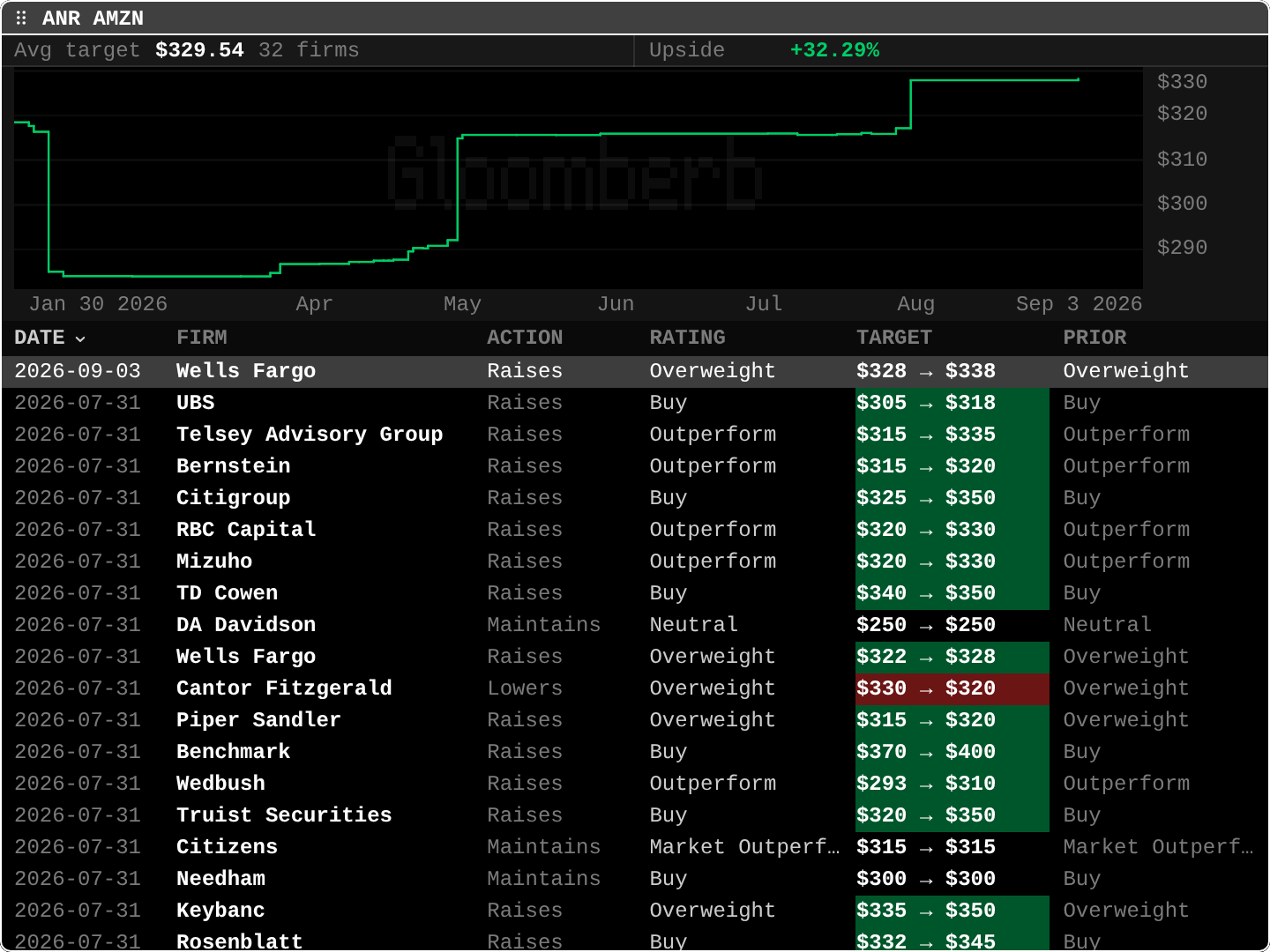
open ittype ANR AMZN.
Avg target $329.54 32 firms: the average 12-month target across 32 covering firms.Upside +32.29%: the average target is 32% above the price at capture (about 249 dollars).- The green line: the average target over time. It dropped in early February, climbed through the spring, and jumped at the end of July, right after the company's report.
- The table:
2026-07-31repeated: most firms updated the day after results.Raises,Maintains,Lowersare target actions; theRATINGcolumn is unchanged for all of them (no upgrades or downgrades here). Cantor Fitzgerald Lowers Overweight $330 → $320: a lower target with the same positive rating. A firm can trim its target and still like the stock.
Practice and recap
Try it3 tasks
- In the screenshot, which firm has the highest new target? (Benchmark, $400.)
- How many of the visible July 31 rows lowered their target? (One: Cantor Fitzgerald.)
- Price 50, average target 45. Upside? (-10%: the average target is below the price.)
Common mistakes4 mistakes
- Reading "Overweight" and "Outperform" as different opinions. They are roughly the same: positive.
- Taking the upside as a forecast. Targets miss often and follow prices.
- Confusing a target raise with an upgrade.
- Ignoring how many firms are behind the average: 3 firms is not 32.
Check yourself3 questions
- Name one positive, one neutral and one negative rating word.
- What is the difference between an upgrade and a target raise?
- Why do so many firms act on the same day?
Answers
- For example Buy, Hold, Sell (or Overweight, Equal weight, Underweight).
- An upgrade changes the rating level; a target raise changes only the price target.
- They update after the company's quarterly report.
Words in this lesson7 words
- rating
- An analyst's verdict, in the firm's own words.
- price target
- Where an analyst expects the price in about 12 months.
- overweight / underweight
- Hold more / less than the stock's weight in the index.
- outperform / underperform
- Expected to do better / worse than the market or sector.
- initiation
- A firm starting coverage of a stock.
- upgrade / downgrade
- A rating moving up / down a level.
- upside
- Average target divided by price, minus 1.
Educational material about reading market data, not investment advice.