What growth is priced in? (RDCF)
RDCF runs a discounted cash flow model backwards, finding the yearly growth today's value assumes and setting it next to the growth the company actually delivered.
- 5 min
- 3 questions
- Lesson 5 of 5
Why you would care
What does the price already assume? Arguing about whether a stock is "cheap" goes nowhere. A better question: "to be worth today's price, how fast must this company grow?" If the answer is 25% a year for ten years and the company has grown 5%, you know what you are betting on.
The idea from scratch
Money later is worth less than money now
If you can earn 9% a year elsewhere, 109 dollars in one year is worth 100 today. Turning a future amount into today's value is called discounting; the rate used is the discount rate.
DCF: a company is its future cash
A DCF (discounted cash flow) model:
- Forecasts free cash flow for each of the next years (say ten), growing at some rate.
- Adds a terminal value: the value of all years after that, assuming slow growth forever (2.5% a year, for example).
- Discounts everything to today and adds it up. The sum is what the business is worth, its enterprise value.
The answer depends heavily on two guesses: the growth rate and the discount rate. Small changes move the result a lot.
Reverse DCF: start from the price
Instead of guessing growth to find a value, take the value the market already gives (enterprise value: market cap plus debt minus cash) and solve for the growth that makes the DCF equal it. That is the priced-in growth.

See it in Gloom
open ittype RDCF AAPL.
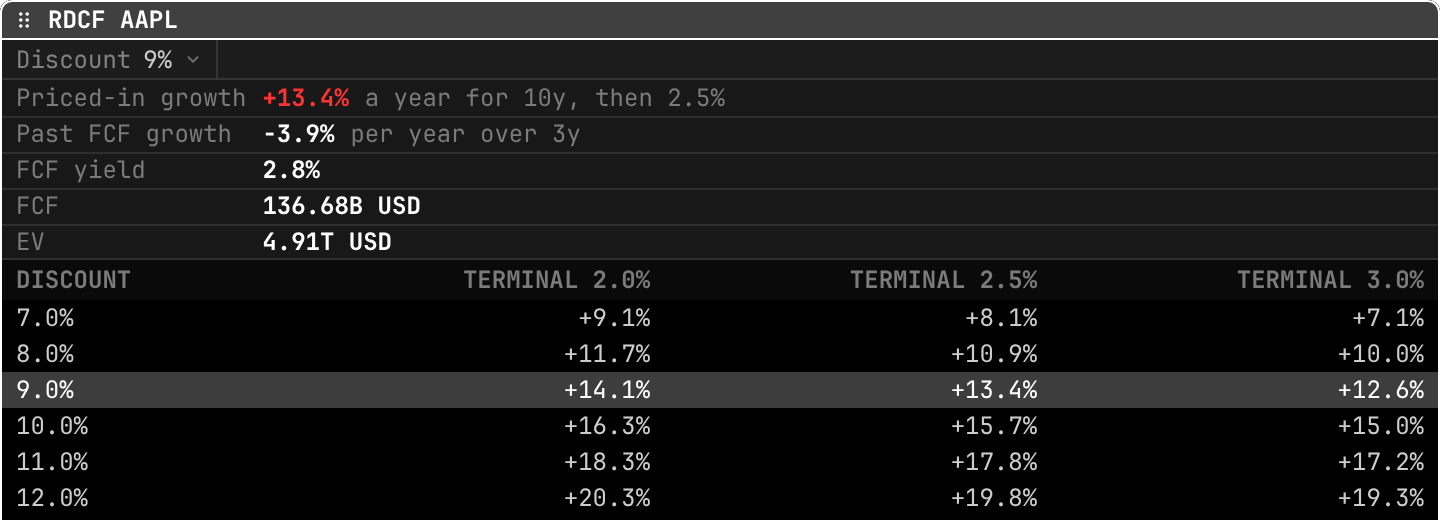
Discount 9%: the rate used (choose from 7% to 12%).Priced-in growth +13.4% a year for 10y, then 2.5%: to justify its value, Apple's free cash flow must grow 13.4% a year for ten years, then 2.5% forever. It is red because it is above the past growth.Past FCF growth -3.9% per year over 3y: what the company actually delivered recently.FCF 136.68B USD,EV 4.91T USD,FCF yield 2.8%: the inputs (136.68 / 4,910 = 2.8%).- The table: priced-in growth for each discount rate (rows) and each long-run growth (columns). At 7% the price needs about 8%; at 12% it needs about 20%. Selecting a row sets the discount rate.
Practice and recap
Try it3 tasks
- In the table, what growth does the price need with an 8% discount rate and 3% terminal growth? (+10.0%.)
- Why does a higher discount rate need more growth? (Future cash is worth less today, so more of it is needed to reach the same value.)
- Discount 200 dollars received in 2 years at 10%. (200 / 1.21 = about 165.)
Common mistakes4 mistakes
- Treating the discount rate as a fact. It is a choice; look at the whole table.
- Comparing priced-in growth with a single strong year. Use several years.
- Using RDCF for banks or insurers, whose "free cash flow" means little.
- Forgetting that free cash flow can jump because of one-off items.
Check yourself3 questions
- What does discounting do?
- What is the difference between a DCF and a reverse DCF?
- Priced-in growth 15%, past growth 4%. What does that tell you?
Answers
- It turns future money into today's value, using a discount rate.
- A DCF assumes growth and finds a value; a reverse DCF takes the value and finds the growth it implies.
- The price assumes much faster growth than the company has delivered: the market expects an acceleration, or the stock is priced for a lot to go right.
Words in this lesson7 words
- discounting
- Turning a future amount into today's value.
- discount rate
- The yearly rate used to discount; the return you require.
- DCF (discounted cash flow)
- Valuing a company as the sum of its discounted future cash flows.
- terminal value
- The value of all cash flows after the forecast years.
- reverse DCF
- Solving for the growth that today's value implies.
- priced-in growth
- The growth rate the current price assumes.
- sensitivity table
- The same answer computed for several input choices.
Educational material about reading market data, not investment advice.