Alerts (ALRT, SA)
An alert watches the market for you, firing on a price level, a day's move, a valuation or technical level, or an event such as an earnings date, a filing or an insider trade, and ALRT lists them all.
- 5 min
- 3 questions
- Lesson 4 of 8
Why you would care
You want to buy if a stock dips to 195, or know the moment a company files an 8-K. An alert turns "I'll keep an eye on it" into a rule.
The idea from scratch
An alert is a rule plus a notification:
Price alert
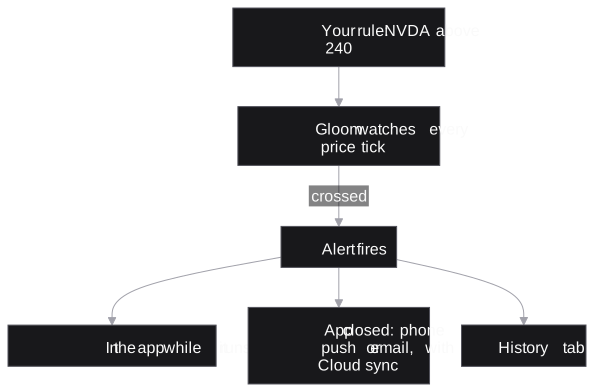
a ticker, a condition and a level. "NVDA above 240" fires the first time the price trades above 240.
Move alert
a ticker and a percent. "NVDA moves 5%" fires when the day's move reaches 5%, up or down.
Event alert
a ticker (or your portfolio) and an event, like "8-K filed".
A price condition is above (>), below (<) or crosses (x, either way). Once a price alert fires, it is done until you re-arm it (set it to watch again). Levels are written as precisely as the market quotes them: a London share in pence. A level the price is already past fires at the next check, and the reply says so:
$ gloom alerts add NVDA above 150   (trimmed)
... Last price 188.70, already above 150.00, so it goes off at the next check.
Move alerts
A move is the day's change from the previous close. Type moves, up or down and a percent, for any listing or pair; several tickers, or --watchlist <name>, make one alert each. From the shell (illustrative tickers, real replies):
$ gloom alerts add NVDA moves 5%   (trimmed)
Added alert ...: NVDA:NASDAQ moves 5.00% (...). Now +3.91% vs Thu 5 Nov close.
The app alerts while it is running; sign in with Cloud sync for ...
$ gloom alerts add AAPL MSFT KO XOM down 3%   (trimmed)
Added 4 move alerts: down 3.00% from the previous close (...).
  The app alerts while it is running; sign in with Cloud sync for ...
  By venue: 2 NASDAQ, 2 NYSE.
It goes off once a session, then re-arms for the next.
Event alerts
ALRT, Events tab. For a US-listed ticker: an earnings date, an SEC filing (8-K, 10-K, S-1...), a news keyword, an analyst rating change, a 52-week high or low, unusual volume, short interest, insider trades, and on Pro an implied volatility spike or large options flow. Congress trades and 13F filings too (chapter 05). An IPO alert (gloom alerts add ipo Stripe) follows a company through its listing: on the calendar, dated, priced, trading.
An IV level alert fires when 30-day implied volatility (the yearly swing options price in) or its skew passes a level, bitcoin and ether included: gloom alerts add BTC-USD iv above 50.
Most event rules need you signed in.
Rules on valuation, technicals and relative strength
Add Alert (a on the Levels tab) also offers:
| Rule | Fires when |
|---|---|
| P/E or P/S | the trailing multiple passes your level |
| RSI | RSI passes your level, say under 30 |
| MA crossover | the 50-day moving average crosses the 200-day, for example |
| Close vs MA | a close lands on the other side of its average |
| Ratio to benchmark | XLK/SPY passes 0.25, for example |
| RRG quadrant | the weekly quadrant against SPY changes |
A moving average (MA) is the average close of the last N days; RSI gauges recent gains against losses, 0 to 100 (chapter 03). These rules read the final close, so a day still trading never fires them.
See it in Gloom
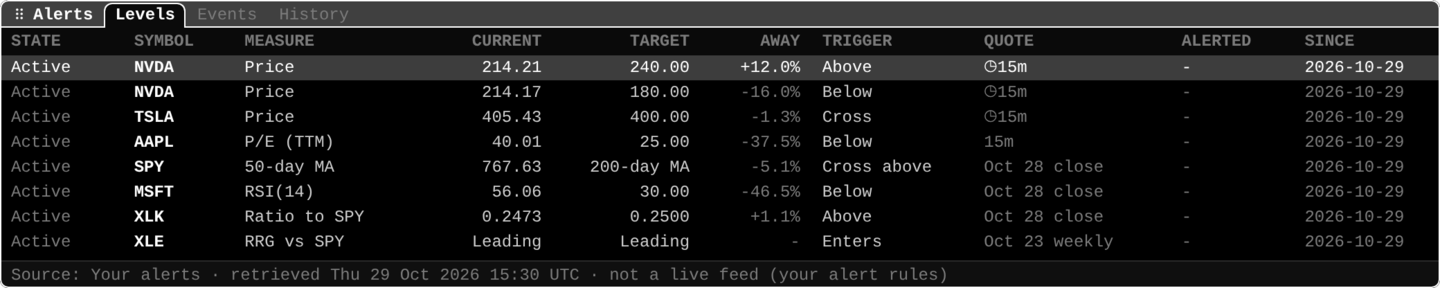
Open ittype ALRT. Create one from anywhere with SA NVDA above 240.
- Tabs:
Levels(prices, moves and the rules above),Events,History(what went off on this device, and what was created, re-armed or deleted). NVDA Price 214.21 240.00 +12.0% Above: the price is 214.21, the target 240; it must rise 12% to fire.TSLA ... 400.00 -1.3% Cross: fires if 400 is crossed in either direction.QUOTE:◷15mis a quote 15 minutes behind; a daily rule shows the close it read (Oct 28 close,Oct 23 weekly).ALERTED -: empty until it fires.SINCE: the day you made it.
Keys: a add, e edit, d delete, m re-arm.
Practice and recap
Try it3 tasks
- Write the command for an alert when TSLA falls below 300. (
SA TSLA below 300, orSA TSLA < 300.) - In the screenshot, which alert is closest to firing? (TSLA, 1.3% away.)
- Write an alert for any day KO moves 2% or more. (
gloom alerts add KO moves 2%.)
Common mistakes3 mistakes
- Expecting a fired alert to fire again. Re-arm it.
- Putting "above" when you meant "crosses" for a level the price might gap through.
- Expecting an RSI or moving-average rule to fire mid-session.
Check yourself3 questions
- What three things make a price alert?
- What does
mdo inALRT? - Your app is closed when a move alert goes off. How can you still hear of it?
Answers
- A ticker, a condition (above, below, crosses) and a level.
- Re-arms the selected alert so it watches again.
- Signed in with Cloud sync: a phone push and a line in that day's market email.
Words in this lesson4 words
- price alert
- Fires when a price goes above, below or across a level.
- move alert
- Fires when the day's move from the previous close reaches a percent.
- re-arm
- Set a fired alert to watch again.
- IV level alert
- Fires when 30-day implied volatility or its skew passes a level.
Educational material about reading market data, not investment advice.