The options chain (OMON)
OMON is the menu of every option on one stock: one tab per expiry, one row per strike, calls left and puts right with quotes and Greeks, and a strip of volatility numbers on top.
- 4 min
- 3 questions
- Lesson 1 of 2
Why you would care
What does each option cost, and how liquid is it? Before any options trade, someone opens the chain. It tells you which contracts exist, what they cost, how liquid they are and how the market prices volatility for each expiry. Reading it fluently is the options equivalent of reading a quote.
The idea from scratch
A chain organizes options on two axes:
Expiry
the last day of the contract. Weekly, monthly, quarterly, sometimes years out.
Strike
the fixed price in the contract, in steps (here 2.50 dollars apart).
For each strike there is a call (right to buy) and a put (right to sell), each with its own quote. Near the current stock price sit the at-the-money (ATM) options; far above and below, the cheap out-of-the-money (OTM) ones.
What to read for each contract:
- Bid / Ask
- What buyers pay / sellers want, per share (one contract usually covers 100 shares)
- Spread %
- (Ask - Bid) / mid: the cost of trading it; wide on far strikes
- Last
- The last trade, possibly old
- Delta (Δ)
- Price change per 1 dollar stock move; also a rough chance of ending in the money
- Gamma (Γ)
- How fast delta changes; highest at the money near expiry
- IV, volume, open interest
- Implied volatility, contracts traded today, contracts still open
- Pick an expiry tab
- Find the strike near the stock price
- Read bid, ask and spread
- Read delta and gamma
- Check the vol strip: ATM IV, HV30, IV/HV
- Send to OSA to build a position
See it in Gloom
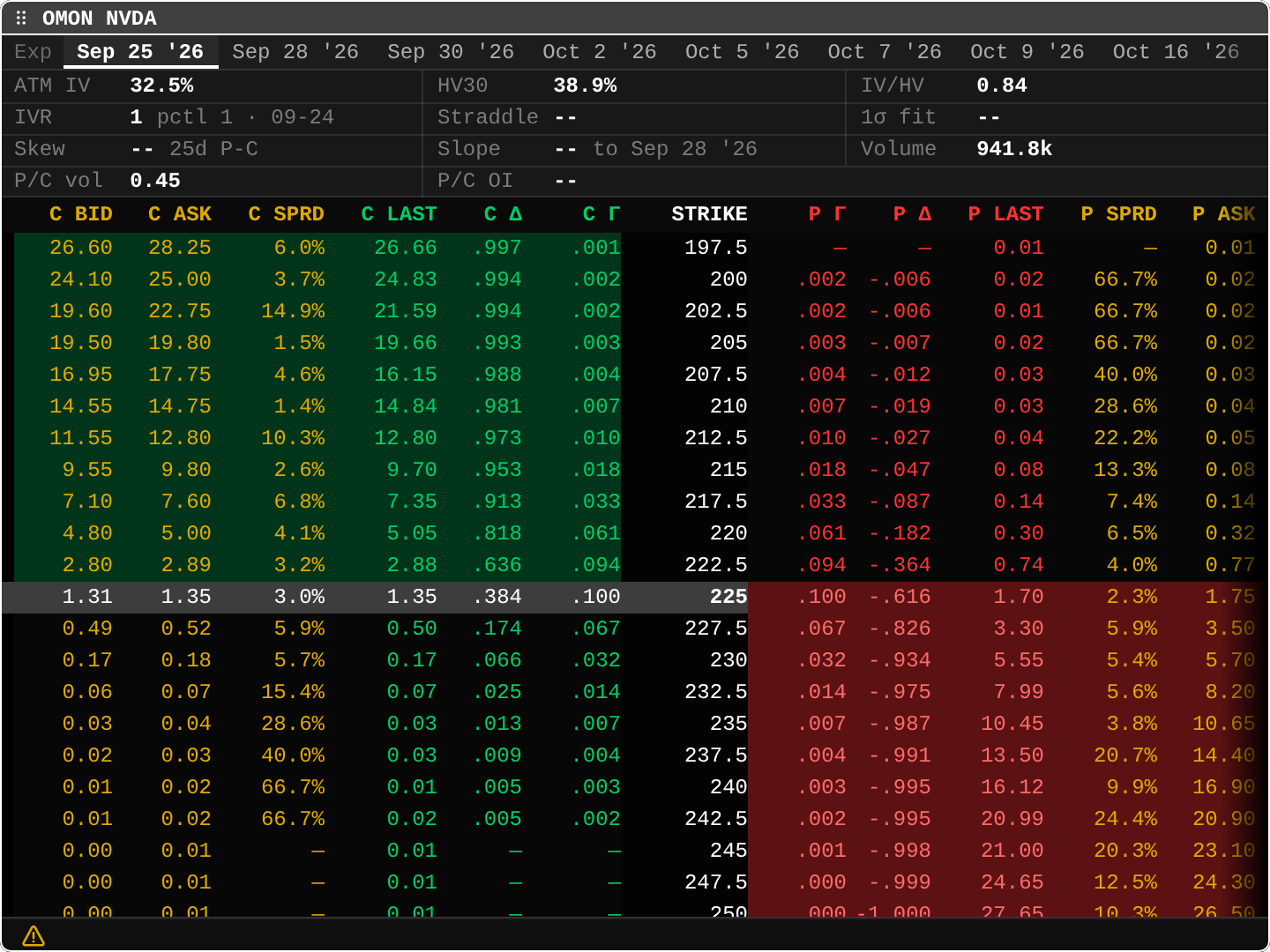
open ittype OMON NVDA. [ and ] step through expiries; x switches the cursor between call and put; c opens the calculator, a adds the contract to OSA, s opens the surface.
- Expiry tabs:
Sep 25 '26,Sep 28 '26... the selected one is highlighted. - The strip:
ATM IV 32.5%,HV30 38.9%,IV/HV 0.84,P/C vol 0.45(put volume / call volume), totalVolume 941.8kcontracts. - The highlighted row
225: the strike nearest the stock (about 224). Call1.31 / 1.35, delta.384; put1.70 / 1.75, delta-.616. - Shading: green calls and red puts are in the money (calls below the price, puts above it).
C SPRD 3.0%at the money vs66.7%on far strikes: far options are cheap but very expensive to trade.- Gamma peaks at the money (
.100) and fades on both sides.
Practice and recap
Try it3 tasks
- What does the 230 call cost per contract? (Ask 0.18 x 100 = 18 dollars.)
- At the 225 strike, add the call delta and the size of the put delta. (0.384 + 0.616 = 1.000: for the same strike and expiry, call delta minus put delta is about 1.)
- Which contract would you avoid trading because of its spread: 225 call or 240 call? (240 call: 66.7%.)
Common mistakes4 mistakes
- Reading the last price as the price you can trade. Use bid and ask.
- Forgetting the 100 multiplier.
- Trading far out-of-the-money options with huge percentage spreads.
- Comparing IVs across expiries without noticing events (earnings) inside one of them.
Check yourself3 questions
- What are the two axes of a chain?
- Which strikes have the highest gamma?
- A call shows bid 2.00, ask 2.20. Spread in percent of the mid?
Answers
- Expiry (tabs) and strike (rows).
- Those near the current price (at the money), especially close to expiry.
- 0.20 / 2.10 ≈ 9.5%.
Words in this lesson6 words
- chain
- The table of all options on one underlying.
- at / in / out of the money
- Strike near / favorable to / unfavorable to the current price.
- contract multiplier
- Shares per contract, usually 100.
- spread %
- (Ask - bid) / mid: the cost of trading.
- put/call ratio
- Put volume (or open interest) divided by call volume.
- open interest
- Contracts still open after the last session.
Educational material about reading market data, not investment advice.