Pricing one bond (YAS)
YAS is a bond calculator that turns a yield into a price (or back) and adds accrued interest, duration, convexity, DV01 and the spread to the Treasury curve.
- 4 min
- 3 questions
- Lesson 6 of 6
Why you would care
What is this bond worth, and how much does a basis point cost? Bond traders quote yields; investors pay prices. Converting between them, and knowing how much a 1 bp move costs, is the daily arithmetic of a rates or credit desk. It also makes the textbook ideas of chapter 1 concrete: price and yield on a seesaw, longer bonds moving more.
The idea from scratch
Price from yield
A bond's price is the value today of all its future payments (coupons and principal), discounted at its yield. If the yield is below the coupon, the bond is worth more than 100 (a premium); above it, less (a discount).
Clean and dirty price
Coupons are paid every six months, but interest builds up daily. Accrued interest is the coupon earned since the last payment. The dirty price (what you actually pay) = clean price (the quoted price) + accrued interest. On a coupon date, accrued is zero and both are equal.
Sensitivity
Duration (Macaulay)
the average time, in years, until you get your money back, weighted by the payments' values.
Modified duration
the % price change for a 1 percentage point change in yield. 4.4 means about -4.4% if yields rise 1 point.
DV01
the price change for a 1 basis point move (here per 100 of face value).
Convexity
the curve in the price-yield relationship; it makes prices rise a bit more when yields fall than they drop when yields rise.
Spread to Treasuries
The bond's yield minus the Treasury yield at the same maturity. Positive for a company (credit risk); here a hypothetical bond yields less than Treasuries, so the spread is negative.

See it in Gloom
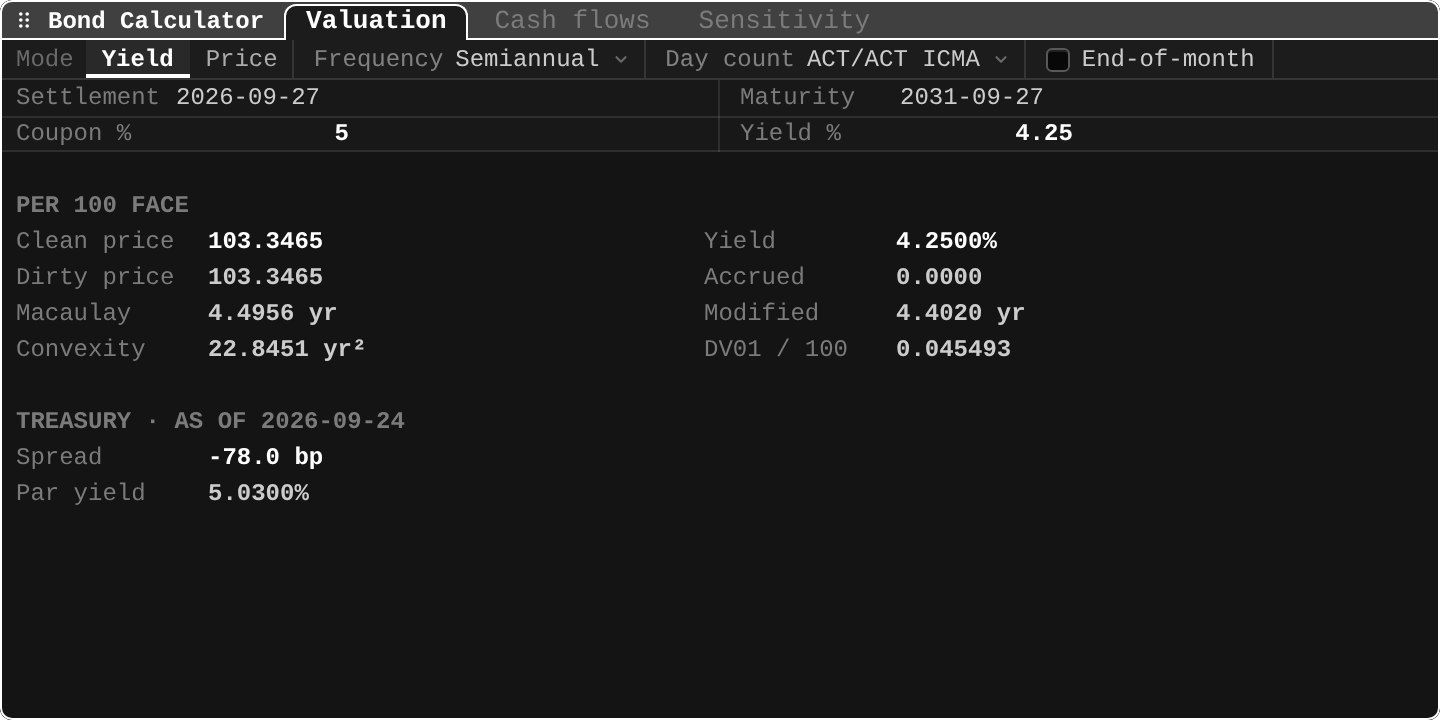
open ittype YAS. Tabs: Valuation, Cash flows, Sensitivity. Mode Yield (type a yield) or Price; Frequency and Day count settings.
- Inputs:
Settlement 2026-09-27,Maturity 2031-09-27,Coupon 5,Yield 4.25. Clean price 103.3465andDirty price 103.3465,Accrued 0.0000: settlement falls on a coupon date, so no accrued interest.Macaulay 4.4956 yr,Modified 4.4020 yr: a 1 point rise in yield would cut the price about 4.4%.DV01 / 100 0.045493: about 4.5 cents per 100 of face per basis point.Convexity 22.8451.TREASURY · AS OF 2026-09-24 Spread -78.0 bp Par yield 5.0300%: the 5-year Treasury yields 5.03%, so this bond at 4.25% is 78 bp below it.
Practice and recap
Try it3 tasks
- If yields rise 10 bp, about how much does the price fall? (10 x 0.0455 ≈ 0.45 per 100.)
- Coupon 5%, yield 6%: premium or discount? (Discount: below 100.)
- Three months after a coupon date, a 5% bond has accrued about how much per 100? (5 / 4 = 1.25.)
Common mistakes4 mistakes
- Quoting the clean price as what you pay; you pay the dirty price.
- Using Macaulay duration as a price sensitivity; use modified duration or DV01.
- Ignoring day-count and frequency conventions when comparing bonds.
- Forgetting convexity for big rate moves.
Check yourself3 questions
- What is accrued interest?
- Modified duration 7. Yields fall 0.5 point. Price change?
- What is DV01?
Answers
- The coupon earned since the last payment date, paid by the buyer to the seller.
- About +3.5%.
- The price change for a 1 basis point move in yield.
Words in this lesson8 words
- premium / discount (bond)
- Priced above / below 100.
- accrued interest
- Coupon earned since the last payment.
- clean / dirty price
- Quoted price / price plus accrued interest.
- Macaulay duration
- Weighted average time to receive the bond's payments.
- modified duration
- % price change per 1 point change in yield.
- DV01
- Price change per 1 bp move.
- convexity
- The curvature of the price-yield relationship.
- day count
- The rule for counting days when accruing interest.
Educational material about reading market data, not investment advice.