Risk factors (RISK)
RISK groups the risk factors in a company's 10-K by theme and shows what was added, dropped or reworded since the previous year.
- 3 min
- 3 questions
- Lesson 2 of 4
Why you would care
What is the company itself worried about, and what changed? Risk factor sections are long, legalistic and mostly copied from last year. That is exactly why the changes matter: a new paragraph is a risk lawyers and management decided to add this year. Reading only what changed turns 30 pages into 2.
The idea from scratch
Risk factors (Item 1A of the 10-K) are the company's own list of things that could materially hurt its business or share price: competition, regulation, supply, key people, lawsuits, debt, technology, the economy. Companies write them partly to protect themselves legally: "we warned you".
Most of the text repeats year after year. The useful signal is the diff (the differences):
| Change | What it can mean |
|---|---|
| New risk | A new product, market, lawsuit, regulation or worry |
| Dropped risk | A problem solved, a business sold, or just a rewrite |
| Reworded risk | Emphasis changed: "may" became "has", "some" became "significant" |

See it in Gloom
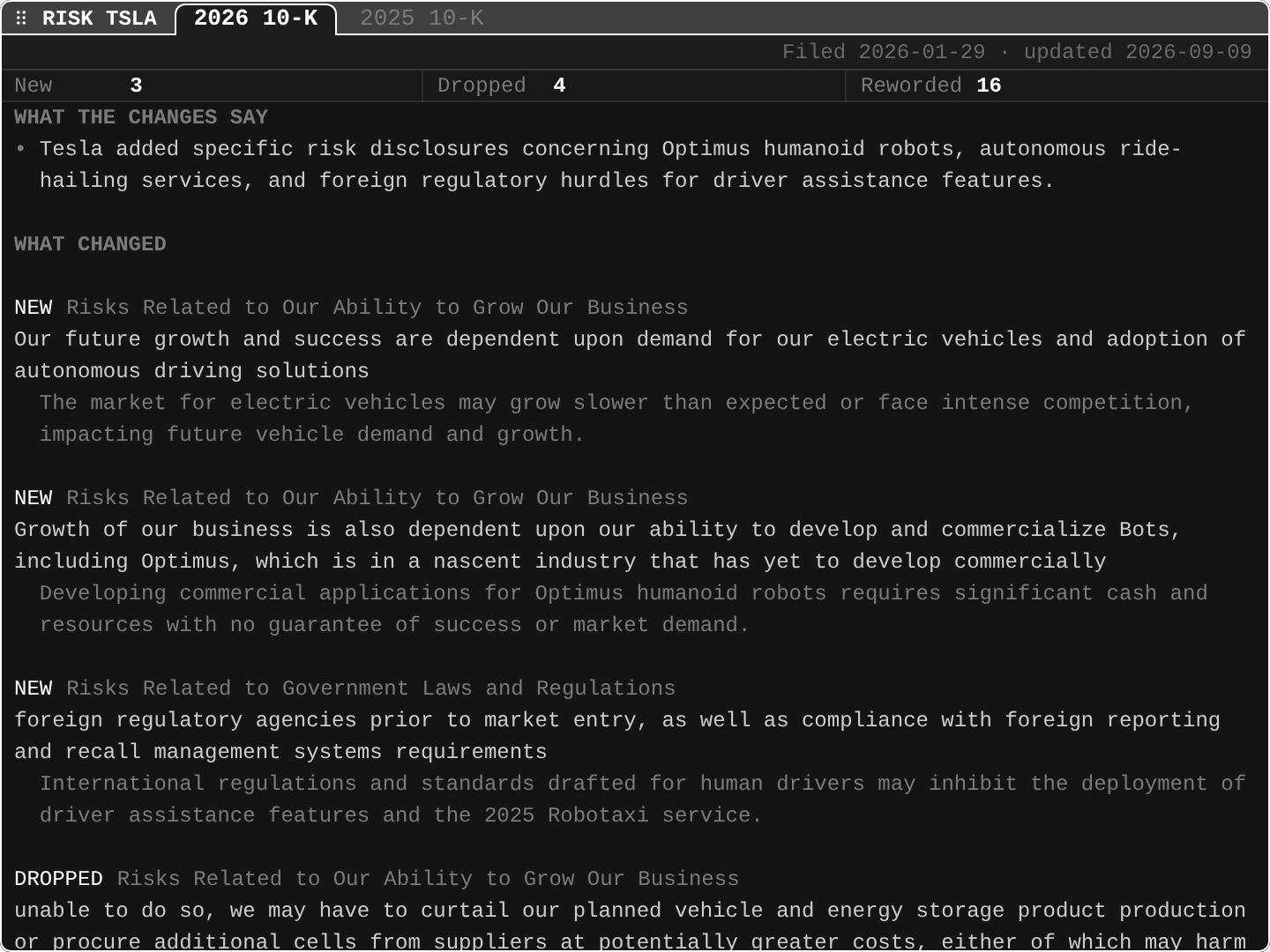
open ittype RISK TSLA. Tabs per year (2026 10-K, 2025 10-K); y switches the year; o opens the filing.
Filed 2026-01-29 · updated 2026-09-09: the 10-K's filing date.New 3 Dropped 4 Reworded 16: how much the section changed.WHAT THE CHANGES SAY: one paragraph: Tesla added risks about humanoid robots, autonomous ride-hailing and foreign rules for driver assistance.NEW Risks Related to Our Ability to Grow Our Business: the theme, then the risk's title in bold-ish text and a one-line summary below.DROPPED: a risk about curtailing production or buying battery cells at higher cost, no longer in the filing.
Practice and recap
Try it3 tasks
- In the screenshot, which new risks relate to products that barely existed before? (Optimus humanoid robots; autonomous ride-hailing.)
- Why might a dropped risk not be good news? (It may just be merged into another paragraph or reworded.)
- Write a reworded risk that signals the problem got worse. ("May affect" becoming "has affected".)
Common mistakes4 mistakes
- Reading the whole section every year. Read the changes.
- Treating every risk as likely. Many are boilerplate.
- Ignoring the 10-Q: companies can update risk factors during the year.
- Assuming a short risk section means a safe company.
Check yourself3 questions
- Where are risk factors in a 10-K?
- Why do changes matter more than the full list?
- What does "reworded" mean in
RISK?
Answers
- Item 1A, "Risk Factors".
- Because most text repeats every year; changes show new or growing concerns.
- The same risk is still there but its wording changed, often in emphasis.
Words in this lesson4 words
- risk factor
- A risk the company lists in its annual report.
- Item 1A
- The 10-K section that holds the risk factors.
- diff
- The differences between two versions of a text.
- boilerplate
- Standard text repeated with little real meaning.
Educational material about reading market data, not investment advice.