SEC filings and 8-K events (SEC, EK)
SEC lists a company's filings on the SEC's public EDGAR database and opens them, and EK reads its 8-K event notices item by item with a short summary of each.
- 4 min
- 3 questions
- Lesson 1 of 4
Why you would care
What has the company officially disclosed, and when? News articles summarize; filings are the source. A guarantee, a new loan, a CFO leaving: each must be filed, usually within days, often before any article appears. Knowing the main forms lets you go straight to the document that matters.
The idea from scratch
The SEC (Securities and Exchange Commission) requires companies with publicly traded securities to disclose information on a schedule and when events happen. Everything lands on EDGAR, the SEC's free public database.
The forms you will meet most
| Form | What it is | When |
|---|---|---|
| 10-K | Annual report: full statements, business description, risk factors | Once a year |
| 10-Q | Quarterly report: statements, management discussion | Three times a year |
| 8-K | "Current report": an important event happened | Within four business days |
| DEF 14A (proxy) | Before the annual meeting: votes, board, executive pay | Once a year |
| S-1 | Registration for a new share offering (an IPO) | When raising money |
| Form 4 | An insider's trade | Within two business days |
| 13D / 13G | Someone crossed 5% ownership | After crossing |
| 20-F / 6-K | Foreign companies' annual / current reports |
The 8-K and its items
An 8-K says which numbered items it covers. A few common ones:
- 1.01 entry into a material agreement (a big contract or deal),
- 2.02 results of operations (the earnings release),
- 2.03 a new direct financial obligation (new debt, a guarantee),
- 5.02 departure or appointment of directors or officers,
- 7.01 Regulation FD disclosure (information shared publicly to stay fair),
- 8.01 other events.

See it in Gloom
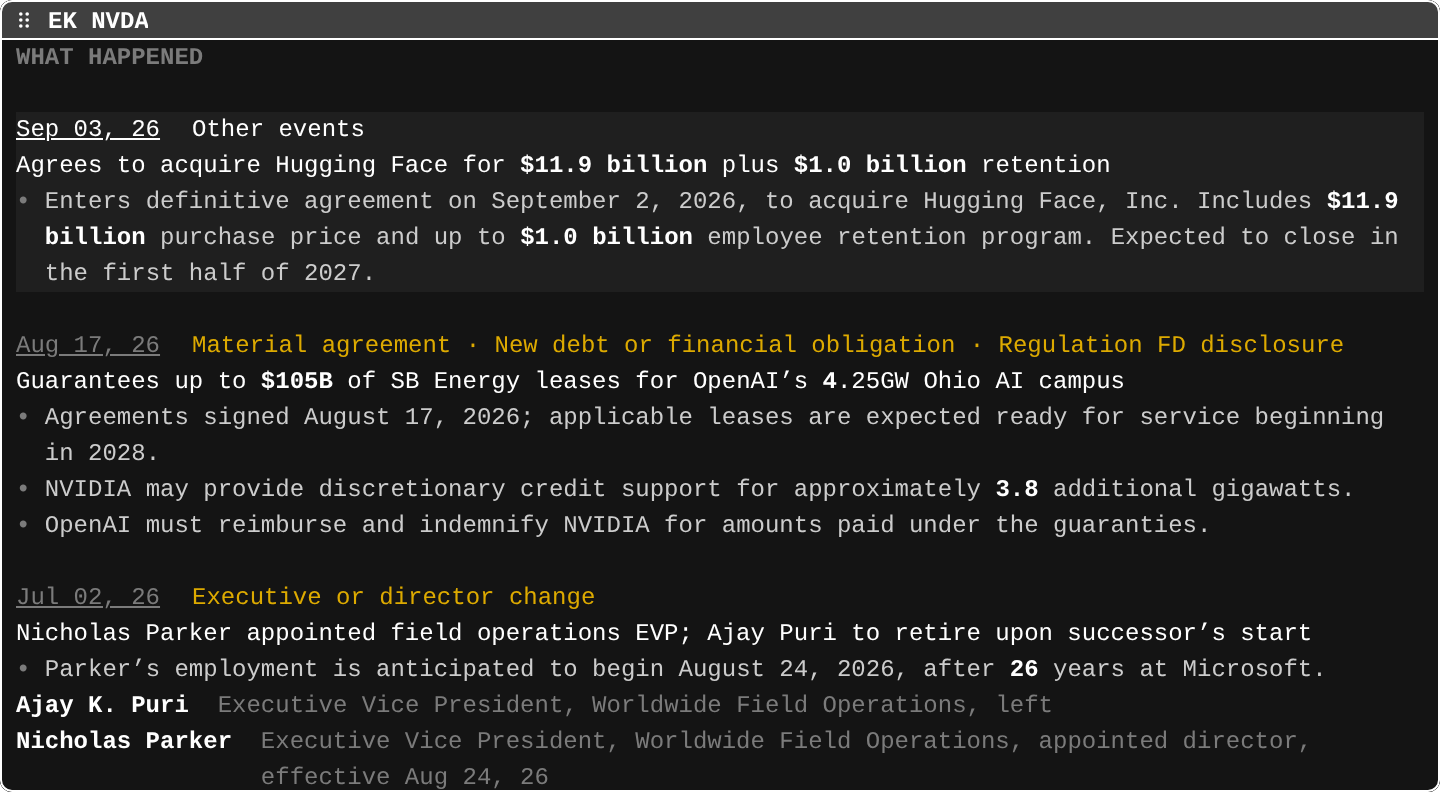
open themSEC AAPL for the list of every recent filing (form, date; Enter opens it inside Gloom, o the original on EDGAR); EK NVDA for 8-Ks. In EK, o opens the filing.
Sep 03, 26 Other events: an item 8.01 filing. Headline: an agreement to acquire a company for 11.9 billion dollars plus a 1.0 billion retention program.- The bullets: the key facts the filing states (signing date, price, expected closing).
Aug 17, 26 Material agreement · New debt or financial obligation · Regulation FD disclosure: one 8-K can cover several items. Here, guarantees of up to 105 billion dollars of leases.Jul 02, 26 Executive or director change: an item 5.02: who left, who was appointed, and when.- Underlined dates are links to the filing.
Practice and recap
Try it3 tasks
- Which 8-K item would you expect on earnings day? (2.02, results of operations.)
- In the screenshot, which filing created a potential obligation for NVIDIA? (Aug 17: the lease guarantees.)
- Where would you find executive pay: 10-K, 8-K or proxy? (The proxy statement, DEF 14A.)
Common mistakes4 mistakes
- Relying on headlines instead of opening the filing.
- Missing Friday-evening filings: companies sometimes file awkward news when attention is low.
- Confusing a 10-Q's unaudited numbers with the audited 10-K.
- Forgetting foreign companies file 20-F and 6-K instead of 10-K and 8-K.
Check yourself3 questions
- What is EDGAR?
- How fast must an 8-K be filed?
- What does item 5.02 cover?
Answers
- The SEC's free public database of filings.
- Generally within four business days of the event.
- Departures or appointments of directors and officers.
Words in this lesson8 words
- EDGAR
- The SEC's public database of filings.
- 10-K / 10-Q
- Annual / quarterly report.
- 8-K
- A current report of an important event.
- 8-K item
- The numbered category of event in an 8-K.
- proxy statement (DEF 14A)
- The pre-annual-meeting document with votes, board and pay.
- S-1
- A registration statement for a new offering.
- 13D / 13G
- Filings by someone owning more than 5% of a company.
- 20-F / 6-K
- Annual / current reports of foreign companies listed in the US.
Educational material about reading market data, not investment advice.