How big a position? (KELLY)
KELLY turns your own guesses (chance of being right, upside, downside) into a position size, caps it with your risk limits, and says how much to add or trim.
- 5 min
- 3 questions
- Lesson 3 of 8
Why you would care
Given what you believe, how much of your money should this be? Two people can like the same stock and still get very different results, because one bets 2% of their money and the other 40%. Sizing is where good ideas become good or bad outcomes. Kelly is a classic way to think about it, and its main lesson is humility: bet less than the formula says.
The idea from scratch
Imagine a coin that lands heads 60% of the time. Each round you bet part of your money: heads you win what you bet, tails you lose it.
- Bet nothing: you never grow.
- Bet everything: one tails and you are wiped out.
- Somewhere in between, your money grows fastest over many rounds.
The Kelly criterion is the formula for that best fraction. For this coin it is 20% of your money per bet (0.6 - 0.4).
For a stock idea, you give three guesses:
- Win probability (how likely the good outcome is),
- Upside (how much you gain if right),
- Downside (how much you lose if wrong).
From them, Kelly computes the fraction that maximizes long-run growth, called full Kelly.
Why nobody bets full Kelly
- Your guesses are guesses. If your win probability is a bit too optimistic, full Kelly overbets badly.
- Full Kelly swings wildly: large drawdowns are normal.
So people bet a fractional Kelly (a quarter or a half of it) and add hard limits: a name cap (no position above X% of the money) and a loss cap (never risk more than Y% of the money on one idea).
- Your guesses: win chance, upside, downside
- Full Kelly fraction
- x your Kelly fraction, e.g. 25%
- Clip by name cap and loss cap
- Target position, then add or trim
See it in Gloom
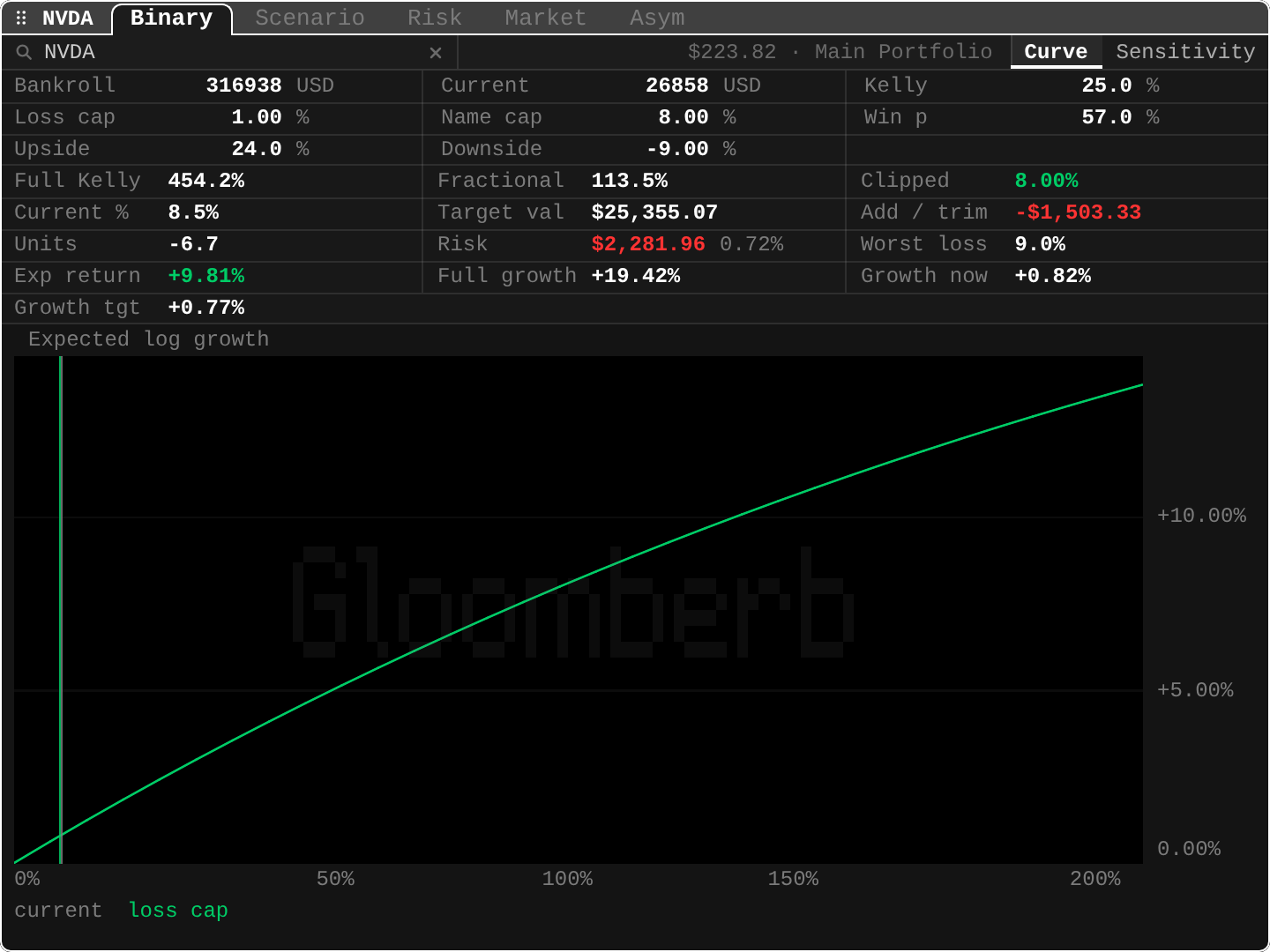
open ittype KELLY NVDA. e edits the inputs, s shows the sensitivity view.
- Inputs:
Bankroll 316938(the money at stake),Win p 57%,Upside 24%,Downside -9%,Kelly 25%(the fraction of Kelly to use),Name cap 8%,Loss cap 1%. Exp return +9.81%: 0.57 x 24% + 0.43 x (-9%) = 9.81%. The average outcome of your guesses.Full Kelly 454.2%: the formula wants 4.5 times the bankroll, which means borrowing. A sign that the guesses are very optimistic.Fractional 113.5%: 25% of full Kelly. Still more than all the money.Clipped 8.00%: the name cap wins.Target val $25,355.07is 8% of the bankroll.Current % 8.5%andAdd / trim -$1,503.33: the position is a bit above target, so the sizer suggests trimming about 1,500 dollars (Units -6.7shares).Risk $2,281.96 0.72%: if the downside happens, the loss is 0.72% of the bankroll, under the 1% loss cap.
The tabs Scenario, Risk, Market and Asym offer other ways to describe your guesses (several outcomes, a volatility, the market's implied view, uneven odds).
Practice and recap
Try it3 tasks
- Check the full Kelly number by hand: p / downside - q / upside = 0.57 / 0.09 - 0.43 / 0.24. (6.33 - 1.79 = 4.54, so 454%.)
- If the name cap were 5%, what would the target value be? (5% x 316,938 = about 15,847 dollars.)
- Lower Win p to 40% in your head. Is the expected return still positive? (0.4 x 24 - 0.6 x 9 = 4.2%: yes, but much smaller.)
Common mistakes4 mistakes
- Typing hopeful guesses and trusting the size. Small changes in win probability change Kelly a lot.
- Betting full Kelly. Almost no professional does.
- Forgetting the caps. The caps, not the formula, decide most real sizes.
- Reading "Full growth" as a forecast. It is the growth rate implied by your guesses.
Check yourself3 questions
- What three guesses does Kelly need for one idea?
- Why do people bet a fraction of Kelly?
- In the screenshot, which limit decided the final size?
Answers
- The win probability, the upside and the downside.
- Because their guesses are uncertain and full Kelly is very volatile; overbetting hurts more than underbetting.
- The name cap of 8%.
Words in this lesson6 words
- Kelly criterion
- A formula for the bet size that grows money fastest over many bets, given your odds.
- bankroll
- The money you size against.
- full Kelly / fractional Kelly
- The formula's size / a chosen share of it, like 25%.
- name cap
- The largest share of the bankroll one position may take.
- loss cap
- The largest share of the bankroll you accept to lose on one idea.
- expected return
- The probability-weighted average of the outcomes.
Educational material about reading market data, not investment advice.