How a stock reacts on macro days (MDAY)
MDAY compares how a US listing moves on CPI, jobs and Fed decision days with a normal day, over up to five years, and lists every release day with its move.
- 4 min
- 3 questions
- Lesson 7 of 7
Why you would care
How much does this stock react to macro releases? Some stocks barely notice an inflation report; others swing twice as much as usual. Rate-sensitive names (banks, real estate, fast growers) often react most. Knowing a name's macro sensitivity helps you size a position before a known date, the same way you check earnings dates.
The idea from scratch
Three scheduled releases move all markets (chapter 01, The macro machine):
CPI
the monthly consumer price index, 8:30 New York time, before the open.
Jobs report (Employment Situation, nonfarm payrolls)
usually the first Friday of the month, 8:30.
FOMC
the Fed's rate decision, eight scheduled meetings a year, statement at 14:00.
For each release day, measure the move: the previous close to the release day's close. Take the absolute value (size, ignoring direction), average it, and compare with the average absolute move on all other days.
A release on a day the market was closed (a jobs report on Good Friday) is measured on the next session.

See it in Gloom
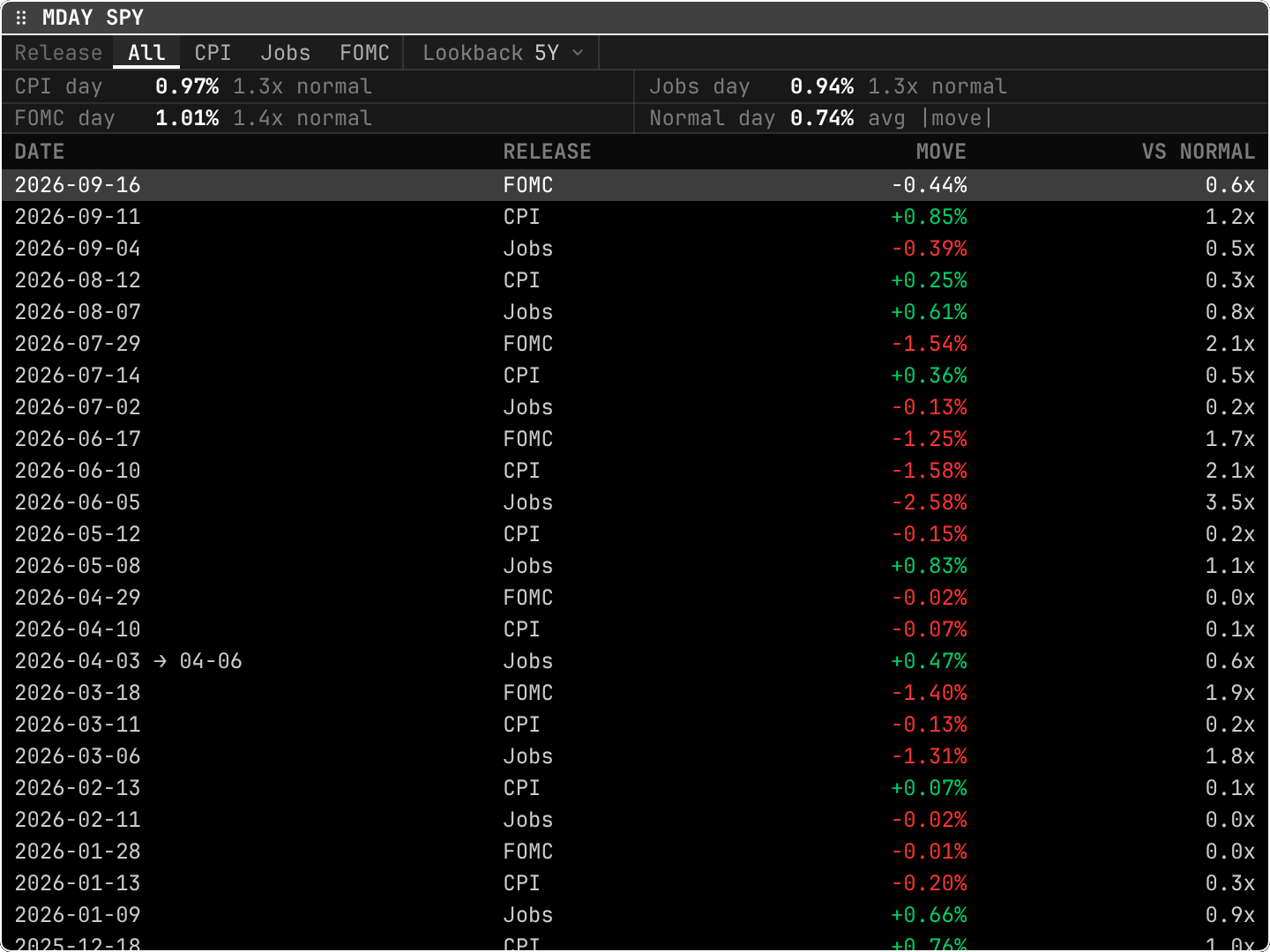
open ittype MDAY SPY. Tabs All, CPI, Jobs, FOMC; Lookback up to 5 years.
Normal day 0.74% avg |move|: SPY's average absolute move on non-release days.CPI day 0.97% 1.3x normal,Jobs day 0.94% 1.3x,FOMC day 1.01% 1.4x: all three days move SPY more than a normal day, FOMC most.- Row
2026-06-05 Jobs -2.58% 3.5x: a jobs report that moved SPY 3.5 times a normal day. - Row
2026-04-03 → 04-06 Jobs: released on a market holiday, measured on the next session. - Many release days show small moves (
0.0x,0.1x): the average hides a few big days.
Practice and recap
Try it3 tasks
- In the screenshot, which release type moves SPY the most on average? (FOMC, 1.4x.)
- Find the largest move in the visible rows. (2026-06-05 jobs, -2.58%.)
- A bank stock shows CPI days at 2.2x normal. What does that suggest? (It is unusually sensitive to inflation surprises, probably through rate expectations.)
Common mistakes4 mistakes
- Reading the average as typical: a few big days drive it.
- Ignoring direction: MDAY's headline uses absolute moves.
- Forgetting other news on the same day (earnings, geopolitics).
- Comparing names with very different normal volatility using raw moves instead of the multiple.
Check yourself3 questions
- How is a release-day move measured?
- What does "1.4x normal" mean?
- Why are absolute moves used?
Answers
- From the previous session's close to the release day's close.
- The average absolute move on those days is 1.4 times the average on normal days.
- To measure the size of reactions regardless of direction, so ups and downs do not cancel.
Words in this lesson5 words
- macro day
- A day with a major scheduled economic release.
- jobs report (nonfarm payrolls)
- The monthly US employment release.
- FOMC
- The Fed committee that sets the policy rate.
- absolute move
- The size of a move, ignoring its sign.
- normal day
- Any session that is not a release day in the lookback.
Educational material about reading market data, not investment advice.