Debt maturities and covenants (DDIS, CRDOC, COVN)
DDIS shows how much of a company's debt comes due each year, and CRDOC and COVN read its loan and bond documents into a capital structure and covenant headroom.
- 4 min
- 3 questions
- Lesson 3 of 3
Why you would care
When must this company repay, and how close is it to breaking a loan rule? Companies rarely fail because profits dip; they fail when debt comes due and nobody will refinance it, or when they break a loan rule and lenders take control. Credit analysts look at the maturity wall and covenant headroom first. These screens put both in one place.
The idea from scratch
Maturity wall
Debt does not all come due at once. A maturity schedule shows how much principal must be repaid in each year. A big bar in one year is a maturity wall: the company must repay or refinance (borrow new money to repay old) at whatever rates prevail then.
US companies report this schedule in the debt note of their 10-K.
Credit documents
The rules of each loan live in legal documents:
- a credit agreement for bank loans and revolving credit lines,
- an indenture for bonds.
They state the amount, the rate, the maturity, whether the debt is secured (backed by assets) and the covenants.
Covenants and headroom
A covenant is a promise to the lenders. A maintenance covenant is tested regularly, for example "net debt / EBITDA must stay below 3.5x". Headroom is how far the company is from the limit:
Breaking a covenant (a breach) lets lenders demand repayment or renegotiate on tough terms.

See it in Gloom
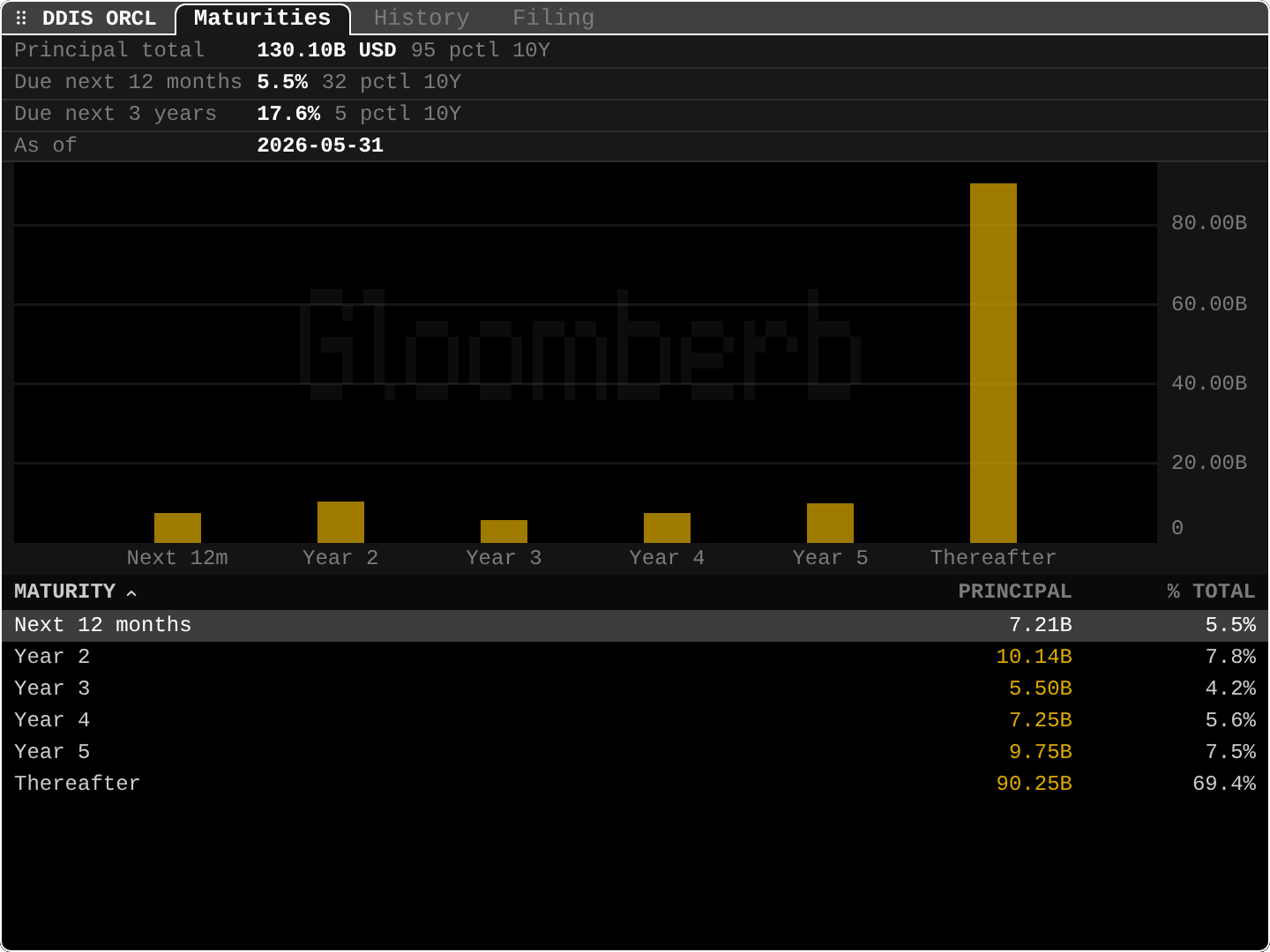
open themDDIS ORCL (tabs Maturities, History, Filing); CRDOC XOM and COVN XOM (tabs Capital, Covenants, Maturities, Screen).
Principal total 130.10B USD 95 pctl 10Y: Oracle's debt is near the top of its own ten-year history.Due next 12 months 5.5%: 7.21 billion due within a year.Due next 3 years 17.6% 5 pctl 10Y: a smaller near-term share than usual: most debt is long-dated.Thereafter 90.25B 69.4%: the bulk matures after five years.As of 2026-05-31: the date of the latest annual filing's schedule.
CRDOC adds outstanding debt, next maturity, undrawn credit lines, secured share and the tightest covenant headroom; COVN draws each covenant's reported value against its limit, amber when headroom is under 20%, red past the limit. Every fact links to the quoted sentence in the document.
Practice and recap
Try it3 tasks
- What share of Oracle's debt is due in years 2 to 5 combined? (7.8 + 4.2 + 5.6 + 7.5 = 25.1%.)
- Covenant: interest coverage must stay above 3.0x; current 4.5x. Headroom? ((4.5 - 3.0) / 3.0 = 50%.)
- Why does a large "Thereafter" bucket reduce near-term risk? (Little must be refinanced soon.)
Common mistakes4 mistakes
- Looking at total debt without the schedule.
- Assuming every covenant is tested every quarter; many bond covenants only apply when the company acts (incurrence covenants).
- Comparing headroom built on different EBITDA definitions.
- Ignoring undrawn credit lines, which are liquidity if needed.
Check yourself3 questions
- What is a maturity wall?
- What is a maintenance covenant?
- Define headroom.
Answers
- A large amount of debt coming due around the same time.
- A financial limit tested regularly, like maximum leverage.
- How far a company's reported metric is from its covenant limit, as a percentage of the limit.
Words in this lesson8 words
- maturity schedule / wall
- Debt due by year / a big concentration of it.
- refinance
- Borrow new money to repay old debt.
- credit agreement / indenture
- The legal document of a loan / of a bond.
- secured debt
- Debt backed by specific assets.
- covenant
- A promise to lenders, like a maximum leverage.
- maintenance / incurrence covenant
- Tested regularly / only when the company acts.
- headroom
- Room before a covenant breaks.
- breach
- Breaking a covenant.
Educational material about reading market data, not investment advice.