Who is who on Wall Street
Wall Street is a few kinds of players: the buy side invests money, the sell side sells it services and trades, the plumbing (market makers, prime brokers, clearing) makes trades happen and settle, and regulators watch them all.
- 6 min
- 3 questions
- Lesson 1 of 3
Why you would care
Who are you talking to, and what do they do all day? "I'm on the buy side, long-short equity." "I run the vol desk at a bank." "We use them as our prime broker." In a meeting, these sentences tell you what someone needs and how they make money. Knowing the map is the fastest way to ask good questions.
The idea from scratch
Picture a giant market hall.
- People who came with money to invest are the buy side.
- Shops that sell them ideas, access and trades are the sell side.
- Stall keepers who always shout a buy price and a sell price are the market makers.
- The hall itself is the exchange (Exchanges, hours and tickers).
- The cashier who makes sure every deal is paid is clearing and settlement.
- The police are the regulators.

The buy side: people who invest
The buy side manages money and buys assets with it, for itself or for clients.
| Who | What they do |
|---|---|
| Asset manager | Runs funds and ETFs for millions of savers, for a fee. |
| Pension fund | Invests workers' savings to pay their retirement. |
| Hedge fund | A private fund for wealthy or professional investors; can go short and use leverage. |
| Endowments, sovereign funds, family offices | Invest for a university, a country, or one rich family. |
The sell side: people who serve them
The sell side is the banks and brokers that sell services to the buy side. A big investment bank has four main jobs:
- Sales: talk to buy-side clients every day, pass on ideas.
- Trading: execute client orders and trade with clients from the bank's own book.
- Research: analysts study companies and publish a rating (buy, hold, sell, or similar words) and a price target (where they think the share price will be, usually in 12 months).
- Investment banking: help companies raise money (selling new shares or bonds) and advise on mergers.
The desks
Sales and trading is split into desks, one per asset family: equities, volatility, rates, credit, FX and commodities.
Go deeper: what each desk trades
| Desk | Trades |
|---|---|
| Equities | Stocks and ETFs. |
| Volatility (equity derivatives) | Options: in effect, it trades how much prices will move (Understanding risk and Derivatives in one page). |
| Rates | Government bonds and interest-rate contracts (Bonds in one page). |
| Credit | Company bonds and contracts on default risk. |
| FX | Currencies. |
| Commodities | Oil, gas, metals, grains. |
Rates, credit, FX and commodities together are often called FICC (fixed income, currencies and commodities).
The plumbing
- A market maker always quotes a bid and an ask, earning the spread and keeping the market liquid. It can be a bank desk or a specialized trading firm.
- A prime broker is the part of a bank that serves hedge funds: it lends them cash (margin) and shares (for shorting), holds their assets, and handles their trades.
- A custodian holds assets safely for their owner.
- Clearing happens right after a trade: details are confirmed, and a clearing house steps in the middle, becoming the buyer to every seller and the seller to every buyer. If one side fails, the other still gets paid.
- Settlement is the final swap: cash goes one way, shares the other. US stocks settle one business day after the trade, called T+1.
The regulators
A regulator is a public body that writes and enforces market rules. In the US: the SEC for securities (stocks, bonds, funds, company disclosures), the CFTC for futures and swaps, FINRA (an industry body overseen by the SEC) for brokers, and the Federal Reserve among others for banks. Other countries have their own.
See it in Gloom
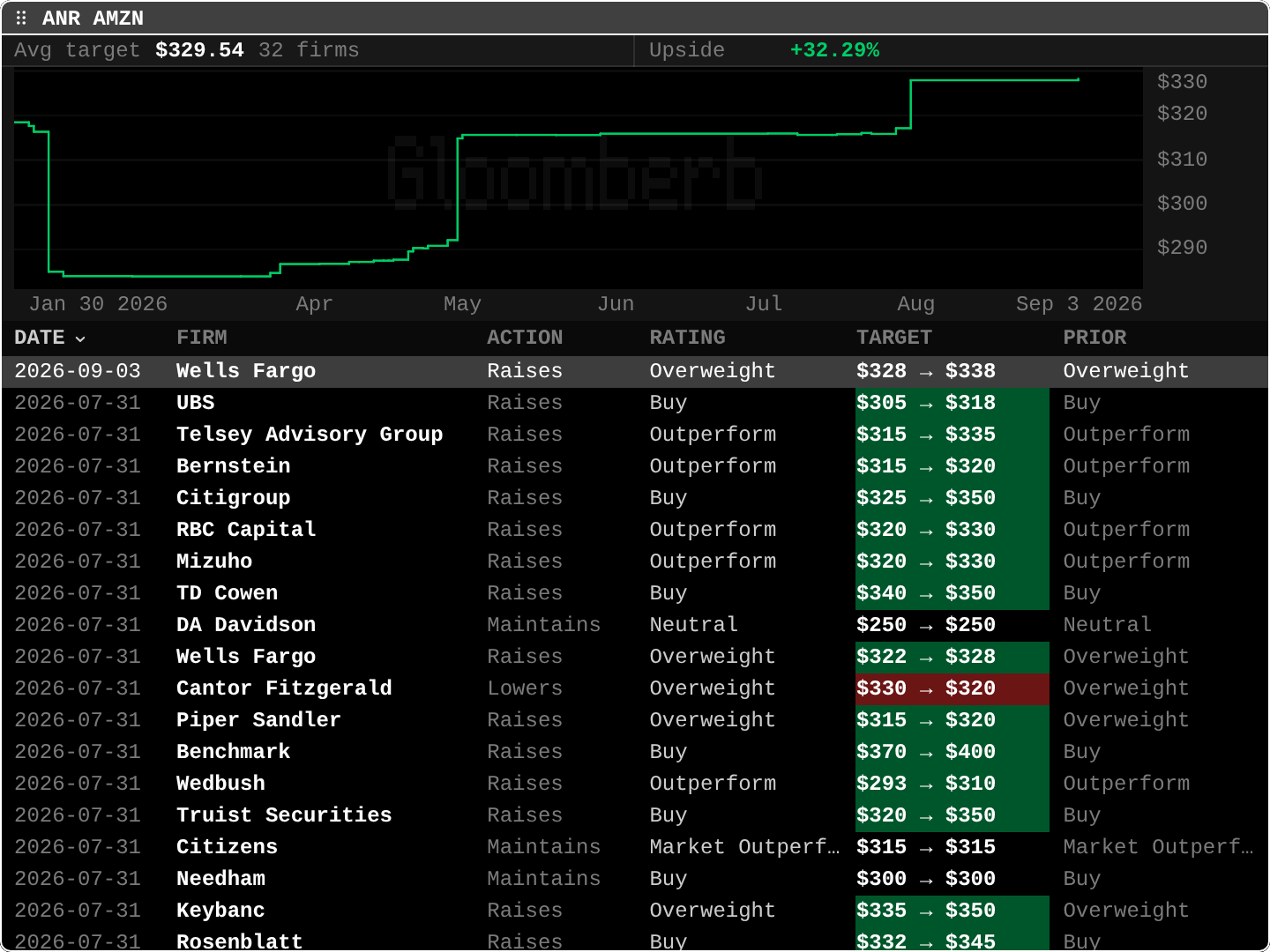
open ittype ANR AMZN. (Taught in chapter 04, Fundamentals and earnings.) This is the sell side's research product, read by the buy side.
Avg target $329.54 32 firms: the average price target across 32 sell-side firms.FIRM: the banks and brokers whose analysts cover the stock.ACTIONandRATING: "Raises", "Maintains", "Lowers"; and ratings in each firm's own words: Buy, Overweight and Outperform all mean roughly "we like it".TARGET $328 → $338: the old and the new price target.
Practice and recap
Try it3 tasks
- Count how many firms changed their target on 2026-07-31 in the visible rows. Why would so many act on one day? (15 of the 18 rows dated that day. Analysts usually update right after a company's quarterly results; How information reaches prices.)
- Find the one firm that lowered its target in the visible rows. (Cantor Fitzgerald, $330 to $320, while keeping Overweight.)
- Classify: a pension fund, an equity analyst, a clearing house. (Buy side, sell side, plumbing.)
Common mistakes4 mistakes
- Thinking a price target is a promise. It is one team's estimate.
- Mixing clearing and settlement.
- Assuming "the bank" is one opinion. Research, trading and banking are separate teams, kept apart by rules.
- Calling every fund a hedge fund. Most money sits with ordinary asset managers and pension funds.
Check yourself3 questions
- Is a hedge fund buy side or sell side?
- What does a prime broker lend a hedge fund?
- A trade happens on Monday in a US stock. When does it normally settle?
Answers
- Buy side: it invests money.
- Cash (margin) and shares (to sell short). It also holds its assets and handles its trades.
- Tuesday, one business day later (T+1).
Words in this lesson18 words
- buy side
- Firms that invest money: asset managers, pension funds, hedge funds.
- sell side
- Banks and brokers that sell research, trading and access to the buy side.
- asset manager
- A firm that runs funds for savers, for a fee.
- pension fund
- A fund that invests savings to pay retirements.
- hedge fund
- A private fund for professional investors; can short and use leverage.
- investment bank
- A bank doing sales, trading, research and capital raising.
- analyst
- A researcher who studies companies and publishes views.
- rating
- An analyst's verdict: buy, hold, sell or similar.
- price target
- Where an analyst thinks the price will be, usually in 12 months.
- desk
- A trading team for one asset family.
- FICC
- Fixed income, currencies and commodities.
- market maker
- A firm that always quotes a bid and an ask.
- prime broker
- The bank unit that lends to, holds for and trades for hedge funds.
- custodian
- A firm that holds assets safely for their owner.
- clearing / clearing house
- Confirming a trade; the house in the middle guarantees both sides.
- settlement
- The final swap of cash and securities.
- T+1
- Settlement one business day after the trade date.
- regulator
- A public body that writes and enforces market rules (SEC, CFTC, FINRA...).
Educational material about reading market data, not investment advice.