Bonds in one page
A bond is a loan you can buy and sell, paying fixed interest until a set repayment date, and its price and its yield always move in opposite directions.
- 6 min
- 3 questions
- Lesson 2 of 2
Why you would care
What return does this loan pay, and how safe is the borrower? "Yields spiked, so tech sold off." "The curve is inverted." "Credit spreads are widening." The bond market is bigger than the stock market, and its main number, the yield, drives the price of almost everything else: mortgages, company loans, and how much investors will pay for future profits.
The idea from scratch
A bond is a loan cut into pieces that investors can buy and resell. The borrower (a government or a company) is the issuer. You, the buyer, are the lender.
Every bond has three basic numbers:
Principal (or face value)
the amount borrowed, paid back at the end. Often 100 or 1,000 per bond.
Coupon
the yearly interest, as a percentage of the principal. A 5% coupon on 1,000 pays 50 dollars a year.
Maturity
the date the principal is repaid. The time left until then is the bond's tenor.
Price and yield: a seesaw
Once issued, a bond trades at a price that changes every day. The yield is the yearly return you get if you buy at today's price and hold to maturity.

On an ordinary fixed-rate bond the coupon never changes. The price and the yield do. That is why people say "yields rose" when bond prices fell: same news, two ways to say it.
Longer bonds move more. A 1-year bond barely cares about a 1-point rate change; a 30-year bond can lose 15% or more. This sensitivity is called duration (chapter 08).
Who borrows: governments and companies
Government bonds
the US government's are called Treasuries. Bills last up to a year, notes 2 to 10 years, bonds 20 or 30 years. They are treated as the safest dollar loans, so their yield is the base rate for everything else.
Corporate bonds
loans to companies. They pay more than Treasuries because the company might not pay back. The extra yield is the credit spread.
If a borrower stops paying, that is a default. Credit rating agencies grade borrowers from AAA (safest) down. Bonds rated below BBB- are called high yield (or "junk"): they pay more because the risk is higher.
The yield curve
Line up a government's yields from short to long maturities and you get the yield curve.
Normal
long yields above short ones. Lenders want more to tie money up for longer.
Inverted
short yields above long ones. Often read as the market expecting rate cuts, for example because a slowdown is coming.
Short yields follow the central bank's rate closely; long yields reflect expected growth and inflation over many years.
See it in Gloom
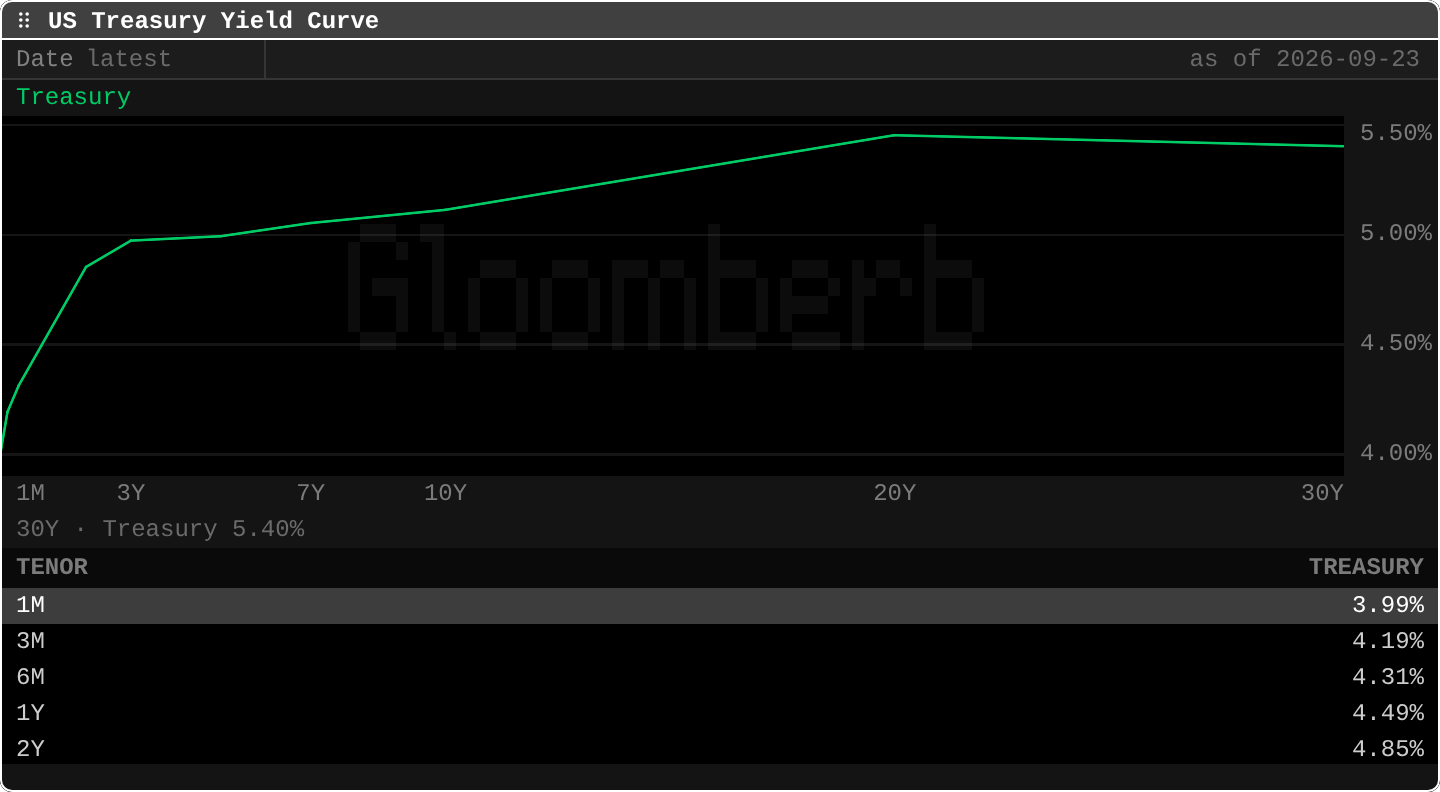
open ittype GC. (Taught in chapter 08, Rates, bonds and credit.)
as of 2026-09-23(top right): the date of this curve. Government curves are published once a day.- The bottom axis: maturities from
1M(one month) to30Y(thirty years). - The line: yields rise fast from 1 month to about 3 years, then slowly up to 20 years. A normal, upward curve.
- The table:
1M 3.99%,2Y 4.85%. Lending to the US for two years paid about 0.86 percentage points more per year than for one month on that day. 30Y · Treasury 5.40%: the 30-year yield, under the chart.
Practice and recap
Try it3 tasks
- In the screenshot, is the curve normal or inverted between 1 month and 2 years? (Normal: 3.99% rises to 4.85%.)
- A bond pays 110 in one year. If you pay 100, what is your yield? (10%.) If you pay 105? (About 4.8%: 5 / 105.)
- Rates fall sharply. Do your existing bonds gain or lose value? (Gain: their fixed coupons now look generous.)
Common mistakes4 mistakes
- Mixing coupon and yield. The coupon is fixed at issue; the yield moves with the price.
- Thinking bonds cannot lose money. Prices fall when rates rise, and long bonds fall a lot.
- Reading "high yield" as "good". It means high risk of not being paid.
- Comparing yields across maturities as if they were the same thing. Use the curve.
Check yourself3 questions
- A 4% coupon bond's price falls. Does its yield go up or down?
- Which pays more yield, a Treasury or a corporate bond of the same maturity? Why?
- What does an inverted curve mean in one line?
Answers
- Up. Same coupon, cheaper price, so a higher return for a new buyer.
- The corporate bond, by its credit spread, because the company might default.
- Short-term yields are above long-term yields, often a sign the market expects rate cuts.
Words in this lesson15 words
- bond
- A loan that investors can buy and sell.
- issuer
- The borrower: a government or a company.
- principal (face value)
- The amount borrowed and repaid at maturity.
- coupon
- The fixed yearly interest, as a % of principal.
- maturity / tenor
- The repayment date / the time left until it.
- yield
- The yearly return if you buy at today's price and hold to maturity.
- duration
- How much a bond's price moves when rates move; longer bonds move more.
- Treasuries (bills, notes, bonds)
- US government debt: up to 1 year, 2 to 10 years, 20 to 30 years.
- corporate bond
- A loan to a company.
- credit spread
- The extra yield over a government bond, paid for the risk of default.
- default
- When a borrower fails to pay interest or principal.
- credit rating
- A grade of a borrower's safety, from AAA down.
- high yield (junk)
- Bonds rated below BBB-: more yield, more risk.
- yield curve
- Yields lined up from short to long maturity.
- inverted curve
- Short yields above long yields.
Educational material about reading market data, not investment advice.