GPU rental prices (GPU)
GPU collects published hourly rental prices for AI chips by model and price basis, with medians and history, so compute can be tracked like a commodity.
- 4 min
- 3 questions
- Lesson 6 of 7
Why you would care
Is AI compute getting cheaper or scarcer? The cost of an hour on a high-end AI chip drives the economics of every AI company, cloud provider and chip maker. When rental prices fall, chips are plentiful; when they rise or offers disappear, compute is scarce. Investors now watch GPU-hour prices the way they watch oil or freight rates.
The idea from scratch
A GPU (graphics processing unit) is the chip that trains and runs AI models. Companies rent them by the hour from:
Hyperscalers
the largest cloud providers, with published list prices.
Neoclouds
newer GPU-focused cloud companies.
Marketplaces
platforms where owners post offers (asks) for spare capacity.
The same chip has several prices, depending on the basis:
- List price
- The published on-demand rate per GPU-hour
- Provider-declared spot
- A cheaper rate for capacity that can be taken back at short notice
- Marketplace ask
- Offers posted on marketplaces, which move with supply
Prices are compared per GPU-hour (one chip for one hour), and the board shows a median across providers so one outlier does not dominate.
These are posted prices, not transaction prices: big customers negotiate discounts that are not public.

See it in Gloom
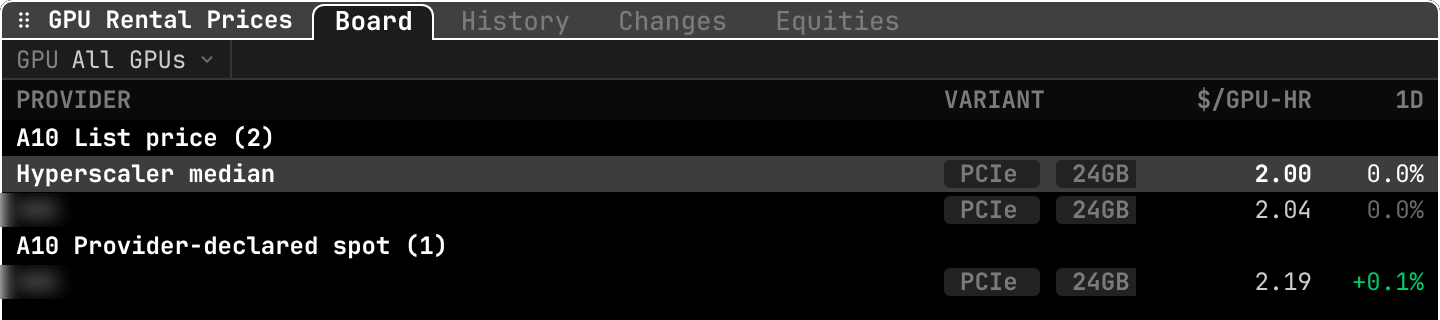
open ittype GPU, or GPU H100 for one model. Tabs: Board, History, Changes, Equities.
A10 List price (2): the A10 chip's list prices, from two quotes.Hyperscaler median PCIe 24GB 2.00 0.0%: the median list price among the largest clouds, 2.00 dollars per GPU-hour, unchanged on the day.- Chips
PCIeand24GB: the form factor and memory of the variant. A10 Provider-declared spot (1) 2.19 +0.1%: a spot rate, here above the list median (spot is not always cheaper).- Footer:
as of Oct 6, 2026 11:54 UTC Free preview. Pro shows every model (H100, B200...) and provider, with full history.
Practice and recap
Try it3 tasks
- 500 GPUs for 10 days at 2.00 dollars an hour: cost? (500 x 240 h x 2.00 = 240,000 dollars.)
- Why use a median rather than an average across providers? (One outlier price would move an average a lot.)
- Name one reason posted prices can differ from what big customers pay. (Negotiated discounts and long-term contracts.)
Common mistakes4 mistakes
- Comparing different GPU models or memory sizes as if they were the same.
- Mixing list prices with marketplace asks.
- Reading posted prices as transaction prices.
- Ignoring availability: a cheap price with no capacity is not a real offer.
Check yourself3 questions
- What is a GPU-hour?
- Name the three price bases.
- What does a falling marketplace median suggest?
Answers
- One GPU used for one hour: the unit for comparing rental prices.
- List price, provider-declared spot, marketplace ask.
- More supply of that chip, or weaker demand.
Words in this lesson6 words
- GPU
- The chip used to train and run AI models.
- GPU-hour
- One GPU rented for one hour.
- hyperscaler
- One of the largest cloud providers.
- neocloud
- A newer, GPU-focused cloud company.
- list price / spot / marketplace ask
- Published rate / interruptible discounted rate / posted offer.
- median
- The middle value of a sorted list.
Educational material about reading market data, not investment advice.