Power and the grid (POWER)
POWER collects the public queues of power projects and large electricity users waiting to connect to the grid, with their history and outcomes.
- 4 min
- 3 questions
- Lesson 5 of 7
Why you would care
Can the grid supply the data centers being planned, and where? AI data centers need enormous amounts of electricity. Whether the grid can supply it decides where they get built, which utilities grow, and which power producers win. The queues are public, slow-moving and full of signal, once you know how to read them.
The idea from scratch
A grid operator (in the US, an independent system operator or ISO, such as PJM or ERCOT) runs the high-voltage network of a region. Anyone who wants to connect a big generator, a battery or a large consumer must file an interconnection request.
The interconnection queue lists all requests: project, developer, size in megawatts (MW), fuel (gas, solar, wind, storage, nuclear...), location, proposed date and status:
Active
still in the process. An application, not a promise of supply.
Completed
connected and operating.
Withdrawn
abandoned. Most queued projects end here.
On the demand side, large-load requests (data centers, factories) show who wants power and from which utility.

See it in Gloom
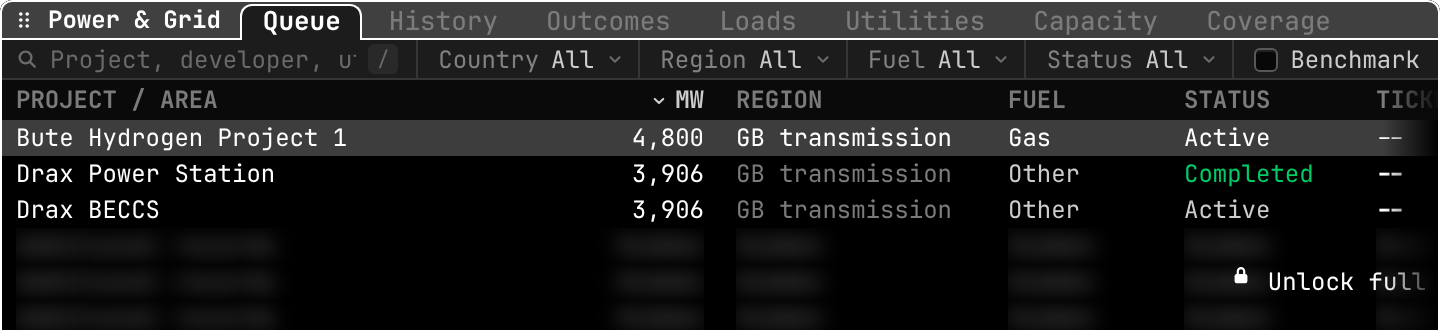
open ittype POWER, or POWER NEE for a listed developer or utility. Tabs: Queue, History, Outcomes, Loads, Utilities, Capacity, Coverage. Filters: Country, Region, Fuel, Status, Benchmark.
Bute Hydrogen Project 1 4,800 MW GB transmission Gas Active: a 4.8 GW request in the British grid, still active.Drax Power Station 3,906 Completed: an operating plant.TICKER: the listed company the project is mapped to, when one is known.Unlock full: free accounts see three records per section; Pro sees all registers and history.Outcomestab: for each entry-year cohort, the share completed, active and withdrawn.
Practice and recap
Try it3 tasks
- Convert 4,800 MW into gigawatts. (4.8 GW.)
- Why is "Active" not the same as future supply? (Most active requests are later withdrawn.)
- Which tab would you open to see how many data-center requests one utility has? (
Utilities, orLoads.)
Common mistakes4 mistakes
- Adding up queued MW as if it will all be built.
- Comparing regions with different queue rules without context.
- Reading a data-center load request as signed demand.
- Forgetting the time lag: years between request and operation.
Check yourself3 questions
- What is an interconnection queue?
- What happens to most queued projects?
- What is a large-load request?
Answers
- The public list of projects asking to connect to a grid, with size, fuel and status.
- They are withdrawn before being built.
- A request by a big electricity user, such as a data center, to connect to a utility's grid.
Words in this lesson6 words
- grid operator (ISO)
- The organization that runs a region's power network.
- interconnection request / queue
- A request to connect to the grid / the list of all of them.
- MW / GW
- Megawatt / gigawatt (1,000 MW): units of power capacity.
- large load
- A big electricity consumer, like a data center.
- utility
- The company that delivers power to customers in an area.
- cohort outcome
- What share of projects from one entry year got built or withdrawn.
Educational material about reading market data, not investment advice.