How information reaches prices
Prices move when new information (results, filings, economic numbers, central bank decisions, news) differs from what people already expected: only the surprise moves the price.
- 6 min
- 3 questions
- Lesson 2 of 3
Why you would care
Why did this stock jump at 4:05 pm? A company reports record profits and its stock falls 6%. Another reports a loss and jumps 10%. This looks crazy until you learn one rule: the market had already guessed. Prices react to the gap between the guess and the news, not to the news itself.
The idea from scratch
A price is a crowd's best guess of what something is worth, given everything known right now. When nothing new happens, the guess drifts. When something new arrives, everyone updates at once.
Expectations first
Before a company reports, analysts publish estimates. The average of their estimates is the consensus: the crowd's guess, written down.
- Result above consensus: a beat.
- Result below consensus: a miss.
- The difference is the surprise.
When people say "it's priced in", they mean the news was expected, so the price already reflects it.
Where news comes from
| Source | What it is | When |
|---|---|---|
| Earnings report | The company's results for the last quarter: sales, profit, and usually a forecast called guidance | Four times a year, on a date set in advance |
| Filings | Official documents sent to the regulator (the SEC in the US). A 10-K is the yearly report, a 10-Q the quarterly one, an 8-K a "something important just happened" notice | 8-Ks within four business days of the event |
| Economic data | Government statistics: inflation, jobs, growth | Scheduled; many US numbers come out at 8:30 am New York time |
| Central bank decisions | The interest rate set by the central bank (the Fed in the US) | Eight scheduled meetings a year in the US |
| News and analysts | Reporters, rating changes, deals, lawsuits, rumors | Any time |
US rules require companies to share important news with everyone at the same time, not with a few favored investors first (the rule is called Reg FD, for fair disclosure). That is why results come out in a public press release and a public call.
Timing: before the open, after the close
Most companies report outside the regular session (9:30 am to 4:00 pm New York time):
BMO
before market open.
AMC
after market close.
So the first reaction happens in after-hours or premarket trading, where fewer people trade and prices can jump. The next morning the stock may open far from yesterday's close. That jump is a gap.

Go deeper: how fast prices react
In big US stocks, computers read headlines and numbers in milliseconds, so most of the first move happens in seconds. Humans then argue about the details for days: what the guidance means, whether the beat was "quality". That slower part is where analysts and investors earn their living.
See it in Gloom
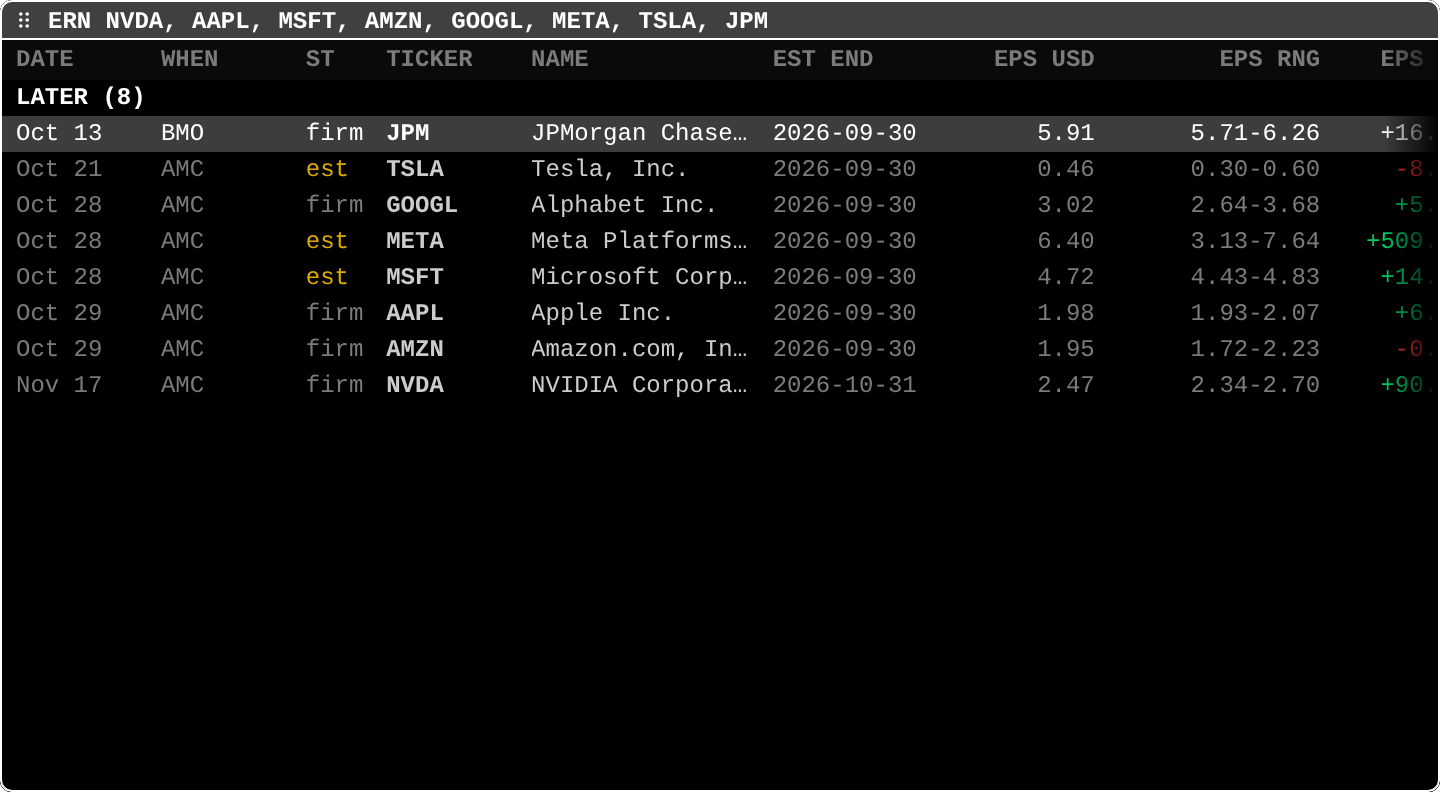
open ittype ERN for the whole market, or ERN NVDA, AAPL, MSFT for a few names. (Taught in chapter 04, The earnings calendar and implied moves; this screenshot shows an earlier layout of the same pane.)
DATE: the report day.Oct 13for JPM, the first of this group.WHEN:BMO(before market open) orAMC(after market close). JPM reports before the open; the rest after the close.ST: whether the date isfirm(confirmed by the company) orest(an estimate).EST END: the last day of the quarter being reported. The report comes a few weeks after the quarter ends.EPS USDandEPS RNG: the consensus estimate of earnings per share (profit divided by the number of shares), and the lowest to highest analyst estimate. A wide range means analysts disagree.
Other places news reaches you in Gloom: the news feeds (N, TOP, CN), the economic calendar (ECO), and each company's 8-Ks (EK). They are taught in later chapters.
Practice and recap
Try it3 tasks
- In the screenshot, which company reports first, and before or after the regular session? (JPM, Oct 13, before the open.)
- Which company has the widest estimate range relative to its estimate? (META: 3.13 to 7.64 around 6.40. Analysts disagree a lot.)
- Imagine NVDA reports 2.70 against a 2.47 consensus. Is that a beat? By how much in percent? (Yes. 0.23 / 2.47 is about 9%.)
Common mistakes4 mistakes
- Judging news as "good" or "bad" on its own. Compare it with what was expected.
- Forgetting guidance. A beat with weak guidance often falls.
- Reading the after-hours move as final. Fewer traders, wider spreads: the next session can change it.
- Trading on a headline you saw late. On a free plan, news is hours old.
Check yourself3 questions
- Consensus EPS 2.00, actual 1.90. Beat or miss?
- What does AMC mean on an earnings calendar?
- A company reports exactly what everyone expected. What usually happens to the price?
Answers
- A miss of 0.10, or 5%.
- The company reports after the market close, so the first reaction is in after-hours trading.
- Little or nothing: the news was priced in.
Words in this lesson11 words
- consensus
- The average of analysts' estimates; the market's written-down guess.
- beat / miss
- A result above / below consensus.
- surprise
- The gap between the result and the consensus.
- priced in
- Already expected, so already in the price.
- earnings report
- A company's quarterly results, published on a set date.
- guidance
- The company's own forecast for coming periods.
- earnings per share (EPS)
- Profit divided by the number of shares.
- 10-K / 10-Q / 8-K
- Yearly report / quarterly report / notice of an important event, filed with the SEC.
- Reg FD
- The US rule that companies must share important news with everyone at the same time.
- BMO / AMC
- Before market open / after market close.
- gap
- When a price opens far from the previous close, with no trades in between.
Educational material about reading market data, not investment advice.