Drug safety reports and clinical trials (FDA, TRIAL)
FDA searches public US reports of drug and device side effects and drug recalls, and TRIAL searches the public registry of clinical studies.
- 4 min
- 3 questions
- Lesson 1 of 8
Why you would care
What do regulators' records say about this drug or device, and which trials are coming? For a drug maker, one safety problem or one failed trial can erase billions of value; one successful study can create them. The raw records are public, and specialists read them long before headlines appear. These two panes let you look at the same records, with the right caution.
The idea from scratch
Adverse-event reports
An adverse event is a health problem that happened while a patient used a drug or device. Doctors, patients and manufacturers report them to the US regulator, the FDA. Each report lists the products involved (with a role: suspect or concomitant), the reactions, and the outcome (not serious, serious, death).
Crucial limits:
- A report does not prove the drug caused the problem.
- Reports are voluntary, unverified, often duplicated.
- Counts grow with how many people use a product and with media attention.
Recalls are different: a firm withdraws or corrects a product, classified by seriousness (Class I most serious).
Clinical trials
Before approval, a drug goes through clinical trials in people:
| Phase | Purpose |
|---|---|
| Phase 1 | Safety and dose, small groups |
| Phase 2 | Does it work? Side effects |
| Phase 3 | Large studies to confirm benefit; the basis for approval |
| Phase 4 | After approval: long-term or new uses |
Sponsors must register most trials publicly, with their status (not yet recruiting, recruiting, completed...), design and expected dates.

See it in Gloom
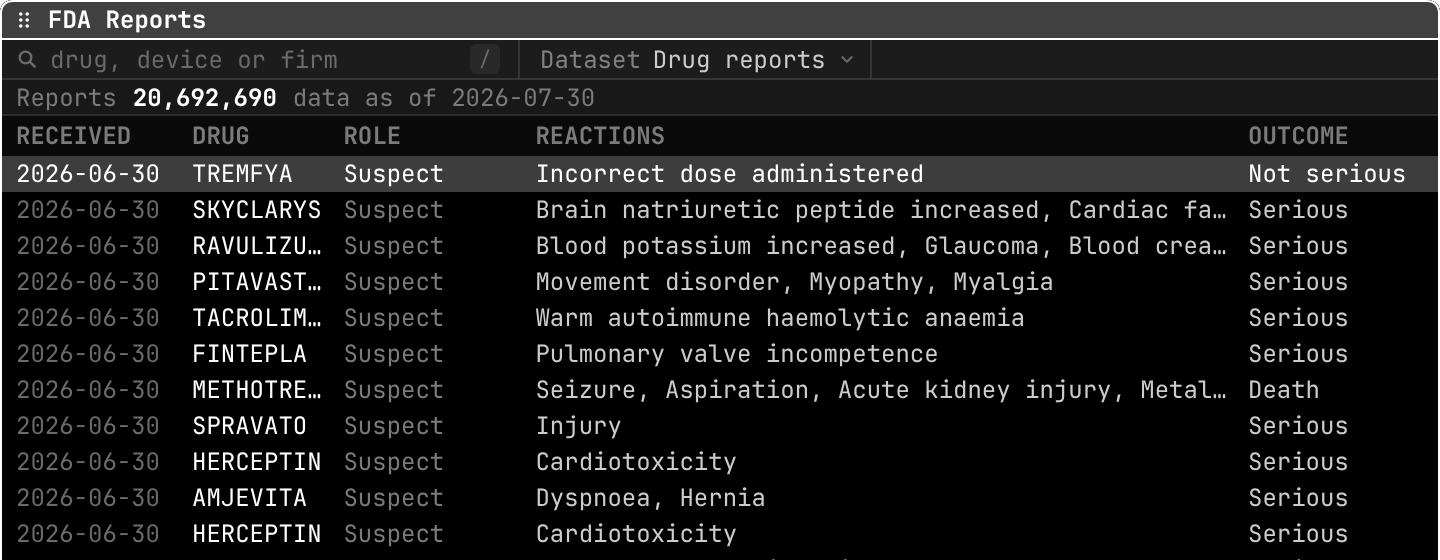
open themFDA (or FDA semaglutide), TRIAL semaglutide. In FDA, the Dataset menu switches between drug reports, device reports and recalls.
Reports 20,692,690 data as of 2026-07-30: the size of the drug database and its last update.ROLE Suspect: the reporter suspects this drug.REACTIONS,OUTCOME: what happened and how serious it was.
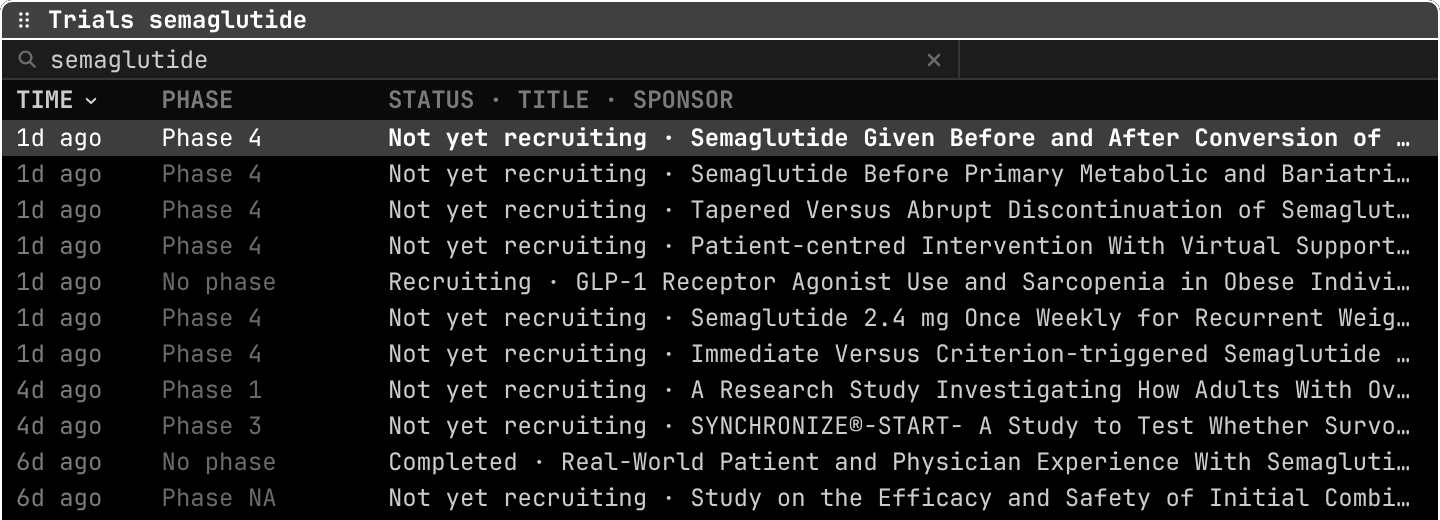
- TRIAL rows:
1d ago Phase 4 Not yet recruiting · Semaglutide Given Before and After...: newest first. Phase 3 ... Completed: the studies that matter most for approvals.
Practice and recap
Try it3 tasks
- In the FDA screenshot, how many visible reports show "Death" as the outcome? (One: the methotrexate report. Most are "Serious".)
- Why can't you conclude a drug is dangerous from a high report count? (Reports do not prove causation and grow with usage.)
- Which phase usually decides approval? (Phase 3.)
Common mistakes4 mistakes
- Treating adverse-event counts as incidence rates.
- Ignoring duplicates and media-driven reporting waves.
- Assuming a "completed" trial succeeded.
- Forgetting that the registry's dates are estimates that slip.
Check yourself3 questions
- What is an adverse event?
- What do the trial phases test?
- What is a recall?
Answers
- A health problem that happened while a drug or device was being used, not necessarily caused by it.
- Phase 1 safety, phase 2 effect and side effects, phase 3 confirmation at scale, phase 4 after approval.
- A firm withdrawing or correcting a product, classified by seriousness.
Words in this lesson6 words
- adverse event
- A health problem during use of a drug or device.
- suspect / concomitant drug
- The drug suspected / another drug the patient also took.
- recall
- Withdrawal or correction of a product.
- clinical trial
- A study of a treatment in people.
- phase 1 to 4
- The stages of clinical development.
- sponsor
- The company or institution running a trial.
Educational material about reading market data, not investment advice.