Litigation and SEC comment letters (LITI, CLTR)
LITI lists a company's lawsuits, enforcement and antitrust cases with their documents and dated status, and CLTR lists the letters SEC staff sent the company about its filings and the replies.
- 4 min
- 3 questions
- Lesson 2 of 8
Why you would care
What legal and regulatory questions is this company facing? A lawsuit, an antitrust case or an enforcement action can cost billions or force a company to change its business. Comment letters are subtler: the regulator asking "why did you account for revenue this way?" can foreshadow a restatement. Both are public, slow, and read by few investors.
The idea from scratch
Litigation and enforcement
Litigation
lawsuits between private parties (customers, competitors, shareholders).
Enforcement
a regulator or prosecutor acting against a company (fines, settlements, orders).
Antitrust
competition authorities challenging mergers or behavior that hurts competition.
A case is tracked through its docket: the official list of filings and decisions. What matters is the status and its changes (filed, motion decided, settled, judgment, appeal) and the dates ahead.
SEC comment letters
When the SEC reviews a company's filings, staff may send a comment letter asking for clarification or changes (form UPLOAD). The company answers with a correspondence letter (form CORRESP). The exchange is published after the review closes (often months later).
Topics that worry analysts: revenue recognition, non-GAAP measures, segment reporting, going concern, restatements.

See it in Gloom
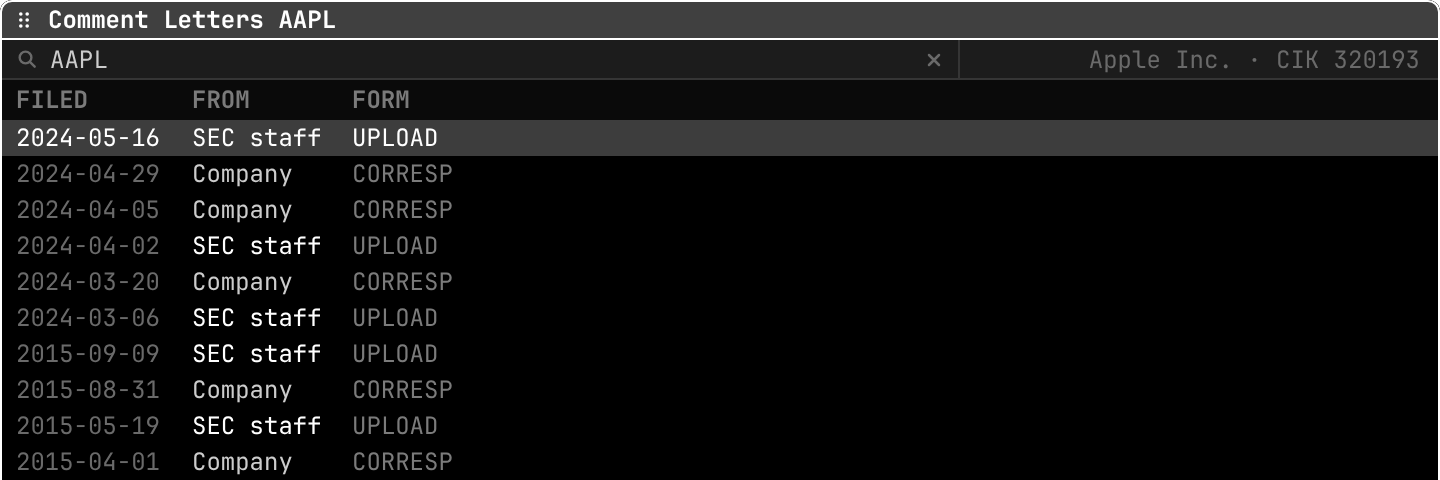
open themLITI AAPL (tabs, Enter evidence, o source, t to the catalyst calendar); CLTR AAPL or CLTR "revenue recognition" for a full-text search across all companies.
- Header:
Apple Inc. · CIK 320193: the company and its SEC identifier. 2024-03-06 SEC staff UPLOAD, then2024-03-20 Company CORRESP: a letter and the reply two weeks later.- Rounds: 2024 had three staff letters and three replies: a longer review.
- Gaps of years (2015 to 2024): reviews happen periodically, not continuously.
Enteropens a letter's text with its topics ("Mentions": restatement, going concern, revenue recognition...);oopens it on the SEC website.
Practice and recap
Try it3 tasks
- In the screenshot, how many days passed between the 2024-04-02 staff letter and the company's next reply? (3 days: it replied on 2024-04-05.)
- Which topics in a comment letter would most worry you? (Revenue recognition, restatement, going concern.)
- What is the difference between litigation and enforcement? (Private lawsuit vs action by a regulator or prosecutor.)
Common mistakes4 mistakes
- Reading any lawsuit as material: large companies always have many.
- Forgetting that comment letters are published months after the review.
- Ignoring the company's reply, which often resolves the question.
- Treating a settlement as an admission of guilt (often it is not).
Check yourself3 questions
- What is a docket?
- What are UPLOAD and CORRESP?
- Why might a comment letter about non-GAAP measures matter?
Answers
- The official list of filings and decisions in a court or agency case.
- UPLOAD is a letter from SEC staff; CORRESP is the company's reply.
- It can force the company to change how it presents the adjusted numbers investors rely on.
Words in this lesson7 words
- litigation
- Lawsuits between private parties.
- enforcement
- Action by a regulator or prosecutor.
- antitrust
- Competition law against monopolies and harmful mergers.
- docket
- The official record of a case's filings and decisions.
- comment letter
- SEC staff's questions about a company's filings.
- non-GAAP measure
- An adjusted metric outside official accounting rules.
- revenue recognition
- The rules for when a sale counts as revenue.
Educational material about reading market data, not investment advice.